How to Hit a Punch Volley in Pickleball
Quick Answer: A punch volley is a short, firm forward push with almost no backswing. Hold a continental grip, keep the paddle up in front of the chest, step or lean into the ball, make contact in front of the body, and aim at the feet or the middle of the opponent instead of swinging for a winner.
What Is a Punch Volley in Pickleball?
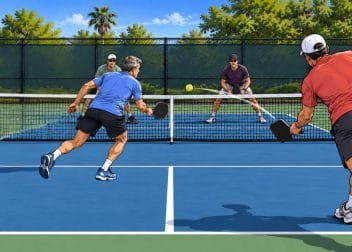
A punch volley is the compact, no-backswing volley players use when a ball arrives with pace at the kitchen line and there is no time for a full swing. Instead of pulling the paddle back and driving through the ball, the paddle stays near the chest and moves forward a few inches, almost like a short jab. The goal is control, not power, since a backswing on a fast ball only makes the shot harder to control. Before drilling the punch volley in isolation, it helps to be clear on what a volley is, since block, roll, and punch are all variations on that same no-bounce contact at the net.
How Do You Set Up for a Punch Volley?
Grip and position do most of the work before the ball even arrives. A continental grip, the same grip used for serves and most volleys, keeps the paddle face neutral so it can go left or right without a grip change. Reading more on the continental grip helps anyone still gripping the paddle like a frying pan.
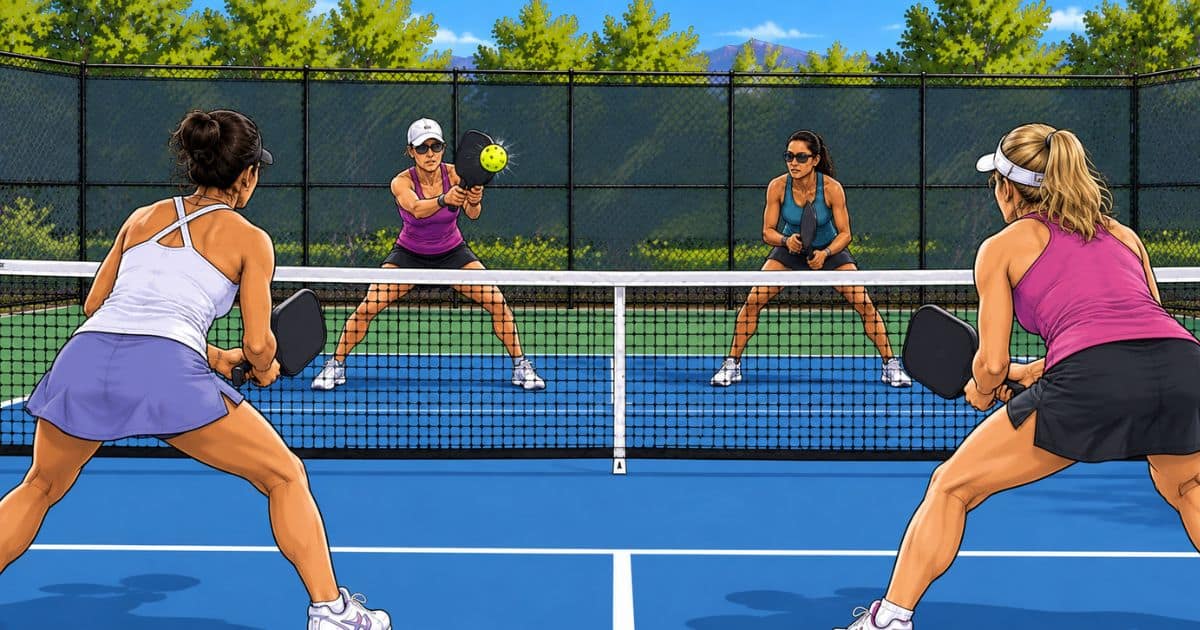
The paddle also needs to live up and out in front of the chest, angled slightly forward, elbows bent rather than locked. A proper ready position at the kitchen line already puts the paddle roughly where it needs to be. Feet stay active with knees slightly bent, weight forward, ready to step rather than reach.
How Do You Execute the Punch Volley Step by Step?
- Start with the paddle up in front of the chest, face angled slightly forward and down.
- Read the ball early and pick a target, the middle of the court or the opponent’s feet.
- Step or lean toward the ball with the front foot rather than waiting for it to arrive.
- Make contact in front of the body, never letting the ball reach the hip or behind it.
- Push the paddle forward six to twelve inches with a firm wrist and no wind-up.
- Stop the paddle shortly after contact instead of following through into a full swing.
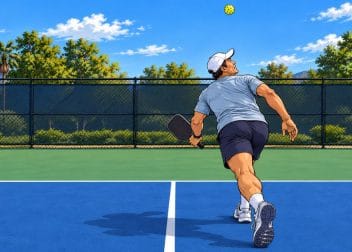
A player who takes a backswing on a fast ball at the net is usually late, and a late paddle at close range turns into an error more often than a winner.
When Should You Punch a Volley Instead of Block or Roll It?
Not every ball at the net calls for the same response, and choosing the right one separates a controlled hands battle from a chaotic one. A ball that arrives at high pace, straight at the body or chest, usually calls for a block, a soft paddle that absorbs speed rather than adding to it. Learning how to block a drive is the natural companion skill, since both shots start from the same ready position and the decision between them happens in a fraction of a second.
A punch volley fits the middle ground: some pace, but not so much that it needs pure absorption, in a spot where a firm push at the feet or into open court can do damage. When the ball is soft, high, and sitting up, a roll volley, which adds topspin and a longer paddle path, becomes the better choice, worth comparing directly against how to hit a roll volley. Many players default to punching everything simply because it repeats easily under pressure, which is exactly why opponents can start guessing the response. The punch volley is also the shot most players reach for to counter a speed-up, since a compact push executes faster than a full swing when a ball jumps at the body up close.
Punch Volley Forehand vs Backhand: What Changes?
The forehand punch volley is usually the first version players learn, since the paddle face is easy to see and the wrist naturally supports a forward push. The backhand asks more of the grip and shoulder. Because the paddle face rotates to the other side, a loose continental grip can let the face open or close at contact, sending the ball wide or into the net. Firming the grip in the last few inches before contact, without tensing the whole arm, keeps the backhand face square.
Footwork shifts too. On the forehand side, players step with the same-side foot toward the ball. On the backhand side, a small shoulder turn replaces a big step, since there is often no time for a full turn at close range. The core mechanics, paddle up, short punch, contact in front, stay the same on both sides.
Where Should a Punch Volley Be Aimed?
Two targets cover most situations: the middle of the court between two opponents in doubles, and the feet of whichever opponent is closest. A ball down the middle removes the angle and creates confusion about who should take the shot. A ball at the feet forces an opponent to volley up on the next ball, which usually hands the net back to the player who punched. Wide open court sounds appealing, but a firm push has less margin for angle than a full swing, so the middle and the feet stay the higher-percentage targets.
Is It a Fault to Hit a Punch Volley While Standing in the Non-Volley Zone?
Yes. Under the 2026 rulebook, a player who volleys a ball while any part of the body, paddle, hat, or clothing touches the non-volley zone, commonly called the kitchen, commits a fault under Section 11. The zone runs 7 feet back from the net on each side, and the fault also covers momentum: a player who volleys from outside the zone but then steps or falls into it right after contact, before the ball is dead, still loses the point. The full boundaries are covered in the guide to kitchen rules, worth reviewing alongside punch volley footwork since the two skills are learned together.
Two Drills to Build a Reliable Punch Volley
Drill 1: Middle Feed Punch Reps. One player stands at the kitchen line while a partner feeds volleys from about 12 feet away, alternating pace from soft to moderately firm. The player at the line punches every ball back down the middle, keeping the paddle up between reps instead of dropping it. Twenty to thirty reps per side, forehand and backhand, builds the habit of a short, repeatable punch rather than a swing.
Drill 2: Hands Battle Punch Only. Two players stand at their kitchen lines and volley back and forth under one rule: no backswing on any shot, punch or block only. This drill exposes the moment a player starts winding up under pressure, since a backswing in a real hands battle usually means the ball comes back late or drives into the net. The restriction trains the compact motion the punch volley depends on faster than isolated feeds alone.
Frequently Asked Questions
What is the difference between a punch volley and a block? A block absorbs pace from a hard-hit ball by softening the grip on contact, with little forward paddle movement. A punch volley adds a short forward push to a ball with less pace, moving the paddle a few inches rather than absorbing.
What grip should you use for a punch volley? A continental grip, standard on both forehand and backhand sides, since it keeps the paddle face neutral without a grip change between shots.
Do you need a backswing for a punch volley? No. The point of the punch volley is skipping the backswing. The paddle starts up in front of the chest and moves forward only a short distance, keeping the shot fast enough for a ball arriving with speed at close range.
Where should you aim a punch volley? The middle of the court in doubles and the feet of the closest opponent are the two highest-percentage targets, since both limit the angle an opponent has to work with on the next shot.
Can you hit a punch volley on the backhand side? Yes. The backhand punch volley uses the same short forward push as the forehand, but it depends more on a firm grip through contact and a small shoulder turn, since the paddle face is harder to keep square on that side.
Is it a fault to volley while standing in the kitchen? Yes. Under the rulebook, Section 11, contacting the non-volley zone during a volley, or through momentum right after one, is a fault against the volleying player, even if the ball is already dead.
How is a punch volley different from a roll volley? A roll volley adds topspin and a longer paddle path to a ball sitting up high and slow. A punch volley uses a short, flat push on a ball that already carries pace.
What mistake do players make most often on a punch volley? Taking a backswing on a ball already moving fast. Once the paddle drops back even a few inches, the shot arrives late, and a late paddle at the kitchen line usually means an error.
Should beginners learn the punch volley before the roll volley? Coaches commonly teach the punch volley first, since it depends on fewer moving parts and reinforces the paddle-up ready position other net skills build on.
Getting comfortable with the punch volley starts with the same fundamentals that shape a good hands battle, and from there, a coach can spot grip and footwork habits that are hard to see alone. The directory of pickleball coaches lists instructors who work on net skills directly, with lesson formats ranging from private sessions to small group clinics.
Written by the Pickler Junction Team.