What Is a Hands Battle in Pickleball and How Do You Win One?
Quick Answer: A hands battle is the rapid volley exchange that happens when two players stand at the kitchen line after a speed-up and trade fast shots at close range. You win one with paddle position and a compact backhand punch volley aimed at the opponent’s body, not with faster reflexes, and by resetting when the exchange turns unfavorable.
What Is a Hands Battle in Pickleball?
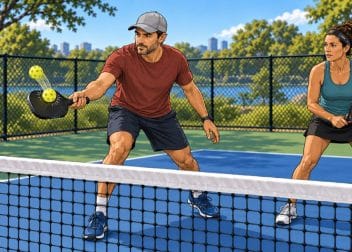
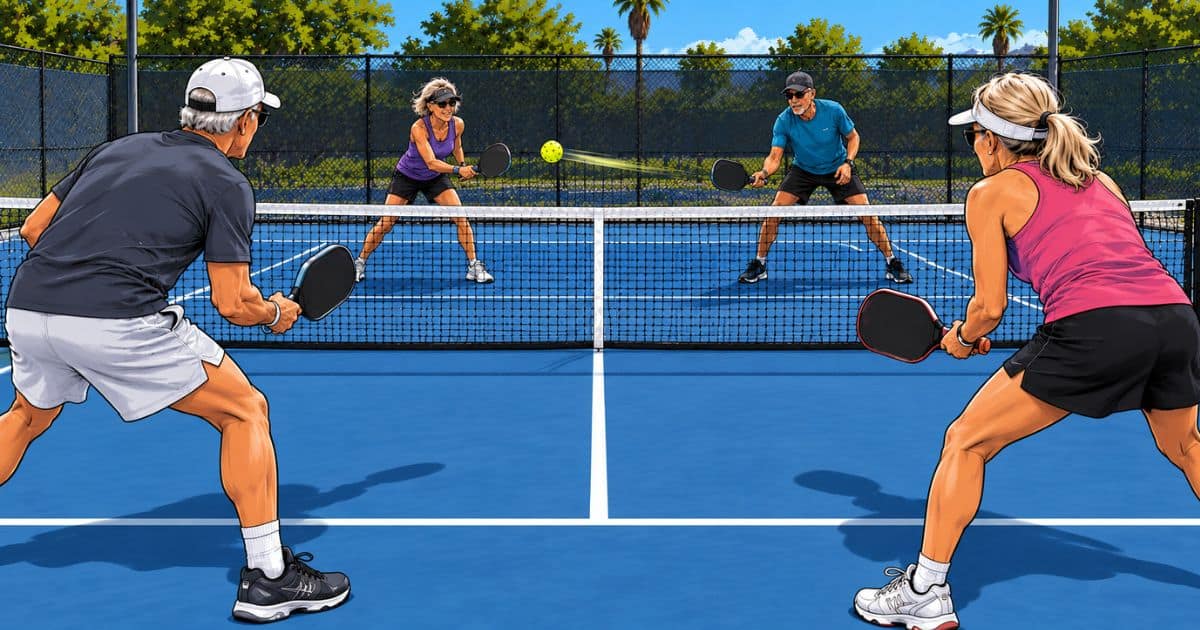
A hands battle starts the moment a speed-up turns a slow dink rally into a fast one. One player drives the ball hard at an opponent standing at the kitchen line, the opponent blocks it back on reflex, and within a second both paddles are trading contact at close range. That rapid string of volleys, each one landing near the body before the previous swing has fully finished, is the hands battle.
The exchange plays out almost entirely at the kitchen line, where both players are already positioned to volley and neither has time to retreat. It ends quickly, usually in two to five shots, when one side pops the ball up, gets jammed too close to the body to redirect it cleanly, or resets the pace with a soft shot instead of continuing to trade.
Some coaches and commentators call this a “hands war.” Whatever the name, the pattern is the same: a fast first shot, then a short burst of blocks and redirects between two players standing right on the line.
Why Do Hands Battles Come Down to Paddle Position, Not Reaction Time?
The court makes the math brutal. With each non-volley zone set at seven feet from the net, the two kitchen lines sit only fourteen feet apart. A firm paddle contact from that distance reaches the other player in well under half a second, faster than most people can consciously see the ball, decide where it is going, and swing a full stroke to meet it.
That is why improving raw reaction time only goes so far in a hands battle. The players who win these exchanges are not the ones with the quickest visual reflexes. They are the ones whose paddle is already in the right place before the ball arrives, so the ball meets the paddle instead of the paddle chasing it.
That starts with a solid ready position: paddle up, out in front of the body, angled slightly forward, elbows relaxed rather than locked. From there, blocking a fast shot means holding the paddle face steady and letting the ball rebound off it, not swinging to meet it. A paddle already dropped at the hip or drifting to one side arrives too late.
Compact swings matter just as much as position. A big backswing pulls the paddle out of the ready position for a moment, and in a hands battle that moment is often the whole exchange. Many players who lose hands battles are not slower, they are pulling the paddle back out of habit from groundstrokes, and that extra motion is what gets them jammed.
Why Is the Backhand Punch Volley the Default Shot in a Hands Battle?
Many players instinctively want to hit everything with a forehand, but the backhand punch volley is the more reliable shot in a hands battle because it keeps the paddle in front of the body rather than pulling it to one side.
A continental grip supports this, since it does not need to change between forehand and backhand contact. A player holding it can block a ball on either side without regripping mid-exchange, which is exactly the kind of half-second delay a hands battle does not allow.
The punch volley itself is short. There is no backswing. The paddle face opens slightly, the wrist stays firm, and the shot is a small forward push rather than a stroke, absorbing the incoming pace and redirecting it rather than adding power. A full swing on an already fast ball usually sends it long or into the net, since the incoming pace is already doing most of the work.
Where Should You Aim During a Hands Battle?
Aiming at open space in a hands battle invites trouble, because open space gives the opponent room to extend the arm and redirect the ball cleanly. Aiming at the body removes that room.
The classic target is the right hip pocket, roughly where a right-handed opponent’s forehand and backhand grips meet. A ball that arrives on that seam forces a split-second decision between the two sides, and a paddle that is a fraction of a second late making that decision usually mishits or jams. Aiming at the body generally, even without picking the exact hip, still cuts down the opponent’s options far more than aiming at a gap to either side, and it carries less risk of sailing wide, since the body is a bigger target than the corners of the court.
When Should You Reset Out of a Hands Battle?
Not every hands battle needs to be won by continuing to trade. Sometimes the better play is to leave the exchange entirely with a reset, a soft shot that drops the ball just over the net and kills its pace.
A few signals point to resetting rather than continuing to punch the ball back. Trading volleys gets harder to control once the ball keeps arriving above shoulder height, and a firm shot is more likely to fly long from there. A paddle face that keeps opening too far and popping the ball up is a sign the exchange is being lost, and a pop-up is exactly the shot an opponent is waiting for. A player pushed off balance or a step behind the ball is better off softening the hands and dropping the ball short to buy time and recover footwork.
Resetting is also one of the main ways to counter a speed-up before a hands battle even starts, by taking the pace off the first hard shot instead of blocking it back with equal pace.
Two Drills to Build Faster Hands
Drill 1: Compact Punch Volleys. Two players stand at their kitchen lines, about fourteen feet apart, and volley the ball back and forth using only short punch volleys, no backswing on either side. Start slow, keep the paddle out in front, and speed up gradually once the rally holds without a backswing creeping in. The goal is repeating the compact motion until it holds up under pace.
Drill 2: Hip Target Feed. One player feeds speed-ups from the kitchen line while a partner or coach places a towel or cone near the right hip position on the other side. The player being fed blocks the speed-up, then aims the next contact at that target rather than anywhere it happens to go. This trains the defensive block and the offensive aim in the same repetition, since a real hands battle asks for both at once.
Running both drills for ten minutes before a session builds the paddle discipline a hands battle demands, since the shot rarely allows time to think between contacts. A coach who can feed live speed-ups and correct paddle position in real time speeds up that process, since timing this fast is hard to self-correct from video alone. Players looking for that kind of hands-on repetition can find a nearby instructor through the directory of pickleball coaches.
Frequently Asked Questions
What is a hands battle in pickleball? A rapid series of volleys traded at close range at the kitchen line, usually started by a speed-up that turns a slow dink rally into a fast exchange.
Is a hands battle the same as a speed-up? No. A speed-up is the single hard shot that starts the exchange. The hands battle is the burst of fast volleys that follows once both players are trading contact.
Why do I keep losing hands battles even though I have decent reflexes? Losing a hands battle is rarely about reaction time alone. It is usually paddle position, an over-large backswing, or a grip that has drifted away from a compact, ready posture.
Should I use a forehand or backhand in a hands battle? The backhand punch volley is the more common default because it keeps the paddle in front of the body without pulling it to one side, but either side works if the paddle stays compact and in position.
Where should I aim when I am winning a hands battle? Aim at the opponent’s body, particularly the right hip pocket where the forehand and backhand grips meet, rather than at open space to either side.
When should I reset instead of continuing to trade shots? Reset when the ball keeps arriving above shoulder height, when the paddle face keeps popping the ball up, or when footwork falls a step behind the ball. A soft, low shot buys time to recover position.
Does grip matter in a hands battle? Yes. A continental grip lets a player block on either side without regripping between shots, which matters when there is no time to adjust the hand mid-exchange.
How close together are players during a hands battle? Both players typically stand at their own kitchen line. Since each non-volley zone extends seven feet from the net, the two lines sit about fourteen feet apart.
Written by the Pickler Junction Team.