
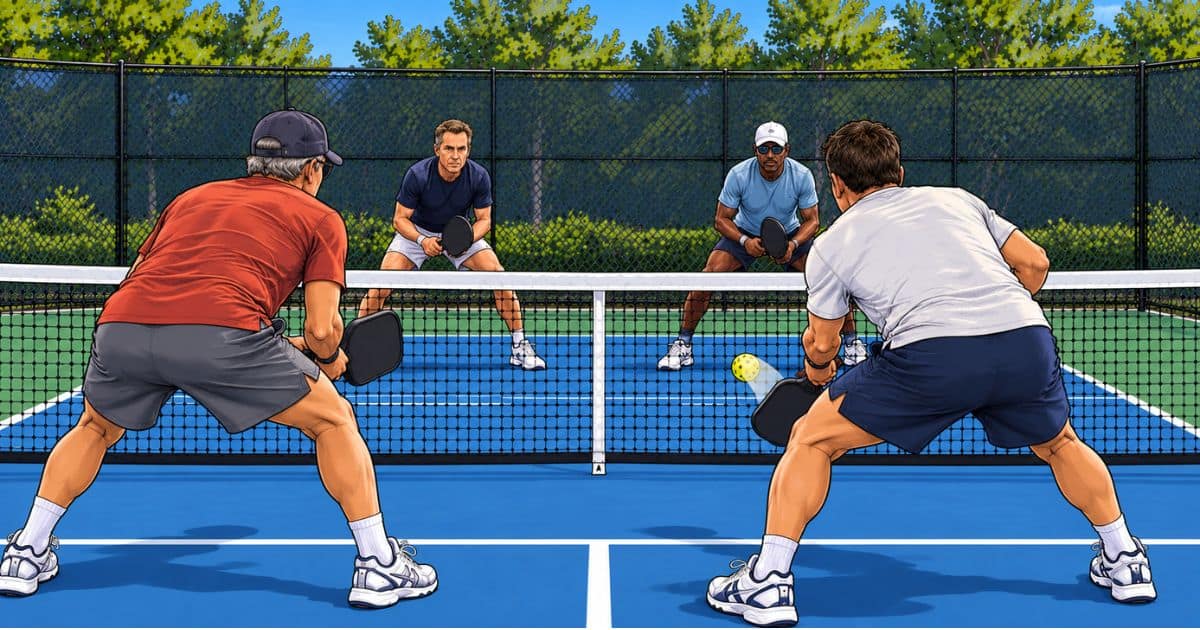
How to Hit a Roll Volley in Pickleball
Quick Answer: A roll volley takes a ball above net height out of the air with a compact low-to-high brushing motion, adding topspin so the ball can dip into the kitchen or at an opponent’s feet. It commonly uses a continental or near-continental grip, contact slightly in front of the body, and a compact motion rather than a full swing.
A roll volley turns a ball sitting above the net into a shot that dips away from an opponent instead of sailing long. It takes timing to learn, but the mechanics break down into a few repeatable pieces.
What Is a Roll Volley in Pickleball?
A roll volley is a volley, meaning contact happens before the ball bounces, hit with a low-to-high brushing path across the paddle face instead of a flat or downward punch. That brushing action creates topspin, which pulls the ball down out of the air faster than gravity alone would, so the shot clears the net with margin but still drops into the kitchen or lands at the opponent’s feet. The guide to what a volley is in pickleball covers the difference between a volley and a groundstroke, and the guide to topspin in pickleball explains why brushing up the back of the ball makes it dip.
How Do You Set Up for a Roll Volley?
Setup starts before the ball gets hit up. Standing at the non-volley zone line with the paddle at chest height and weight forward on the balls of the feet gives enough time to react when a dink or drive floats higher than the net. The takeback stays short, often just a few inches, because a long backswing is the top reason a roll volley sails long: more backswing adds more forward speed than the shot needs.
What Grip and Contact Point Should You Use?
A continental or near-continental grip, the standard grip for net volleys, lets the paddle face angle for the low-to-high path without much forearm rotation. Contact happens out in front of the body, roughly even with or slightly ahead of the front foot, at the earliest point the ball can be taken cleanly out of the air, which gives the opponent less time to recover and keeps the swing short. The paddle brushes up the back and slightly under the ball rather than driving through it, and surface texture affects how much bite that brushing motion gets; the guide to how paddle texture creates spin covers what to look for in a paddle when spin matters.
What Does the Wrist Do During a Roll Volley?
The wrist can contribute to the topspin, but the brushing path comes from a coordinated movement of the hand, wrist, forearm, and arm. A relaxed wrist can help the paddle brush up and forward through contact, but the motion should stay compact and controlled rather than rely on a forced snap. A very rigid wrist can make it harder to create a brushing path, while an oversized follow-through can make the shot harder to control. The motion feels closer to a quick flick than a stroke, compact enough that an opponent has little warning a roll is coming instead of a punch.
When Should You Roll the Volley Instead of Punch It?
A roll volley fits a ball that sits up above net height with time to load the shot, typically a dink or soft drive left too high. Rolling it sends the ball down into the kitchen with pace that is hard to counter, since topspin keeps the ball low after the bounce. A flatter punch volley, covered in the guide to hitting a punch volley in pickleball, is usually the better choice on a ball with less time to react, such as a fast exchange at the net, because the compact punch executes quicker and carries less risk of a mishit. Either shot needs to stay low enough after crossing the net that the opponent cannot simply reset with an easy dink, a point covered in the guide to keeping the ball low in pickleball.
What Is the Most Common Roll Volley Mistake?
Too much swing is the top cause of missed roll volleys. Players used to generating power with a full stroke bring that motion to the net, and the extra arm speed overwhelms the small window where topspin can bring the ball back down, so the shot sails long. The fix: shorten the backswing until it barely exists, let the wrist add the spin, and trust that a compact motion with clean brush contact carries enough pace on its own. A second error is trying to roll a ball already dropping fast rather than one still rising, which leaves no time to build a clean low-to-high path before contact.
Where Can You Legally Hit a Roll Volley?
A roll volley can be hit from anywhere behind the non-volley zone line, but not from inside it. Under the 2026 rulebook, a volley is defined as a strike of the ball before it bounces, and Rule 11.A.1 makes it a fault when a volleying player, or anything touching that player, contacts the non-volley zone during the volley. Rule 11.A.2 extends that fault to momentum, so stepping into the zone after the roll volley is hit, even after the ball is dead, still counts against the player who hit it. Players setting up right on the line need to stay balanced and avoid momentum that carries them into the non-volley zone after contact. The guide to pickleball kitchen rules covers how the non-volley zone works for every volley.
Two Drills to Groove the Roll Volley
The first drill is a feed-and-roll drill: a partner or coach feeds soft, high balls one at a time, and the hitter takes each one early with a short backswing and a wrist snap, aiming every roll at the same spot in the kitchen. Twenty to thirty reps per side, focused on a compact motion rather than pace, builds the feel for a roll over a punch.
The second drill works off a dink exchange. Two players dink cross-court, and every third or fourth ball, one player leaves a dink slightly high so the partner practices rolling it into the kitchen instead of punching it flat. This matters because in a real point, the ball that invites a roll volley usually comes out of a dink rally, not a clean feed, and reading that moment is a separate skill from repeating the motion. The soft hands this drill builds overlap with the guide to what a dink is in pickleball, the shot that most often sets up the roll.
Frequently Asked Questions
What is the difference between a roll volley and a punch volley? A roll volley brushes low to high across the ball to add topspin, while a punch volley makes flatter, more direct contact with little to no spin. The punch executes faster and carries lower risk on quick exchanges, while the roll suits a ball with enough height and time to load the shot.
Do you need topspin to hit a roll volley? Yes. Topspin defines a roll volley and separates it from a flat punch volley. Without the low-to-high brushing action that creates topspin, the shot is a punch, not a roll, even if the paddle path looks similar.
Can you hit a roll volley from inside the kitchen? No. Under the rulebook, a volley is a strike of the ball before it bounces, and Rule 11.A.1 states that a fault occurs when a volleying player, or anything touching that player, contacts the non-volley zone during the volley. A roll volley has to be struck from behind the line.
What happens if momentum carries a player into the kitchen after a roll volley? Under the rulebook, Rule 11.A.2 makes that a fault too, even after the ball has already become dead. A player finishing a roll volley near the line needs to stay balanced enough to avoid drifting forward after contact.
What grip works best for a roll volley? A continental or near-continental grip is the standard choice, since it lets the paddle face angle for a low-to-high path without much forearm rotation. The grip usually stays the same as a punch volley; the wrist action is what changes.
Why does the ball dip after a roll volley? Topspin makes the top of the ball spin forward relative to its flight path, which increases downward air pressure and pulls the ball toward the court faster than gravity alone. That is why a roll volley can clear the net with margin and still land in the kitchen instead of sailing long.
Is a roll volley the same as a topspin volley? Yes. Roll volley and topspin volley describe the same shot, and some coaches also call it a topspin roll. The technique, a brushing low-to-high contact that adds spin, is identical regardless of the name used.
What is the most common mistake when learning the roll volley? Too much swing. A full stroke on a shot that only needs a short backswing and a wrist snap is the top reason a roll volley sails long.
How do you practice the roll volley without a partner? A ball machine set to feed soft, high balls works as a substitute for a partner feed, and hitting against a wall from a few feet back can isolate the wrist snap. Neither replaces live reps, since reading a dink that sits up during a rally is a separate skill from repeating the motion alone.
Working the roll volley into a match takes repetition against a live partner and feedback on timing that is hard to catch in your own game. Pickler Junction’s directory of pickleball coaches lists instructors who teach net-game shots like the roll volley in private and group lessons, a way to get eyes on grip, contact point, and wrist timing in person.
Written by the Pickler Junction Team.