The Ready Position in Pickleball
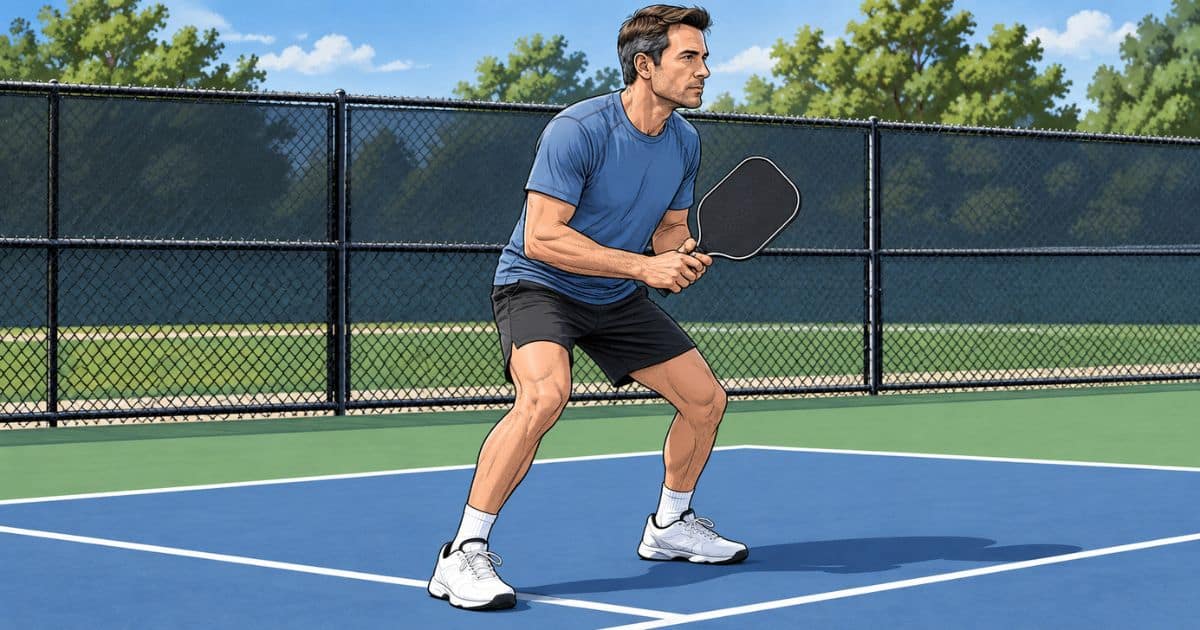
Quick Answer: The ready position in pickleball is an athletic stance: feet about shoulder width apart, knees bent, weight on the balls of the feet, paddle up in front. Tony Roig describes a neutral 12 o’clock hold, while Kaitlyn Kerr, CJ Johnson, Ana Nodilo, and Stacie Townsend favor a backhand-ready tilt toward 10 or 11 o’clock at the kitchen line.
What is the ready position in pickleball?
The ready position is the stance a player returns to between every shot, and Stacie Townsend, writing for Inside the Den, gives the recipe: feet set, knees bent, weight forward, paddle up and out in front, summed up as “Be Athletic!” Andrea Fogarty’s positioning guide for USA Pickleball lists “an athletic stance with bent knees” with the paddle up as a first habit for new players.
The reason comes down to time. Fogarty writes that “most points are won at the Non-Volley Zone line,” where two players stand 14 feet apart across the two 7 foot non-volley zones, close enough that a hard ball leaves almost no time to react. Four-time US Open champion Laura Fenton Kovanda, quoted by CJ Johnson at Better Pickleball, says players who appear to have “quick hands” are often simply holding the paddle in the right spot all rally.
Where should the feet, knees, and weight be?
Townsend’s guide calls for feet “about shoulder width apart” or slightly wider, knees bent, and “weight on the balls and insides of your feet.” Todd Jungling, a certified instructor writing at PickleballMAX, gives nearly the same recipe. CJ Johnson goes a step wider, teaching feet “wider than shoulder-width, knees and hips flexed, and weight on the balls of your feet.”
Kaitlyn Kerr, writing for Selkirk, is blunt about the knees: “you should never be standing up straight on the pickleball court unless you’re jumping for a high volley or lob.” Johnson adds that when the paddle drops toward the legs, weight drifts from the balls of the feet back toward the heels, and balance goes with it. The movement side of the stance is covered in the guide to improving footwork for pickleball.
How high should the paddle be, and at what angle?
Every coach cited in this article agrees the paddle belongs up and in front of the body. They split on height and angle.
On height, Kerr teaches holding the paddle “in front of your chest with a slightly bent elbow.” Townsend argues for roughly belly button level, and explains why: “if you are holding your paddle at chest height, anything above your paddle head will likely be going out of bounds.”
On angle, picture a clock face with 12 o’clock pointing at the net. Two main schools exist, plus a full-backhand variant one coach mentions.
The neutral school. Tony Roig, a senior pro and IPTPA-certified master teaching professional, describes the ready position at Better Pickleball as “holding the paddle in a neutral position, around the 12 o’clock position, directly in front of your body.”
The backhand-ready school. Kerr writes, “If noon is straight ahead, your paddle should be pointed at the 11 if you are right-handed, or the 1 if you are left-handed.” Johnson teaches the same 11 o’clock tilt and says it “allows you to move quickly from the backhand to the forehand.” Ana Nodilo at Pickleball Union recommends 10 or 11 o’clock and summarizes the idea as “Backhand ready, forehand available.” Her reasoning: most speedups at the kitchen line target “the body, paddle shoulder, hip, or middle seam,” and a backhand counter from those crowded contact points is “compact, stable, and faster.” Pickleball University’s guide estimates a backhand-ready paddle at the net covers roughly 80 percent of the body. Jungling describes 9 o’clock as a third option, strong against body shots but slow to the forehand, and lands on 10 to 11 o’clock himself.
None of these coaches teaches a forehand-ready tilt at the kitchen line.
Does the ready position change from the baseline to the kitchen line?
Yes, and the change is mostly in the paddle. Townsend teaches roughly 12 o’clock at the baseline and 10 or 11 o’clock in the transition zone and at the kitchen line. Pickleball University and Jungling describe the same split.
Jungling’s reasoning is that a more neutral hold suits positions farther from the net, where the incoming ball is usually a serve or deep return with time for a full swing. Townsend and Nodilo make the kitchen line case, where a speedup at the chest leaves no time to swing and the backhand tilt is their answer.
Kerr notes one exception to paddle up: when defending a putaway, “your paddle should drop lower toward your knees or ankles because your opponent will likely be slamming the ball toward your feet.” That situation is common in midcourt, and the guide to resetting from the transition zone covers it. Where to stand at all is covered in the guide to positioning in pickleball doubles.
What is the split step, and when does it happen?
The split step is the small hop that returns a moving player to the ready position at the moment the opponent hits. Fogarty’s guide: “Just before your opponents hit, take a small hop to reset your balance.” Coach Jess of Athena Pickleball, quoted by The Dink, calls it “a small, controlled balancing movement that grounds your weight and resets you into a true pickleball ready position,” with the timing cue “landing as you hear the pop of the paddle.”
The Dink Media Team’s April 2026 split step guide adds two details: start the hop “as their paddle begins its forward swing. Not when they contact the ball. Slightly before,” and keep it to “Six inches off the ground, max.” Ben Hurtuk’s guide for Paddletek goes lower still, one to two inches, landing on the balls of the feet with the paddle one to two feet in front of the body. Reading the swing early enough to time it is the skill covered in the guide to improving reaction time in pickleball.
Common ready position mistakes
Jungling names a common beginner error: “having your paddle dangling down by your side.” Kerr’s warning about standing up straight covers the second fault, locked knees. A third is a strangled grip. Kerr teaches a loose grip with a locked wrist: if a partner tried to steal the paddle, it “should simply glide out of your hand.”
The Dink guide lists two split step faults: hopping too late, and jumping too high, which “takes too long to complete and leaves you briefly airborne and helpless.” A related mistake is parking in the transition zone, where Fogarty warns it is “easy for opponents to hit hard, downward shots at your feet.” More of these habits appear in the guide to common pickleball mistakes.
Which drills build the ready position?
The slinky drill, from Kerr’s Selkirk guide: two players dink at the kitchen line. After about five shots, one player takes two steps back while the rally continues, repeating until reaching the baseline, then works forward again. The goal is the same stance and paddle position at every depth.
Feed and freeze, from The Dink: a partner feeds balls while the player split steps on each strike and holds the landing, 20 to 30 repetitions per set.
Shadow split steps, from Hurtuk: no ball, no partner. Count the steps aloud, small hop, land on the balls of the feet, bend the knees, paddle out front, and practice “in your driveway or yard ahead of time.”
A wider set of starter exercises appears in the list of beginner pickleball drills.
Frequently asked questions
What is the ready position in pickleball? The balanced stance a player returns to between shots: feet about shoulder width apart, knees bent, weight on the balls of the feet, paddle up in front of the body.
Should the paddle point at 12 o’clock or 11 o’clock? Tony Roig teaches a neutral 12 o’clock hold. Kaitlyn Kerr and CJ Johnson teach 11 o’clock, and Ana Nodilo, Stacie Townsend, and Todd Jungling teach 10 or 11 o’clock, all backhand-ready for right-handers at the kitchen line.
How high should the paddle be held? Kerr teaches chest height with a bent elbow. Townsend teaches roughly belly button level, arguing that a ball above a chest-high paddle is likely heading out.
Should the knees be bent in the ready position? Yes. Kerr writes that a player should never stand up straight on the court except when jumping for a high volley or lob.
What is a split step? A small hop timed to the opponent’s contact that resets the feet into the ready position. The Dink’s guide caps the hop at six inches; Ben Hurtuk describes one to two inches.
When exactly should the split step happen? The Dink Media Team’s guide says to start the hop as the opponent’s paddle begins its forward swing so the feet land at contact. Coach Jess of Athena Pickleball gives the cue “landing as you hear the pop of the paddle.”
Is the ready position different at the baseline than at the kitchen line? The stance is the same, but the paddle angle changes. Townsend and Pickleball University both teach roughly 12 o’clock at the baseline and 10 or 11 o’clock at the kitchen line.
Why does a dropped paddle matter so much? A paddle at the hip has farther to travel to meet a fast ball, and CJ Johnson points out that a dropped paddle shifts body weight back onto the heels.
Stance habits are hard to see from inside them. An instructor watching from the sideline can spot whether the paddle drifts down, whether the knees lock, and whether a 12 or 11 o’clock hold fits a player’s hands. Instructors who teach these fundamentals are listed in the directory of pickleball coaches near you, and players who want a grounding in the basics first can start with the guide to pickleball tips for beginners.
Written by the Pickler Junction Team.