How to Counter a Speed-Up in Pickleball
Quick Answer: To counter a speed-up, read the cue early, a dropped paddle face and a set stance, then hold the paddle at chest height with the backhand slightly favored. Pick one of three answers: block the ball down into the kitchen, counter it back at the body or middle, or let it go if it is heading out.
What Is a Speed-Up, and Why Do You Need an Answer for It?
A speed-up is when a player driving a soft dink rally suddenly punches the ball hard at an opponent, trying to end the point before the other side can react. The guide to what a speed-up is in pickleball covers the mechanics in full, but the short version matters here: a speed-up only works if the person on the other end is caught flat-footed.
A speed-up is not a rules violation and it is not unstoppable, it is a bet that you will be slow to react. Every answer in this guide exists to make that bet a losing one more often than not.
How Do You Read the Cue Before the Ball Arrives?
The counter starts before contact. Watch the paddle face during a dink exchange. When an opponent’s paddle drops below the ball and the face opens up, that is the setup for a speed-up, not a soft dink. A dink comes off a paddle that stays roughly level with the ball, while a speed-up comes off a paddle that dips and then drives up and through.
Eyes matter too. Many players glance at their target a split second before they swing, especially at the body or a gap down the middle, so watching the paddle first and the shoulders second gives you extra warning that watching the ball alone does not.
Footwork gives it away as well. A player setting up to speed up usually squares their shoulders and sets their feet to build a stable base for pace, unlike the relaxed stance of a patient dink.
What Ready Position Gives You the Best Chance to Counter?
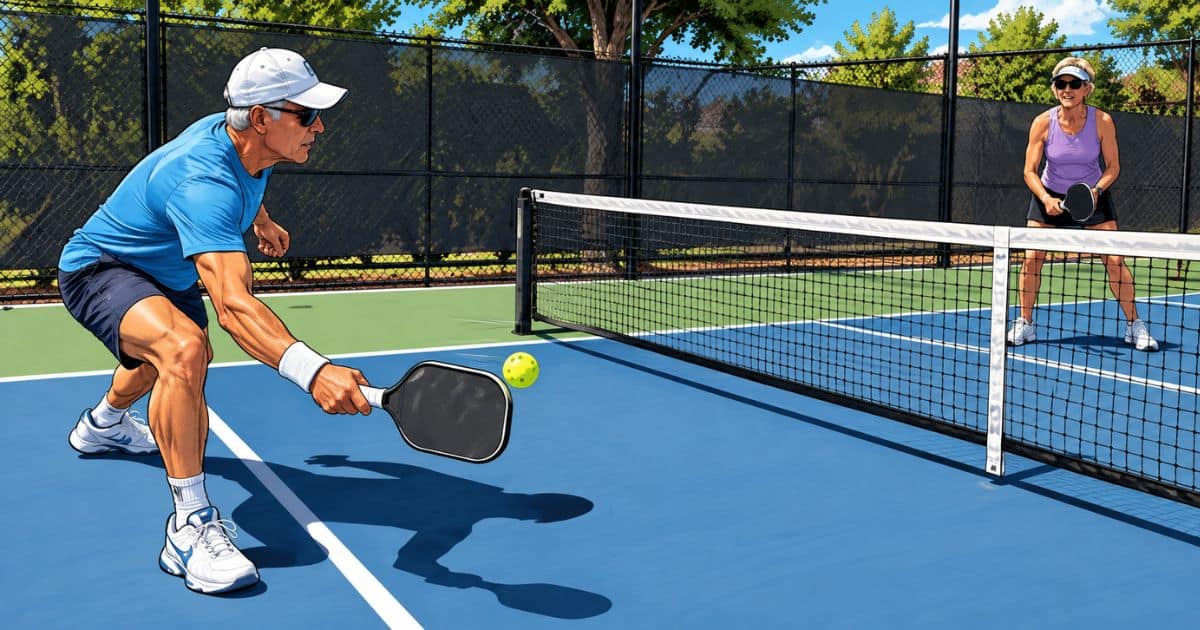
Between shots at the net, hold the paddle up around chest height, angled slightly toward your backhand side. The ready position guide breaks down stance and grip in more detail, but the backhand lean matters specifically for speed-ups.
Most speed-ups target the body or backhand, since a backhand block is the shot many players trust the least under pressure. Favoring the backhand slightly closes that gap before the ball is even hit.
Keep your knees bent and your weight forward on the balls of your feet. A speed-up gives you a fraction of a second to react, and a flat-footed stance eats up most of that time just getting your body moving.
What Are the Three Answers to a Speed-Up?
Once the ball is coming hard, you have three real options. Which one fits depends on the pace, the angle, and where the ball is relative to your body.
Block or Reset It Into the Kitchen
The most reliable answer against a hard, well-placed speed-up is a soft block that drops the ball back into the non-volley zone. This works the same way as a reset: instead of swinging back, you let the paddle absorb the pace and redirect the ball low and short.
Keep the paddle face slightly open, firm the wrist, and let the incoming pace do the work rather than adding your own swing. The goal is to take the speed out of the ball and land it inside the seven-foot non-volley zone that runs along both sides of the net, so your opponent cannot simply speed it up again from a comfortable height. It is the same instinct used to block a hard drive, triggered from a dink instead of a groundstroke.
Counter Back at the Body or the Middle
If the speed-up comes in a little slow, high, or loose, you can counter it back rather than only absorb it. Punch the ball back low and flat, aimed at the body of the player who hit it or at the middle seam between two opponents.
Aiming at the body works because a player who just committed to an aggressive shot is rarely reset into a defensive stance yet. Aiming at the middle works differently: the seam between doubles partners causes hesitation, which is often enough on its own against a fast ball. This quick paddle contact at the net is sometimes called a hands battle, and a compact backhand flick works well for firing back from close range.
Let It Go If It Is Heading Out
Not every speed-up needs an answer. If the ball is tracking wide, long, or past the baseline, let it go rather than lunge at it. Reaching for a ball that is going out turns a free point into an unforced error, a common mistake against players who rely on pace over placement, sometimes called banging the ball. The guide on how to beat a banger covers this pattern further, but the rule at the net is simple: track the ball, and commit only once you are sure it is staying in.
What Do You Do When the Ball Hits Your Hip?
The hip is the hardest spot to defend, because it sits between a forehand and a backhand swing and there is rarely time to choose which one to use. Most players end up jamming the paddle down and hoping.
A better habit is to rotate your hips slightly away from the ball as it arrives, which opens room for a short, compact swing rather than a cramped one. Keep the paddle low and let the wrist make the final adjustment instead of the whole arm.
Treat a ball at the hip the same as any other speed-up: block it low into the kitchen unless it is loose enough to counter, and avoid muscling a full swing through a shot with almost no time behind it.
How Do You Train This Reaction So It Becomes Automatic?
Reflex blocks are a physical skill before they are a strategic one, and they improve with repetition. Feeding drills, where a partner or coach fires speed-ups from a basket at increasing pace, build hand speed and paddle control that reading alone cannot. The guide to improving reaction time has drills built around this close-range, high-pace exchange. A coach who watches your ready position and paddle prep in real time can usually spot the habit costing you the most reaction time.
When Should You Speed Up Instead of Defend?
Everything above assumes you are on the receiving end. Knowing when to initiate a speed-up matters just as much, since a well-timed one turns a neutral dink rally into a point you control. The guide on when to speed up in pickleball walks through the setups worth attacking and the ones worth leaving alone.
Finding More Help
Reading the cue, holding a paddle-up ready position, and knowing the three answers, block, counter, or let it go, turns a shot designed to rush you into one you can handle calmly. A coach who works this specific exchange with a player can speed up the learning curve considerably, and the directory of pickleball coaches is a place to find one local who teaches net play and fast-hands exchanges.
Frequently Asked Questions
What is the fastest way to improve at countering speed-ups? Repetition against live pace helps more than reading about it. A partner or coach feeding speed-ups from a basket, starting slow and building up, trains the hands to react before the brain has to think through the choice.
Is blocking a speed-up the same as resetting a dink? The mechanics are similar, both use an open paddle face and absorbed pace, but a speed-up block allows less reaction time since the ball travels faster.
Should you back up from the kitchen line to counter a speed-up? No. Backing away gives the ball more time to drop and more room for a second shot into open court. Staying at the line with a compact block keeps the pressure even.
Why do speed-ups so often target the backhand? A backhand block is the shot many players trust the least, producing more mishits and pop-ups than a forehand shot does. Favoring the backhand in the ready position closes that gap.
Can a speed-up be countered with a full swing? Rarely. A full swing needs more time than a speed-up allows, and a big backswing usually means late contact or a ball sent long. A short, compact motion works better.
What grip works best for blocking a speed-up? A continental grip, the one used for most volleys, lets the paddle face open or close quickly without changing grips mid-point.
Does the two-bounce rule affect how a speed-up is defended? No. The two-bounce rule governs only the serve and return at the start of a rally. A speed-up happens well after both bounces, so it has no bearing on how the shot is defended.
How do you know whether to counter or just block? Read the pace and placement in the moment. A hard, well-aimed speed-up usually leaves time only to block. A slower or loose one, especially one sitting up above the net, can be countered back at the body or the middle instead.
Written by the Pickler Junction Team.