
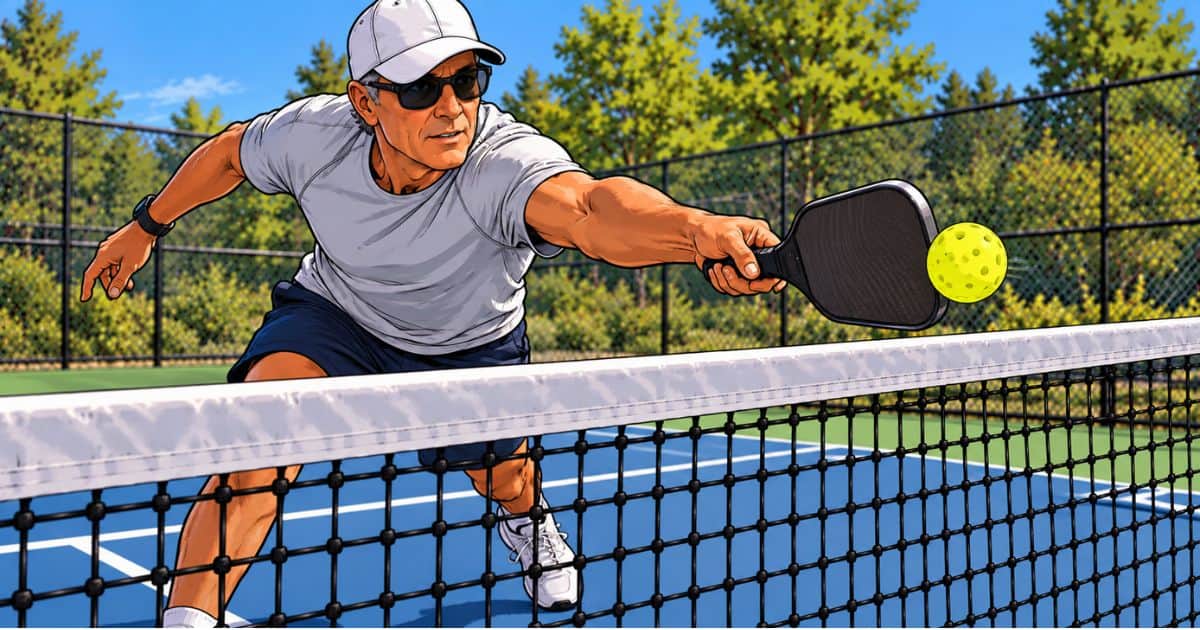
Can You Reach Over the Net in Pickleball?
Quick Answer: No, not before contact. Under the 2026 rulebook, Section 13.F, the ball must fully cross the net to a player’s side before that player hits it, and Section 13.I bars reaching over first. Once contact is made on the player’s own side, the paddle and body may follow through over the net without touching it or the opponent’s court.
The net splits the court into two invisible walls that rise from the ground to the ceiling, and that boundary is what the rulebook calls the plane of the net. Section 13.F states that the ball must entirely cross to a player’s side of the net before that player hits it, and Section 13.I applies the same boundary to the player: a player, or anything worn or carried, paddle, hat, hair, cannot cross into the opponent’s half of that plane while the ball is live, except in two situations covered further down. The net itself is fixed at the height covered in the guide to the height of a pickleball net, but the plane rule has nothing to do with how tall the net is; it governs where and when contact happens, not what the net measures.
Can You Reach Over the Net Before Hitting the Ball?
No. Under the rulebook, Section 13.I.1.a says that when any part of a player, or anything worn or carried, crosses the plane of the net before that player hits the ball, it is a fault against the player. The fault is about where the paddle is at the moment of the swing, so a paddle that crosses early is a violation even when it never touches the net, the post, or the opponent’s side of the court. Section 13.F backs up the same idea from the ball’s side: the ball has to finish crossing to the receiver’s side before the receiver can legally strike it, so reaching out to meet the ball early breaks two rules at once.
What Can You Do With Your Paddle After You Hit the Ball?
Once contact is legal, meaning the ball has already crossed to the player’s side and the strike happens from there, the rulebook allows the follow-through to travel across the net. Section 13.I.1 permits a player to cross the plane immediately after hitting the ball, but only while finishing that same strike, not as a separate move made afterward. A firm forehand taken close to the net can carry the paddle, wrist, or a shoulder over the net line as long as nothing touches the net or the net support system, a restriction covered in the guide to whether you can touch the net in pickleball, and as long as nothing touches the opponent or the opponent’s side of the court, a separate fault under Section 13.H.
Why Is the Erne Legal If Reaching Over the Net Is Not?
The erne, explained fully in the guide to what an erne is in pickleball, looks like a player is crossing into the opponent’s space, since it involves stepping around the non-volley zone to volley the ball near the sideline before it bounces. What makes it legal is where contact happens: the strike is made outside the net post while the player’s feet stay off the non-volley zone and its side extension, a separate requirement covered in the guide to pickleball kitchen rules, so the paddle never crosses the plane of the net at all. Because Section 13.I of the rulebook only restricts crossing the plane between the two net posts, and Section 13.C separately allows a ball to be returned around the outside of the net post, an erne made on the striker’s own side breaks neither rule.
How Is the ATP Different From Reaching Over the Net?
The ATP, or around-the-post shot, explained in the guide to what an ATP is in pickleball, solves the same problem the erne does from the other direction: instead of reaching over the net, the player sends the ball around the outside of the net post entirely. Section 13.C of the rulebook covers this directly, stating that a ball may be returned around the outside of the net post, without requiring the shot to pass over the net or between the posts at all. Because the ball never crosses the plane between the posts, the ATP is not tested against the reaching-over rule; it is tested only against whether the ball lands in bounds on the opponent’s side.
Does the Rule Change During a Fast Volley Near the Net?
No. A fast exchange at the net, sometimes called a hands battle, is still governed by the same plane rule that applies to a slow dink, as covered in the guide to what a volley is in pickleball. Under the rulebook, Section 13.I restricts crossing the plane whether the ball is traveling at rally pace or coming back fast off a block, so a player who punches at a fast ball before it fully crosses commits the same fault as one who reaches early on a slow dink.
Can You Reach Over the Net If the Ball Bounces Back?
There is one case where reaching over the net to play a ball already on the opponent’s side is legal. Under the rulebook, Section 13.I.2, if a ball bounces on the receiving player’s side and then spins back across the net to the opponent’s side without being hit, the receiving player may cross over, under, or around the net to play it, but only after the ball has fully crossed back. Reach across too early, while the ball is still on the receiver’s own side or mid-crossing, and Section 13.I.2.a makes that an early-crossing fault, the same category of violation as reaching over before a normal strike.
What Happens If a Player Is Called for Reaching Over the Net?
A reaching-over violation ends the rally immediately, with the same scoring result as any other fault, described in the guide to what is a fault in pickleball. In doubles, the rulebook applies Section 13.I to whichever player’s paddle, hand, or body actually crosses the plane, so a fault on one partner costs the team the rally the same way a service fault would. The call is about timing rather than obvious contact with the net, which is why footwork and timing near the net are worth drilling on purpose.
Frequently Asked Questions
Can you reach over the net without ever hitting the ball? No. Under the rulebook, Section 13.I.1.b, crossing the plane of the net without hitting the ball is a fault, even when the player touches nothing on the other side.
Is reaching over the net always a fault? No. Under the rulebook, Section 13.I.1, a player may cross the plane immediately after hitting the ball, as long as the crossing happens during that same strike and its follow-through rather than as a separate move.
Can a paddle touch the net during a legal follow-through? No. Under the rulebook, Section 13.G, a player or anything worn or carried must not contact the net or net support system while the ball is live, and that rule applies during a follow-through the same as at any other point in the rally.
What is the erne shot in pickleball? The erne is a shot where a player moves around the non-volley zone to volley a ball near the sideline before it bounces, making contact outside the net post while both feet stay off the non-volley zone and its side extension.
Does the erne break the net plane rule? No, because under the rulebook, Section 13.C allows a ball to be returned around the outside of the net post while Section 13.I only restricts crossing the plane between the two posts, so contact made outside the post never crosses that plane.
What is the difference between an ATP and reaching over the net? An ATP sends the ball around the outside of the net post under Section 13.C, while reaching over the net means crossing the plane between the posts, which the rulebook restricts under Section 13.I to the moment right after a legal strike.
Can you reach over the net if the ball bounces onto your side and then spins back to your opponent’s side? Yes, in that one case. Under the rulebook, Section 13.I.2, the receiving player may cross over, under, or around the net to play the ball, but only once it has fully crossed back to the opponent’s side.
What happens if a player is called for reaching over the net? The rally stops immediately and the point goes to the opponent, the same result as any other fault.
Does the reaching-over rule work the same way in doubles? Yes. The rulebook applies Section 13.I to whichever player’s paddle or body actually crosses the plane, so either partner can be faulted individually for an early reach.
Can a player reach over the net to block a hard-hit ball? No more than in any other situation. Contact still has to happen on the striker’s own side of the net first, whether the shot is a soft dink or a hard block, so a punch volley must be made before any part of the paddle crosses the plane.
A player who keeps getting called for reaching over the net usually needs work on shot timing near the kitchen line rather than a rule change, and a session with a coach who understands this rule can turn that habit around faster than trial and error on a Saturday morning. Search the pickleball coaches directory to find one nearby who teaches net play, the erne, and the ATP as part of a normal lesson plan.
Written by the Pickler Junction Team.