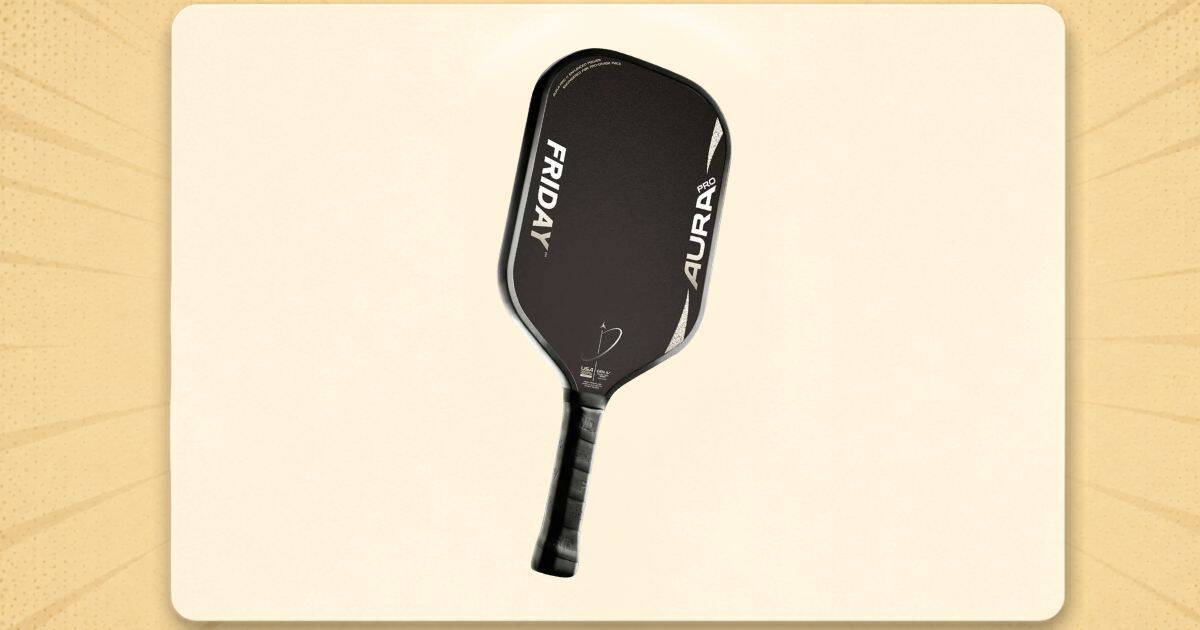
Friday Aura Pro Pickleball Paddle Review
JUNCTION SCORE 4.6 / 5
★★★★★ 4.6
Review Score: 4.6 / 5 based on 1,716 verified ratings (Shop.com 849; Friday Pickleball 825; Matt’s Pickleball 18; Pickleball Central 11; Dick’s Sporting Goods 10; Desert Paddle 3)
Community Score: Highly Recommended, based on Reddit and community threads
The Friday Aura Pro delivers top-tier power output and a satisfying dwell-forward feel at a price that undercuts most paddles in its performance class, making it a strong buy for intermediate to advanced players who prioritize drives and serves. The main catch is a low twist weight that punishes off-center hits toward the rail, which players who rely on wide-angle stability will feel.
Best for: Intermediate to advanced players who want elite power and spin with a manageable swing weight
Skip if: You need maximum off-center stability or prefer a soft, muted foam feel
Price: $169
USAP Approved: Yes
The Review
Yes, for the right player. The Friday Aura Pro is a Gen 4 double-thermoformed paddle built around a Dual-Foam Core combining EPP and EVA foam, a T700 Raw Carbon Fiber face, and Friday’s patent-pending ElasTECH Internal Perimeter Weighting System, all packaged in a blow-molded carbon fiber frame. Serve speed lands at the 93rd percentile of over 500 paddles measured in lab testing, spin RPM comes in at the 83rd percentile of a comparable pool, and the paddle retails for $169, a price point that buyers and reviewers consistently describe as punching well above its weight. See detailed review below.
What Reviewers Like
Power that stands out at this price. The Aura Pro’s power output is the single most praised characteristic across every source reviewed. Serve speed measured at 61.0 MPH in lab testing, placing it at the 93rd percentile of 513 paddles measured, and the firepower score comes in at 84 out of 100. Players who bought it describe effortless pace on drives without feeling like they are swinging out of control, and buyers who switched from paddles costing significantly more report that the Aura Pro matches or exceeds what they were used to. The ElasTECH perimeter system and thermoformed carbon frame are the construction features Friday credits for this output.
Dwell time and feel that reward aggressive play. The Dual-Foam Core produces a dwell sensation that players describe as plush and confidence-inspiring, particularly on hard drives and topspin serves. What makes the Aura Pro distinctive among Gen 4 foam paddles is that it reads firmer and more polymer-like than most, which appeals to players who find typical foam cores too muted or dead-feeling. Owners note that the dwell gives them the confidence to swing freely on groundstrokes while still keeping the ball in play, a balance that is difficult to find in this construction category.
Spin generation backed by measured data. The T700 Raw Carbon Fiber face produces strong surface roughness, measuring at the 86th percentile of 272 paddles tested for that metric. Spin RPM in lab testing came in at 2,295 RPM, placing the paddle at the 83rd percentile of 511 paddles measured. Players who bought it consistently highlight the gritty face texture as a standout feature, noting that topspin serves and drives feel noticeably more loaded than what they experienced on previous paddles.
A sweet spot that earns its reputation. The Aura Pro is described across multiple sources as delivering a large, forgiving sweet spot that is rare for a paddle positioned at the advanced end of the market. Buyers report confidence on off-center contact, and the paddle’s balance point at the 89th percentile of 575 measured places it firmly in head-heavy territory, which contributes to plow-through on contact. Forgiveness scores 9 out of 10 in published testing, a mark that published reviewers explicitly called unusual for a paddle targeting advanced players.
Kitchen performance that surprises for a power paddle. Several owners specifically call out improved dinking and reset performance, crediting the gritty carbon face for grabbing the ball at the kitchen line and producing controlled, angled dinks. Punch volley speed measured at the 76th percentile of 513 paddles tested, confirming that the paddle is not one-dimensional. Players who logged extended hours with the Aura Pro report that their soft game held up better than expected given how much raw power the paddle generates.
Build quality that feels refined. The blow-molded carbon frame and ElasTECH perimeter system give the paddle a structural solidity that owners describe as thoughtfully engineered. The edge guard in particular draws positive comments, with buyers noting it feels sturdier than what they experienced on earlier Friday models. Control scores 9 out of 10 and Durability scores 9 out of 10 in published testing, reflecting the overall impression that the Aura Pro is a well-finished product for its price.
Reported Limitations
Low twist weight means off-center rail hits are felt. The biggest real trade-off with the Aura Pro is its twist weight, which measures at the 16th percentile of 596 paddles tested. That figure means the paddle is less stable than roughly 84 percent of the paddles in that pool when contact happens toward the side rails rather than the center of the face. Players who rely on wide-angle volleys or who frequently mis-hit toward the edges will feel that instability in their hand. Published reviewers who tested the paddle note that weight customization, specifically adding lead tape at the 3 and 9 o’clock positions, is the practical fix, but that adds a step that players who prefer a stock setup will need to account for.
Raw carbon grit will wear over time. The T700 Raw Carbon Fiber peel ply texture that produces the paddle’s strong spin numbers follows a shorter lifespan pattern than durable grit surfaces. Published reviewers who tested the paddle explicitly flag this as a known limitation of the surface construction, noting that players who depend heavily on spin generation should expect the face to lose some of its bite as hours accumulate. This is not unique to the Aura Pro among raw carbon paddles, but it is a real cost consideration for players who want consistent spin performance over a long ownership window.
Dinks require adjustment for some players. While many owners report improved kitchen performance, the carbon face’s ball-grabbing texture can pull dinks downward into the net if the player does not adjust their technique. Published reviewers who spent time at the kitchen with the Aura Pro note this as a minor but real learning curve, particularly for players transitioning from smoother-faced paddles. It is not a dealbreaker, but players whose game is built primarily around soft, touch-dependent net play should expect a period of adaptation.
Which Should You Choose: Elongated, Hybrid, or Widebody?
The Elongated is the recommended starting point for most players, offering the longest reach and a swing weight that matches the manufacturer’s stated 116 figure across multiple measurements. The table below covers the three available shapes.
| Spec | Elongated (Recommended) | Hybrid | Widebody |
| Best for | Reach, power-focused play | Balanced all-court play | Maneuverability, stability |
| Weight | 8.0 oz avg (7.8 to 8.2 oz range) | 8.0 oz | 7.85 oz |
| Swing Weight | 116 | 116 | 108 |
| Twist Weight | 6.02 | 6.43 | 6.86 |
| Dimensions | 16.5″ x 7.5″ | 16.2″ x 7.6″ | 16.0″ x 8.0″ |
| Who it suits | Players who want maximum reach and power output | Players who want a balance of power and maneuverability | Players who prioritize stability and a larger face |
The Widebody is the most stable of the three shapes, carrying the highest twist weight at 6.86 and the lowest swing weight at 108, making it the most maneuverable option in the line. Players who found the Elongated’s low twist weight to be a limiting factor should consider the Widebody before adding lead tape.
How Reviewers Compare It to Rivals
Friday Aura Pro vs. Selkirk LABS Project Boomstik. The Boomstik sits above the Aura Pro in raw power output according to published reviewers who tested both, and players who have used both confirm the Boomstik is in a different tier for pure explosive pop. Where the Aura Pro competes is on control and feel, with buyers who switched between the two noting that the Aura Pro is more manageable at the kitchen and easier to work with on resets. The Aura Pro also retails at $169, while the Boomstik carries a higher price, making the Friday paddle the more accessible option for players who want most of the power without the full cost or weight commitment.
Friday Aura Pro vs. Bread and Butter Loco. Published reviewers who ranked both paddles place the Loco above the Aura Pro in pop-based power, describing the Loco as the choice for players whose game is built around raw explosive feel. The Aura Pro counters with a dwell-forward character that players who prefer a more controlled power delivery tend to favor. Players who compared the two directly in extended on-court sessions found the Aura Pro more consistent on aggressive drops and dinks, while the Loco edged ahead in pure pop sensation.
Friday Aura Pro vs. Friday Fever. Players who moved from the Fever to the Aura Pro report that the Pro has noticeably more power and pop, with a firmer feel that sits closer to a polymer response than the Fever’s softer profile. The dinking experience is described as improved on the Aura Pro, with the gritty face providing better grip at the kitchen. Players who loved the Fever’s soft, dwell-heavy character may find the Aura Pro’s firmer response a meaningful change, though published reviewers who tested both consider the Aura Pro the more refined and capable paddle overall.
Friday Aura Pro vs. Honolulu Sword and Shield J2NF. Published reviewers describe the Sword and Shield J2NF as among the very best paddles available, priced around $175, and position the Aura Pro as delivering approximately 90 percent of that performance at $169, making it the stronger value play for players who do not need the absolute ceiling of performance and want to keep their budget in check.
Who Is the Friday Aura Pro Best For?
The Aura Pro is built for players in the intermediate to advanced range who want a power-forward paddle that does not sacrifice dwell feel or spin generation to get there. Players at the 4.0 level and above who drive the ball frequently, rely on heavy topspin serves, and want a paddle that rewards aggressive groundstrokes will find the Aura Pro fits their game well. The manageable swing weight relative to its power output also makes it attractive to players who found heavier power paddles too fatiguing over long sessions.
The Elongated shape is the right starting point for most players in this category, particularly those who want reach and power. Players who struggle with off-center stability or who play a wider, more lateral game should look at the Widebody shape, which carries a significantly higher twist weight and will feel more forgiving on rail hits without requiring lead tape customization.
Buy it if you:
- Prioritize serve speed and drive power above all other attributes
- Want strong spin generation from a gritty raw carbon face
- Play an aggressive baseline or transition game and want dwell-forward feel
- Are looking for advanced-level performance at a $169 price point
Skip it if you:
- Need maximum off-center stability without adding lead tape
- Prefer a soft, muted foam feel over a firmer, polymer-like response
- Build your game primarily around touch and net play
- Want a grit surface that holds its texture over a long ownership window
At a Glance
| Spec | Detail |
| Price | $169 |
| Shape Options | Elongated, Hybrid, Widebody |
| Weight | 8.0 oz avg (Elongated); 7.8 to 8.2 oz range |
| Core Thickness | 16mm |
| Core Material | Dual-Foam Core (EPP + EVA foam) |
| Face Material | T700 Raw Carbon Fiber |
| Paddle Length | 16.5″ (Elongated); 16.2″ (Hybrid); 16.0″ (Widebody) |
| Paddle Width | 7.5″ (Elongated); 7.6″ (Hybrid); 8.0″ (Widebody) |
| Handle Length | 5.5″ |
| Grip | 4.25″ circumference, tacky |
| Swing Weight | 116 (Elongated); 116 (Hybrid); 108 (Widebody) |
| Twist Weight | 6.02 (Elongated); 6.43 (Hybrid); 6.86 (Widebody) |
| Spin RPM | 2,295 RPM (Elongated, lab measured) |
| Construction | Gen 4 Double Thermoformed, blow-molded carbon frame, ElasTECH Internal Perimeter Weighting System |
| USAP Approved | Yes |
| Warranty | 6-month manufacturer warranty; 99-day return policy (standard colorways) |
| Review Score | 4.6 / 5 based on 1,716 verified ratings |
| Community Sentiment | Highly Recommended |
The Verdict
Yes, for players who want power-forward performance without paying a premium price. The Aura Pro’s serve speed sits at the 93rd percentile of 513 paddles measured, its spin RPM lands at the 83rd percentile of 511 paddles measured, and its firepower score of 84 out of 100 places it among the strongest-performing paddles in its price class. At $169, it undercuts many paddles that deliver comparable or lesser output, and buyers who have owned paddles costing significantly more consistently describe the Aura Pro as matching or exceeding their previous gear on the metrics that matter most to power players.
The honest caveat is the twist weight. At the 16th percentile of 596 paddles measured, the Aura Pro is less stable on off-center rail contact than the vast majority of paddles in its pool. Players who do not customize with lead tape will feel that limitation during wide-angle exchanges. The raw carbon face is also a finite asset: the surface roughness that produces the paddle’s strong spin numbers will diminish over time, which is a real consideration for players who want consistent spin performance across a long ownership window.
Players who drive the ball frequently, serve aggressively, and play a power-oriented baseline or transition game will find the Aura Pro’s trade-offs easy to accept. Players whose game is built around touch, resets, and soft hands at the kitchen will find the firmer feel and the learning curve on dinks harder to work around, and should consider whether a more dwell-heavy or softer-faced paddle fits their style better. Players who want maximum stability without customization should look at the Widebody shape before dismissing the line entirely.
The Friday Aura Pro earns its price for the player it is designed for. The combination of top-percentile serve speed, strong spin generation, a dwell-forward feel that rewards aggressive play, and a $169 retail price makes it one of the more compelling options in its performance tier. Players who fit the power-forward profile and are comfortable with the twist weight trade-off should buy it with confidence.
Frequently Asked Questions
Is the Friday Aura Pro good for beginners?
No, the Aura Pro is not the right fit for beginners. Friday positions the paddle for intermediate to advanced players, and the power output, firmer feel, and low twist weight all favor players who already have consistent mechanics and can direct the ball intentionally. Beginners who have not yet developed reliable stroke technique will find the power difficult to control and the dinking adjustment curve steep. Players just starting out are better served by a more forgiving, softer paddle before stepping into a performance-focused tool like the Aura Pro.
Is the Friday Aura Pro tournament approved?
Yes. The Aura Pro is approved for USAP sanctioned tournament play, confirmed across multiple sources including the product listing at Pickleball Central and published reviewer specifications.
What is the spin rate?
Spin RPM measured at 2,295 RPM in lab testing, placing the Aura Pro at the 83rd percentile of 511 paddles measured in the same pool. Surface roughness, which drives spin generation, measured at the 86th percentile of 272 paddles tested for that metric. The T700 Raw Carbon Fiber peel ply face is the primary driver of this performance, though published reviewers note that raw carbon surfaces follow a shorter texture lifespan than more durable grit constructions.
How does the Aura Pro compare to the standard Friday Aura?
The Aura Pro is firmer, more power-focused, and produces more pop than the standard Aura. Players who tested both describe the standard Aura as softer and more dwell-heavy, making it a better fit for all-court players who prioritize feel and touch. The Aura Pro sits closer to a polymer response in feel despite its foam core, and published reviewers who tested both consider the Pro the more capable paddle for players who want to drive the ball aggressively. Players who prefer a softer, more muted response should consider the standard Aura instead.
Are there durability problems with the Aura Pro?
No recurring structural complaints appear in the sources reviewed. The edge guard and overall build quality draw consistent praise from buyers, and the 6-month manufacturer warranty covers structural defects including handle breakage, cracked or loose edge guards, face cracks, and delamination. The one durability consideration that published reviewers flag is surface texture: the raw carbon fiber face will lose grit over time, which affects spin generation rather than structural integrity. Players who want a surface that holds its texture longer should factor that into their decision.
Is the Friday Aura Pro good for doubles?
Yes, with some nuance. The Aura Pro’s punch volley speed at the 76th percentile of 513 paddles measured confirms it performs well at the net, and several owners report that their dinking and reset game held up better than expected for a power-forward paddle. The low twist weight is the relevant caveat in doubles, where wide-angle volleys and quick exchanges at the kitchen line are common. Players who add lead tape at the 3 and 9 o’clock positions to address the stability gap will find the paddle well-suited to doubles play. Players who prefer a stock setup and play a wide, lateral net game may find the Widebody shape a better fit.
What shapes does the Aura Pro come in, and which should I choose?
The Aura Pro is available in three shapes: Elongated at 16.5 by 7.5 inches, Hybrid at 16.2 by 7.6 inches, and Widebody at 16.0 by 8.0 inches, all at $169. The Elongated is the primary reviewed shape and the right starting point for players who want maximum reach and power output. The Widebody carries the highest twist weight at 6.86 and the lowest swing weight at 108, making it the most stable and maneuverable option in the line, and the best choice for players who found the Elongated’s off-center stability limiting. The Hybrid sits between the two on both metrics and suits players who want a balance of reach and stability.
| Written by The PJ Review Team. AI-assisted, human-verified research and analysis. |
| Sources: Friday Pickleball official product page (825 ratings); Shop.com (849 ratings); Matt’s Pickleball, lab measurements and expert review (18 ratings); Pickleball Central, product listing and specifications (11 ratings); Dick’s Sporting Goods (10 ratings); Desert Paddle (3 ratings); Pickleheads, expert review with sub-scores; JustPaddles, product listing and Paddle Lab measurements; Pickleball Effect, expert review with performance metrics and lab measurements; Amazon, product listing (availability and variant data); Reddit r/Pickleball, community threads. |
| Aggregated from publicly available ratings, reviews, and measurements from the sources listed above, plus qualitative community discussion on Reddit r/Pickleball. Scores and sentiment reflect data available at the time of publication and may change. |
| No brand paid for, sponsored, or influenced this review. The sources cited are independent and are not affiliated with or endorsing Pickler Junction. |
Still narrowing down your next paddle? Browse every category in the Pickler Junction gear directory. Pickler Junction may earn a commission if you purchase through links in our directory.