How to Improve Reaction Time for Pickleball
Quick Answer: Pickleball reaction time improves less by making your reflexes faster and more by needing them less: reading the speed-up earlier, holding a ready paddle position, and drilling fast exchanges until common patterns become automatic. Wall drills and partner speed games are the workhorses.
The secret hiding inside every “fast hands” compliment is that the hands were early, not fast. Reaction training in this sport is mostly the science of buying yourself tenths of a second before the ball is even struck.
What actually determines how fast you react at the net?
Four layers, and raw reflex is the smallest of them.
The first layer is reading: recognizing from an opponent’s paddle angle, backswing, and body language that a speed-up is coming before it comes. Experienced players are not guessing; they have seen ten thousand wind-ups, and their response starts during the opponent’s swing. This is why reaction time improves for decades after raw reflexes plateau.
The second layer is readiness: where your paddle lives between shots. A paddle held up in front of the chest, roughly at the height where attacks arrive, has almost no distance to travel. A paddle resting at your thigh donates the entire duel to the other side.
The third layer is pattern automation: the standard replies, backhand block, punch volley, reset, drilled until they run without deliberation. Deciding costs more time than moving.
Only the fourth layer is generic quickness, and it is the least trainable. The good news follows directly: nearly everything that matters is skill, and skill is buyable with practice at any age.
Which drills genuinely sharpen reactions?
Ones that compress time or remove predictability, done in short doses at high attention.
- The wall speed drill: volley continuously against a wall from 8 to 10 feet, then step in a foot as you improve. The wall never hits out and never gets tired, and shrinking distance shrinks time.
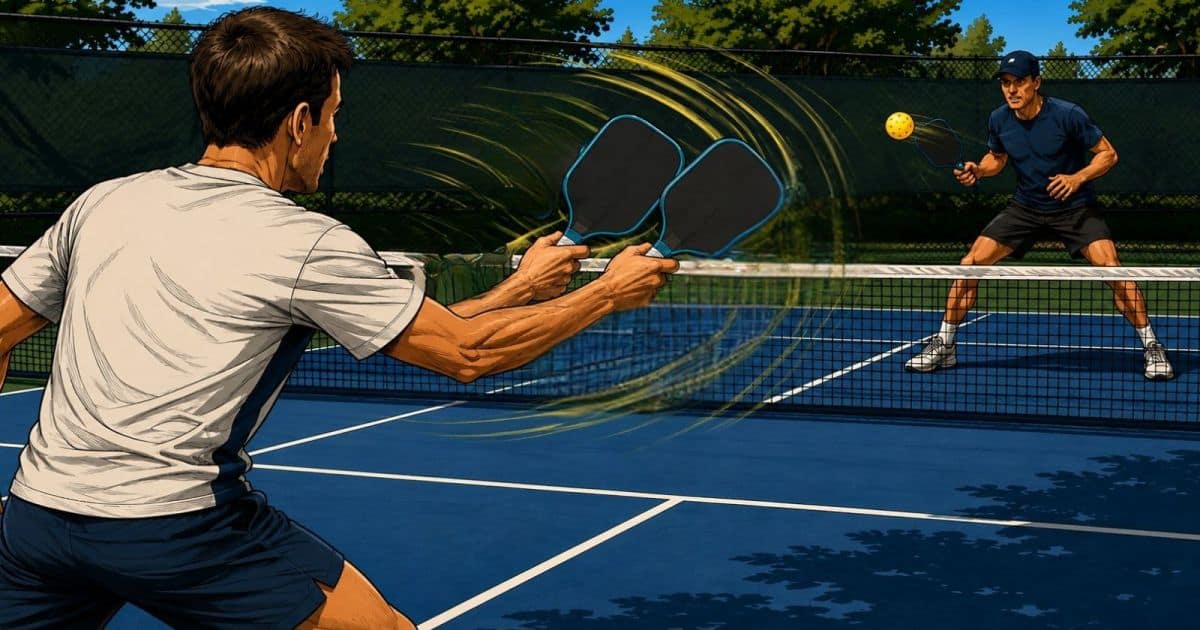
- Partner speed-up exchanges: cooperative dink rallies where either player may attack at will; defend the attack, then reset to dinks. The closest drill to the real event.
- Rapid-fire feeding: a partner feeds hard balls at your body and both wings at random, faster than comfortable, for 20 to 30 second bouts.
- Reset-under-fire: partner attacks, you soften everything back to the kitchen. Trains the most valuable fast-hands skill, which is taking pace off, not adding it.
- Two-touch wall games: alternate forehand and backhand touches on the wall to force grip and face changes at speed.
- Ball-drop catches: partner drops a ball from shoulder height; you catch it after one bounce from increasing distance. Crude, portable, honest.
The dose logic mirrors all speed work: fresh, brief, and sharp, with sessions ending when touches get sloppy. Ten minutes against a wall three times a week outperforms an hour of it on Saturday, and the same freshness rule governs the footwork half of quickness, covered in our guides to pickleball footwork and agility training, because hands are only as fast as the feet that deliver them square to the ball.
How much of “fast hands” is really posture and position?
More than half, at recreational level, and it is the half you can fix this week.
The ready position audit: paddle up at chest height, slightly backhand-biased since most attacks target the backhand shoulder, elbows off the ribs, weight on the balls of the feet, and a micro split step between every exchange. Installing just that posture tends to produce an immediate, unearned-feeling upgrade in exchanges, because their paddle starts each duel already 80 percent of the way to the block.
Distance management is the other posture secret. Standing an inch behind the kitchen line instead of crowding it adds a sliver of flight time to every attack, and against faster opponents that sliver is the rally. Conversely, understanding when attacks come, off high dinks, off bouncing balls at the opponent’s midline, lets you pre-load. The anatomy of the attack itself, and what makes a ball attackable, is the subject of our guide to the speed-up in pickleball, which is reaction training’s required reading: you cannot read a pattern you have never studied.
There is also an unglamorous defensive rule inside this topic: the fastest correct response to many chest-high attacks is not a counterattack but a block or a duck, and knowing your job in advance is itself a reaction-time upgrade.
Does age have to slow your hands down?
Raw reflex declines gradually; net-game quickness does not have to, because the compensations are larger than the loss.
Anticipation compensates for raw speed, which is why players in their sixties and seventies win hands battles against faster-twitch opponents through earlier reads, better paddle position, and deeper pattern libraries. The trainable layers keep improving while the untrainable one erodes slowly, and the sum can rise for a very long time.
The practical senior adjustments: bias further toward reading and readiness drills over pure rapid-fire, defend a step off the line to buy flight time, and lean on the reset as the signature response, since soft hands age far better than counterspeed. Eye habits help too, watching the opponent’s paddle face rather than the ball during their swing is where the early information lives.
A wall is the honest scoreboard here. Ten-minute sessions a few mornings a week, sustained across a winter, move the distance you can hold a wall volley from, and opponents stop targeting the shoulder they used to. Nothing about raw reflexes changes. Preparation does.
FAQ
How do I improve my reaction time for pickleball? Train reads, readiness, and patterns: study the speed-up, hold a chest-high ready paddle, and drill wall volleys and partner speed exchanges in short, fresh doses.
Can reaction time really be trained? The sport-specific parts, recognition, paddle position, automatic responses, improve substantially at any age. Raw reflex changes little, and matters less than assumed.
What is the best solo drill for fast hands? Wall volleys from 8 to 10 feet, stepping closer as control improves. Short daily sessions beat long occasional ones.
Where should my paddle be between shots? Up in front of the chest, slightly backhand-biased, elbows off the body. Paddle height is the cheapest hand-speed upgrade in the sport.
Why do I lose fast exchanges even though I see the ball fine? Usually deciding mid-exchange instead of owning automatic responses, or starting with the paddle low. Drill one standard reply per situation until it fires unprompted.
Should I stand right on the kitchen line? Crowding it maximizes offense but minimizes your time to react. Many players defend better a half step back, especially against harder hitters.
Do reflex balls and light gadgets help? Mildly, as general hand-eye work. The ball, wall, and a willing partner remain the highest-transfer tools.
Does age ruin fast hands? No. Reads, readiness, and resets compensate for gradual reflex decline, which is why experienced seniors keep winning hands battles.
Want a live partner for the fast stuff? The drilling groups at the clubs in our directory are where speed games happen nightly, and the coaches in our listings run the feeding drills no wall can replicate.
Written by the Pickler Junction Team.
*This article is general information, not medical advice. Talk with your doctor about your own health before starting a new sport.