Pickleball Serving Rules: Every Rule That Governs the Serve
Quick Answer: Under the 2026 USA Pickleball rulebook, a legal serve is hit from behind the baseline with a foot down, clears the non-volley zone, and lands in the diagonal service court. A volley serve needs a clear upward arc, contact below the waist, and paddle head below the wrist. A drop serve skips those limits. There is no second serve.
The 2026 USA Pickleball rulebook, in effect since January 1, 2026, moved serving into Section 7 from the old Section 4, with related rules in Sections 3, 4, 5, 6, 8, 10, 13, 14, 17, and 25. This hub takes them in rally order.
Where must the server stand under the 2026 rulebook?
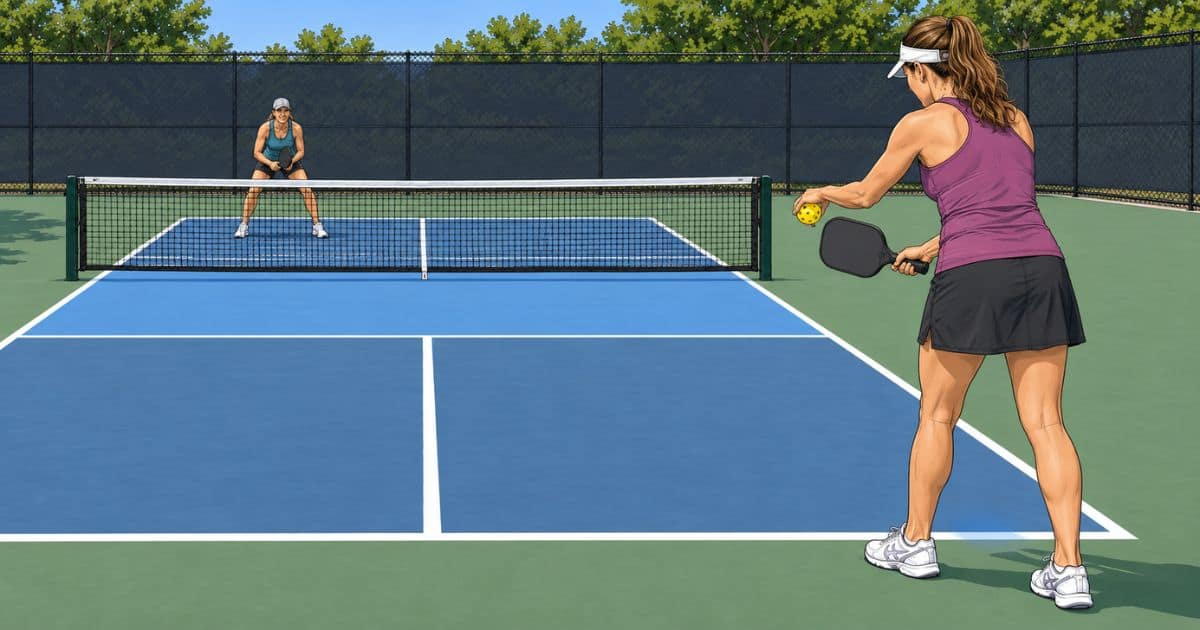
Rule 7.A.1 of the 2026 rulebook requires at least one of the server’s feet to be touching the correct serving area when the serve is hit, and Rule 3.A.4.g of the 2026 rulebook defines that area as the space behind the baseline, bounded by and including the imaginary extensions of the sideline and centerline. Three foot faults follow:
- Both feet off the playing surface at contact, as in a jump serve, under Rule 7.A.1.a of the 2026 rulebook.
- A foot touching the court at contact under Rule 7.A.2 of the 2026 rulebook, which includes the baseline itself, since the 2026 rulebook defines the court as the area inside the outer edges of the lines.
- A foot beyond the imaginary sideline or centerline extension under Rule 7.A.3 of the 2026 rulebook.
What makes a volley serve legal in 2026?
A volley serve is hit before the released ball bounces. Rules 7.C.1 through 7.C.3 of the 2026 rulebook require the paddle to move in a clear upward arc at contact, the paddle head to be clearly no higher than the wrist joint, and the ball to be clearly no higher than the waist. The 2026 edition added the word “clearly” to each test, so borderline serves are now ruled faults. Missing any one is a fault under Rule 7.C.5 of the 2026 rulebook, while Rule 7.C.4 of the 2026 rulebook permits a forehand or backhand motion.
The release is regulated too. Rule 7.B.1 of the 2026 rulebook requires a release with one hand only or the paddle only, Rule 7.B.2 of the 2026 rulebook bans adding spin with any body part or the paddle before the hit, and Rule 7.B.3 of the 2026 rulebook requires the release to be visible to the receiver. The 2026 change document clarifies that spin applied by the paddle at contact is legal.
How does the drop serve differ?
The question of whether the drop serve is legal in pickleball has a short answer under the 2026 rulebook: yes, with two conditions. Rule 7.D.1 of the 2026 rulebook requires a release from a natural, unaided height, and Rule 7.D.2 of the 2026 rulebook forbids propelling the ball before the hit. Rules 7.D.3 and 7.D.4 of the 2026 rulebook set no limit on how many times or where the ball bounces. Because Rule 7.D.6 of the 2026 rulebook lists only those two conditions as drop serve faults, the arc, wrist, and waist tests do not apply once the ball has bounced.
Where must the serve land?
Rule 7.E of the 2026 rulebook requires the serve to travel diagonally, clear the opponent’s non-volley zone with or without touching the net, and land in the correct service court. Under the 2026 rulebook it is a fault against the server when the ball lands outside that court (7.E.1), lands in the non-volley zone (7.E.2), hits a permanent object (7.E.3), or hits the server or partner (7.E.4), and a fault against the receiving side when it hits the receiver or partner before landing (7.E.5).
Rule 3.A.4.c of the 2026 rulebook makes the lines bounding the non-volley zone part of the zone, so Rule 8.C of the 2026 rulebook calls a serve on the kitchen line out, while Rule 8.B of the 2026 rulebook confirms a serve on the baseline, sideline, or centerline of the correct court is in.
Rule 10.A of the 2026 rulebook then requires the serve and the return of serve to each bounce before being hit, which the explanation of the two-bounce rule in pickleball covers in full.
Who serves first in doubles, and why does the game start at 0-0-2?
Rule 17.C.4 of the 2026 rulebook settles who serves first with a fair method such as a coin toss.
Rule 5.B of the 2026 rulebook states that both players on a team serve before a side out, except at the start of each game, when only the starting server serves, and does so as second server. That is why Rule 6.B.2 of the 2026 rulebook has the opening score called as zero, zero, two: serving team score, receiving team score, then server number. When that server loses a rally, the side out comes at once.
After each side out, Rule 5.B.2 of the 2026 rulebook makes the player on the right side according to the team’s score the first server and the partner the second server. Rules 5.B.5 and 5.B.6 of the 2026 rulebook have each server alternate between the right and left serving areas after every point won, until the second server loses a rally and the side out is declared. Because Rule 5.B.3 of the 2026 rulebook ties position to the team score, partners switch sides only when their team wins a point, as the breakdown of how pickleball scoring works shows.
Rule 6.C of the 2026 rulebook requires the full score to be called before the serve, and Rules 6.D and 6.D.1 of the 2026 rulebook make serving more than 10 seconds after the call a fault.
How do singles serving rules work?
Singles has no second server, so the score call drops to two numbers. Under Rule 5.A.1 of the 2026 rulebook, the server serves from the right serving area when the server’s own score is zero or even and from the left when it is odd, into the diagonally opposite court. Rule 5.A.2 of the 2026 rulebook has the player keep serving, alternating sides after each point won, until losing a rally.
What happened to the let serve, the spin serve, and the chainsaw?
The let serve no longer exists. Pickleheads records that USA Pickleball removed the let in January 2021, and Rule 13.A of the 2026 rulebook keeps a ball that contacts the net, rope, or cable between the posts in play. A serve that clips the net and lands in the correct service court is live; one that drops in the kitchen is a fault under Rule 7.E.2 of the 2026 rulebook. The guide to what a let in pickleball was covers the old rule.
The pre-spun serve is gone too. Pickleheads documents that the two-handed chainsaw serve, popularized by Zane Navratil, was prohibited at the end of 2021, and that the one-handed pre-spin serve was banned effective January 1, 2023. Rule 7.B.2 of the 2026 rulebook carries that ban forward. See what a chainsaw serve is for that history, and the roundup of weird pickleball rules for more surprises, including the net-cord serve that stays live.
What does a service fault cost?
The serve. Rule 4.A of the 2026 rulebook awards a point only for serving and winning the rally, so a first-server fault hands the ball to the partner and a second-server fault produces a side out, unless the game uses the provisional rally scoring option in Rule 14.A of the 2026 rulebook. Section 25 of the 2026 rulebook, new this year, covers wheelchair and adaptive standing play with its own bounce and positioning rules, explained in the guide to para pickleball.
Frequently asked questions
Can you serve overhand in pickleball? Not as a volley serve. Rule 7.C.3 of the 2026 rulebook requires contact clearly no higher than the waist, and Rule 7.C.1 of the 2026 rulebook requires a clear upward arc.
Do you get a second serve in pickleball? No. Under the 2026 rulebook a service fault by the server ends that service attempt at once, so the serve passes to the partner or the other team with no second try.
Is a serve that lands on the kitchen line good? No. Rule 3.A.4.c of the 2026 rulebook makes the non-volley zone lines part of the zone, and Rule 8.C of the 2026 rulebook calls that serve out.
Can the serve touch the net? Yes. Rule 13.A of the 2026 rulebook keeps a ball that contacts the net in play if it lands in the correct court.
Who serves first in pickleball doubles? The side that wins the coin toss under Rule 17.C.4 of the 2026 rulebook chooses, and its right-side player opens the game as second server at zero, zero, two under Rule 6.B.2 of the 2026 rulebook.
When do doubles partners switch sides? Only after their team wins a point while serving, since Rules 5.B.5 and 5.B.6 of the 2026 rulebook have the server alternate serving areas after each point.
Can you put spin on a pickleball serve? Yes, with the paddle. The 2026 change document allows spin at paddle contact, while Rule 7.B.2 of the 2026 rulebook bans adding spin during the release.
Can you serve backhand in pickleball? Yes. Rules 7.C.4 and 7.D.5 of the 2026 rulebook allow a forehand or backhand motion for both serve types.
Knowing the rules is the fast part; a repeatable legal serve takes reps. The walkthrough of the pickleball serve for beginners covers the mechanics, and the directory of pickleball coaches lists instructors by city who can spot a rising paddle head a player cannot feel.
Written by the Pickler Junction Team.