Is the Drop Serve Legal in Pickleball?
Quick Answer: Yes, the drop serve is fully legal in pickleball. Introduced provisionally in 2020 and made permanent in the 2022 USA Pickleball rulebook, it remains legal in 2026 with no new restrictions. You drop the ball, let it bounce, and hit it any way you like, free of the volley serve’s motion requirements.
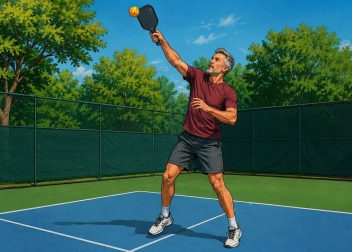
The drop serve is a serve in which you release the ball, let it bounce on the court, and then strike it. That single bounce changes everything, because none of the strict swing requirements that govern the traditional serve apply once the ball has bounced.
Why Does the Drop Serve Have Fewer Rules?
The volley serve, where you hit the ball out of the air, carries three mechanical requirements under the 2026 rulebook, each now sharpened with the word clearly: contact clearly below the waist, paddle head clearly below the wrist, and an arm clearly swinging in an upward arc. Those rules exist to keep serves underhand and returnable. A ball that has bounced from a natural drop can only rise so high, usually around knee to thigh height, so the bounce itself does the regulating. That’s why the rulebook drops all three swing requirements for the drop serve. You can slice it, chop it, hit it sidearm, or swat it with a high-to-low motion. All legal.
What Are the Actual Drop Serve Rules?
The rules govern the drop, and only the drop. Under the 2026 rulebook’s serving section:
- Release the ball from your hand or paddle face at any height you can naturally reach. Jumping or using the paddle to boost your release point is out.
- The ball must fall under gravity alone. No downward throw, no toss, no added force in any direction.
- The ball may bounce anywhere and as many times as it wants before you hit it, on the court, behind the baseline, wherever.
- Standard foot rules still apply at contact: at least one foot behind the baseline, nothing touching the court inside it, feet within the serving area’s imaginary extensions.
- The release must be visible to the receiver, same as any serve.
That second rule is the one that gets called. Pushing the ball downward to get a higher bounce is a fault. Let it fall, period.
Drop Serve vs Volley Serve: Which Should You Use?
Use the drop serve if your volley serve mechanics ever get questioned, if you’re newer to the game, or if you struggle with serve consistency. It’s nearly impossible to serve illegally with a legitimate drop, which is exactly why coaches hand it to beginners and why players with borderline motions adopted it after the 2026 language change gave referees authority to fault anything that isn’t clearly legal.
Use the volley serve if you want maximum power and depth. Hitting out of the air at waist height simply generates more pace than hitting a ball that bounced up to your knee. Most competitive players stay with the volley serve for that reason. I switched to a drop serve for a season while rebuilding my toss and my double faults basically vanished, then I moved back once the volley motion was clean. There’s no rule against switching between the two mid-game, or even mid-service turn.
Did the 2026 Rules Change the Drop Serve?
No mechanical changes at all. The 2026 USA Pickleball rulebook reorganized the serving rules into Section 7 and cleaned up language throughout, which sparked plenty of rumors, but the drop serve emerged untouched. It’s still fully legal, still governed only by the release rules, and still the simplest legal serve in the sport. The stricter clearly standard applies to volley serve mechanics, which if anything makes the drop serve more attractive for anyone whose serve draws side-eye at sanctioned tournaments.
One strategic note: a drop serve is harder to hit deep, and short serves invite aggressive returns. If you adopt it, drill depth deliberately. A perfectly consistent golden-pickle-chasing service game still starts with a serve your opponent has to respect. Coaches at local camps and clinics can tune either motion in a single session.
FAQ
Can the ball bounce twice on a drop serve?
Yes. The rulebook places no limit on bounces before you strike the ball. Practically, one bounce is all you’ll use, since the ball loses height fast.
Can you slice or put backspin on a drop serve?
Yes. Because the swing requirements don’t apply, any paddle motion is legal at contact, including chops and slices that would be faults on a volley serve. Spin from your paddle is legal on any serve. Spinning the ball with your hand before release is illegal on every serve.
How high can you hold the ball before dropping it?
As high as you can naturally reach with hand or paddle. You may raise your arm fully. You may not jump to increase release height or propel the ball downward.
Does the drop have to happen behind the baseline?
The ball can bounce anywhere, including inside the court. Your feet are what matter: standard serving foot rules apply at the moment you strike the ball.
Is the drop serve legal in tournaments?
Yes, in all USA Pickleball sanctioned play, recreational leagues, and every major format. It has been a permanent rule since 2022.
Why do pros rarely use the drop serve?
Power and depth. Striking out of the air at waist height produces a faster, deeper serve than hitting a bounced ball at knee height. Pros accept the tighter rules for the bigger weapon.
Can you switch between drop serve and volley serve during a game?
Yes. Nothing requires you to declare or stick with one style. Many players use the drop serve as a reliable second gear on pressure points.
Written by the Pickler Junction Team.