Pickleball Serve for Beginners
Quick Answer: A legal pickleball serve is hit underhand, with the ball no higher than your waist at contact, from behind the baseline, and it must land in the diagonally opposite service court past the non-volley zone line. Beginners should prioritize depth and consistency over pace. The USA Pickleball rulebook allows two serve styles, the volley serve and the drop serve.
The serve starts every pickleball point. It is hit underhand from behind the baseline, and it is the one shot in the game a player controls completely before the rally starts.
The rules that make a serve legal
Under the 2026 USA Pickleball rulebook, four things make a serve legal, and missing one is a fault.
- The ball stays no higher than your waist at contact, under Rule 7.C.3.
- The paddle moves in a clear upward arc at contact, under Rule 7.C.1.
- The paddle head stays below your wrist at contact, under Rule 7.C.2.
- A foot stays in the serving area, and neither foot touches the court until after contact, under Rule 7.A.
The ball must also clear the non-volley zone and land in the service court diagonally opposite you, under Rule 7.E. Landing on the zone line is out; landing on the baseline or sideline of the correct box is in.
You get one serve. There is no second serve in pickleball, which is why consistency matters more here than power.
The two legal types of serve
The rulebook permits two serve styles, the volley serve and the drop serve, and both are equally legal.
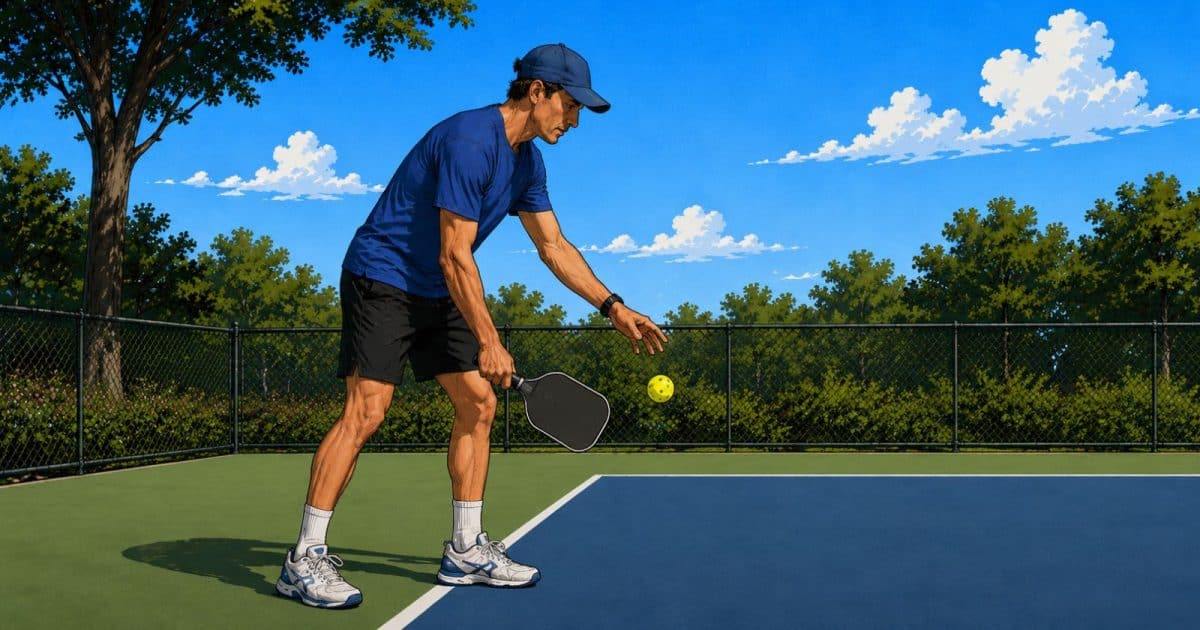
The volley serve is the traditional one, covered under Rule 7.C. Drop the ball from your hand, or hold it and strike it out of the air, and hit it before it bounces. You may not toss it upward and hit it overhead, and you may not add spin during release beyond letting the ball roll off the paddle face.
The drop serve, covered under Rule 7.D, lets you drop the ball, let it bounce, and hit it after. Release it from a natural height without pushing it down. Once it bounces, there is no waist-height rule and no upward-motion requirement, which is why many beginners find it easier.
Players who struggle with contact height should start with the drop serve. It removes two of the four ways to fault. A separate guide covers whether the drop serve is legal.
How to hit a good beginner serve
- Stand behind the baseline, feet roughly shoulder width, front foot pointed at your target.
- Hold the ball out in front of you, away from your body, so the drop is clean.
- Drop it. Do not toss it up. A toss invites the tennis motion that causes waist-height faults.
- Swing from low to high, contacting the ball in front of you and below your waist.
- Aim for the deep middle of the service box, not the corners.
- Follow through toward your target instead of stopping at the ball.
Deep middle is the smart target for a beginner. It gives the biggest margin for error, pushes the returner back, and takes away the sharp angle they could hit off a short serve. A paddle that suits your grip also makes a repeatable motion easier to groove; a guide on what pickleball equipment beginners need covers the basics.
What to work on first
Getting it in. That sounds obvious, and it is still where new players lose the most points. A serve that always lands in beats one that is fast twice and out three times.
Once the serve is landing reliably, work on these in order:
- Depth. Aim to land the ball in the back third of the service box.
- Consistency of motion. The same drop, the same swing, every time.
- Placement. Learn to move the ball between the middle and the outside corner.
- Pace and spin. Last, and only after the first three are solid.
Many players skip straight to pace and spin and wonder why their serve percentage collapses. A guide on improving your pickleball serve is worth reading once the basics are steady, and how to spin a pickleball serve covers what the rules allow.
The most common beginner serve mistakes
- Tossing the ball up. Natural from tennis, but a fault on the volley serve.
- Contacting too high. If the ball feels comfortable to hit, it is often above your waist.
- Stepping on the baseline early. Easy to do when you swing hard. Give yourself a foot of room.
- Serving to the wrong box. Always diagonal. Your score determines the side.
- Aiming for the corners. The margin is tiny and the reward is small at this level.
- Swinging as hard as possible. Pace you cannot control is a gift to the other team.
A structured lesson tends to fix most of these fast. A piece on what to expect at a pickleball clinic for beginners covers how a first session usually runs.
Calling the score before you serve
Yes, and beginners forget constantly. Under the 2026 rulebook, the score must be called before the serve, and the server has 10 seconds to serve after the call, under Rules 6.C and 6.D. In doubles you call three numbers, under Rule 6.B.2: your team’s score, the other team’s score, and whether you are the first or second server. Nine, four, two means your team has nine, the other team has four, and you are the second server. In singles you call two numbers, your score and the receiver’s score, under Rule 6.B.1.
Which side you serve from also follows the score. Under the rulebook’s Rule 5.A.1, even scores serve from the right side and odd scores serve from the left, the same logic doubles teams use.
Calling it clearly and loudly is also the simplest thing you can do to look like you belong on the court. A guide to how pickleball scoring works walks through the whole system.
FAQ
Can you serve overhand in pickleball? No. Under the rulebook’s Rule 7.C, the paddle must move in a clear upward arc, the paddle head must stay below your wrist, and the ball must stay below your waist at contact. An overhand serve is a fault regardless of where it lands.
How many serves do you get in pickleball? One. There is no second serve. A fault on the serve loses the rally, which is why consistency matters more than power.
Where does the pickleball serve have to land? In the service court diagonally opposite you, past the non-volley zone line, under the rulebook’s Rule 7.E. Landing on the non-volley zone line is out. Landing on the baseline or sideline of the correct box is in.
Can the serve hit the net and still count? Yes. Under the rulebook, Rule 7.E allows a served ball to touch the net on the way over, and if it lands in the correct service court, play continues. There is no separate let serve to replay.
Which side do I serve from? Even score, right side. Odd score, left side, under the rulebook’s Rule 5.A.1. The same logic sets the serving side in doubles.
Is the drop serve easier for beginners? For many players, yes. Letting the ball bounce removes the waist-height and upward-motion faults, under Rule 7.D of the rulebook. It is fully legal, and some tournament players use it by choice.
How hard should a beginner hit the serve? Around seventy percent of full effort is a reasonable target. The goal is a deep, repeatable serve. Pace can come later, once the ball is landing in the same area every time.
Can I bounce the ball before serving? You can bounce it beside you while getting ready. That is not the serve itself. A drop serve requires you to release the ball and let it fall without pushing it downward, per Rule 7.D of the rulebook.
If you want the serve fixed properly in one session, Pickler Junction’s pickleball coaches directory lists coaches by city, and many offer a single-session tune-up built around exactly this shot.
Written by the Pickler Junction Team.