Games Similar to Pickleball
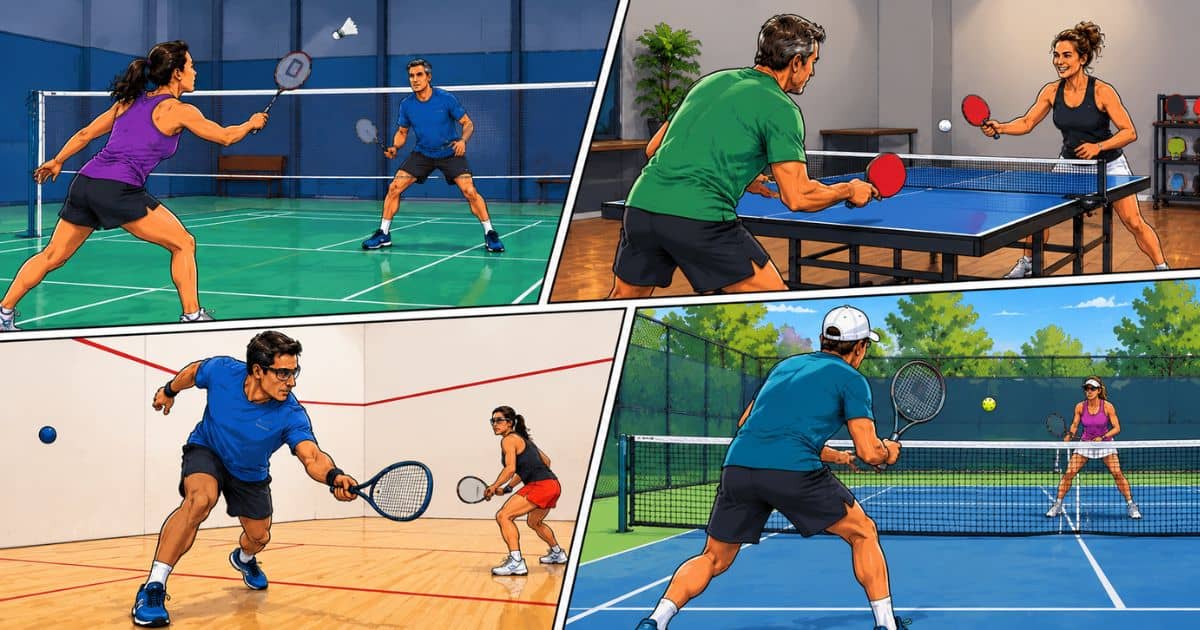
Quick Answer: The games closest to pickleball are padel, platform tennis, POP tennis, badminton, table tennis, racquetball, and squash. Pickleball was built from badminton, tennis, and table tennis in 1965. Padel and platform tennis share the paddle and the doubles feel, badminton shares the 20 by 44 foot court footprint, and racquetball and squash share the reflex rallies, though on enclosed courts.
According to USA Pickleball’s history page, the game started in 1965 on Bainbridge Island, Washington, when Joel Pritchard and Bill Bell set up on an old badminton court with ping-pong paddles and a perforated plastic ball, then lowered the net from 60 inches to 36 inches. That origin is why so many other racket sports feel familiar. This guide covers seven of them: court, gear, US findability, and who each suits. For a primer, start with what pickleball is and how it is played.
Pickleball is a combination of what?
Pickleball combines badminton, tennis, and table tennis. The court, 20 feet wide by 44 feet long, is the size of a doubles badminton court. The net, 36 inches at the sidelines and 34 inches at center, resembles tennis on a small scale. The solid paddle and quick net exchanges come from table tennis. USA Pickleball says Joan Pritchard named the game after the “pickle boat” crews of college rowing, not the family dog; the full story is in the guide to why it is called pickleball.
Is padel the closest game to pickleball?
Padel shares doubles play, an underhand serve, and a fast net game with pickleball, then diverges. Under the International Padel Federation’s 2026 rules, a padel court is 10 meters wide and 20 meters long, roughly 33 by 66 feet, enclosed by back walls with a minimum total height of 4 meters (a 3 meter wall topped by 1 meter of fencing). The ball can be played off those walls after it bounces. The net is 0.88 meters at center rising to 0.92 meters at the ends. Rackets are solid and perforated, capped at 45.5 centimeters long and 38 millimeters thick, and the ball looks like a tennis ball but is specified at a lower pressure.
The United States Padel Association reported, as of April 2026, just over 1,000 courts open across 31 states, and cited SFIA data showing 1,073,000 Americans played padel in 2025. Padel suits players who want longer rallies, more running, and wall play. Read the padel vs pickleball comparison, and for the venue side see how a padel court compares with a pickleball court.
What is platform tennis, and why does the court look familiar?
Platform tennis was developed in 1928 at Fox Meadow Tennis Club in Scarsdale, New York. Under American Platform Tennis Association rules as posted in 2026, the playing lines form a rectangle 44 feet long and 20 feet wide, identical to a pickleball court, on a raised 60 by 30 foot deck enclosed by 12 foot screens. The net stands 37 inches at the posts and 34 inches at center. Players hit a spongy rubber ball, about 2.5 inches in diameter, with a perforated paddle capped at 18 by 12 inches. A ball may be played off the screens after it bounces, and in doubles the server gets only one serve.
The deck has space underneath for heating, so platform tennis is played outdoors through the winter. The APTA reports 36,000 members, and courts sit mostly at private clubs, so access usually runs through a membership or an invitation. It suits players who like cold-weather doubles.
What is POP tennis?
POP tennis is the renamed version of paddle tennis, which Pop Tennis USA says has been played for more than 100 years. The official court is 50 feet by 20 feet, and after a 2015 USTA partnership the sport also uses 60 foot junior tennis courts. Adults use a green dot tennis ball with 25 percent less compression than a standard ball, players get one underhand serve, and paddles are solid, stringless, and capped at 18.5 inches long and 38 millimeters thick.
Pop Tennis USA names Venice, California, St. Augustine, Florida (site of the nationals), and New York City as the established hubs, with newer activity in Texas and the Carolinas. POP tennis suits former tennis players who want a smaller court without giving up topspin.
How does badminton compare with pickleball?
Badminton gave pickleball its court. A doubles badminton court measures 20 feet by 44 feet, the same footprint pickleball uses, but the net is far higher at 5 feet 1 inch at the posts and 5 feet at center. Players swing strung rackets at a shuttlecock that never bounces, so every rally is played in the air, with no two-bounce rule and no dink.
USA Badminton maintains a member club directory organized into six regions (Northeast, Midwest, Southern, Northwest, Southwest, and Pacific), and casual play shows up in school gyms and community centers. Badminton suits players who want heavy cardio and overhead shots. The full contrast is in the pickleball vs badminton guide.
Is table tennis good cross-training for pickleball?
Table tennis supplied pickleball’s original paddles. The official table is 9 feet long, 5 feet wide, and 30 inches (76 centimeters) high, with a 6 inch net. Small rubber-faced paddles and a lightweight plastic ball make spin and reaction time matter more than movement.
USA Table Tennis says it promotes the sport through more than 250 clubs and over 350 tournaments across the nation annually, and tables are common in recreation centers. Table tennis suits players who want to sharpen hand speed for hands battles at the net. For a direct comparison, see pickleball vs ping pong.
What about racquetball and squash?
Under USA Racquetball rules as posted in 2026, a racquetball court is 20 feet wide, 40 feet long, and 20 feet high, with a back wall at least 12 feet high. Players use a strung racquet no longer than 22 inches and a hollow rubber ball about 2.25 inches in diameter, and every wall, including the ceiling, is in play. A squash court, which US Squash builds to World Squash Federation specifications, is 32 feet long and 21 feet wide with a 19 inch “tin” along the bottom of the front wall that the ball must clear, and the ceiling is out of play.
Sports Destination Management reported in April 2024 that US Squash CEO Kevin Klipstein put the count at about 14,000 racquetball courts, down from a peak of more than 30,000, with many being repurposed. The same report put racquetball participation near 3.5 million from 2017 through 2023, down from 12 million in 1980. Racquetball courts still exist in many older health clubs and YMCAs, while squash stays concentrated in private athletic clubs and universities. Both suit players who want a singles workout. The racquetball vs pickleball comparison covers the differences in detail.
Is there another name for pickleball?
Rulebooks, governing bodies, and court signage use pickleball, and no alternative name appears in the 2026 USA Pickleball rulebook, including its Section 3 definitions. The game has been called pickleball since 1965, with the early two-word spelling “Pickle Ball” merging over time.
What do you call a pickleball player?
There is no single accepted term. “Pickleball player” is the standard phrase in rulebooks and media coverage. The word “pickler” circulates informally and appears in glossaries, defined as a pickleball player, often one obsessed with the sport.
FAQ
Which game is most similar to pickleball? Padel and platform tennis are the closest in feel, since both are doubles paddle sports with underhand serves and fast net exchanges. Platform tennis even uses the same 20 by 44 foot playing lines. Badminton shares the court footprint but plays entirely in the air.
Pickleball is a combination of what three sports? Badminton, tennis, and table tennis. The court is a doubles badminton court, the low net resembles a tennis net on a small scale, and the solid paddle and short exchanges come from table tennis.
Is padel the same as paddle tennis? No. Padel is a walled court sport played on a 10 by 20 meter court. Paddle tennis is the older American game now called POP tennis, played on a 50 by 20 foot court with no walls. Platform tennis is a third distinct sport played on a raised, screened deck.
Can a pickleball paddle be used for padel or platform tennis? Not in sanctioned play. Padel rackets are capped at 45.5 centimeters long and 38 millimeters thick under the 2026 FIP rules, and platform tennis paddles are capped at 18 by 12 inches under APTA rules as posted in 2026.
What do you call a pickleball player? “Pickleball player” is standard. “Pickler” is informal and appears in glossaries, defined as a pickleball player, often one obsessed with the sport. It has not replaced “pickleball player” as the standard phrase.
How many padel courts are in the United States? The United States Padel Association reported just over 1,000 courts across 31 states as of April 2026.
Is racquetball still easy to find? It is harder than it was. A 2024 Sports Destination Management report quoted US Squash CEO Kevin Klipstein estimating about 14,000 US racquetball courts, down from a peak of more than 30,000. Many older health clubs and YMCAs still have them.
Which of these sports is easiest for a pickleball player to pick up? Table tennis and POP tennis require the least new technique, since both use a solid paddle. Padel and platform tennis add wall or screen play. Badminton, racquetball, and squash use strung rackets and different swing patterns.
Pickleheads, USA Pickleball’s official court finder, lists 25,000+ places to play pickleball, against roughly 1,000 padel courts and about 14,000 racquetball courts cited above, both counted by court rather than by venue. Municipal drop-in commonly runs $2 to $6 and private indoor drop-in $10 to $20 as of September 2026, and the directory of public pickleball courts across the country lists open-play locations by city.
Written by the Pickler Junction Team.