How to Dink Crosscourt in Pickleball
Quick Answer: To dink crosscourt, contact the ball in front of your body with an open paddle face, push rather than swing, and aim for the opponent’s sideline kitchen corner. The crosscourt path is longer than a straight dink and crosses the net near its lowest point, 34 inches at center, which gives more margin for error.
What Is a Crosscourt Dink, Exactly?
A crosscourt dink is a soft, controlled shot hit diagonally across the net so it lands in the opponent’s kitchen on the far side of the court, rather than straight ahead. It is one of the two basic dink directions, the other being a straight, or down the line, dink. For the fundamentals of the shot itself, the guide to what a dink is in pickleball covers grip, contact, and the soft arc that keeps the ball out of an opponent’s strike zone. Crosscourt is not a different swing, just the same soft push redirected along a diagonal line.
Why Does a Crosscourt Angle Give You More Margin?
Two things make the crosscourt dink more forgiving than hitting straight ahead. The first is distance. Because the shot travels on the diagonal, it covers more court than a straight dink hit from the same spot, which gives the ball more time to settle into a low, controlled arc before it reaches the kitchen line.
The second is the net itself. The net sits 36 inches high at the sidelines and 34 inches high at the center, its lowest point (Section 3 of the 2026 USA Pickleball rulebook). A crosscourt dink hit from around the middle of the court crosses near that low center strap, so there is more room above the tape than a shot hit from closer to the sideline. That two-inch difference sounds small, but at dink speed it separates a ball that clears comfortably from one that clips the tape.
Pulling an opponent wide with a crosscourt dink also opens the middle of the court, which matters in doubles. The guide to pickleball doubles strategy covers how that gap sets up the next shot.
How Do You Set Up Contact for a Crosscourt Dink?
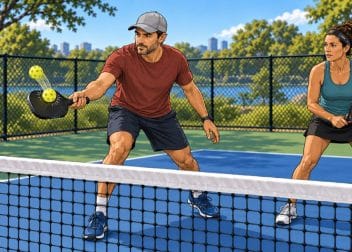
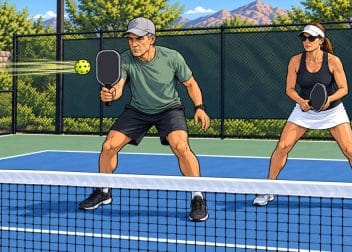
Contact happens in front of your body, not off to the side or behind your hip. Shift your weight so the ball meets the paddle roughly even with your front foot, with your arm extended but not locked.
Keep the paddle face open, tilted back slightly so it lifts the ball rather than driving it flat. The motion is a push, not a swing. There is little to no backswing. The paddle moves forward and slightly upward through the ball, guided mostly by the shoulder and a light wrist, and stops soon after contact instead of following through like a groundstroke.
To send the ball crosscourt instead of straight, turn your shoulders and paddle face toward the diagonal target before contact, rather than opening the wrist at the last instant. Setting the angle early, with the whole upper body, is far more repeatable than trying to steer the ball with the hand alone.
Where Should You Aim a Crosscourt Dink?
Aim for the corner where the opponent’s kitchen line meets the sideline, not the sideline itself. That corner gives you the longest diagonal path available, which is exactly what creates the extra net clearance described above.
Leave a buffer of a foot or more inside the sideline. A crosscourt dink hit right at the line has no room for a mis-hit, and a ball that lands even slightly wide is an unforced error instead of a winner. The goal is a shot the opponent has to move for, not a line-painting attempt.
How High Should the Ball Bounce on a Crosscourt Dink?
A crosscourt dink should bounce low enough that the opponent cannot get the paddle above the ball and attack it. A bounce around knee height or lower gives an opponent little to drive; a dink that pops up to waist height or higher is an invitation to be put away.
Height gets set at contact, not after. A paddle face that is too open, or too much upward push, sends the ball high and sets up an easy attack. The guide to keeping the ball low in pickleball breaks down the contact adjustments that keep a dink, crosscourt or straight, from sitting up.
How Do You Keep Your Footwork Square During Crosscourt Dinks?
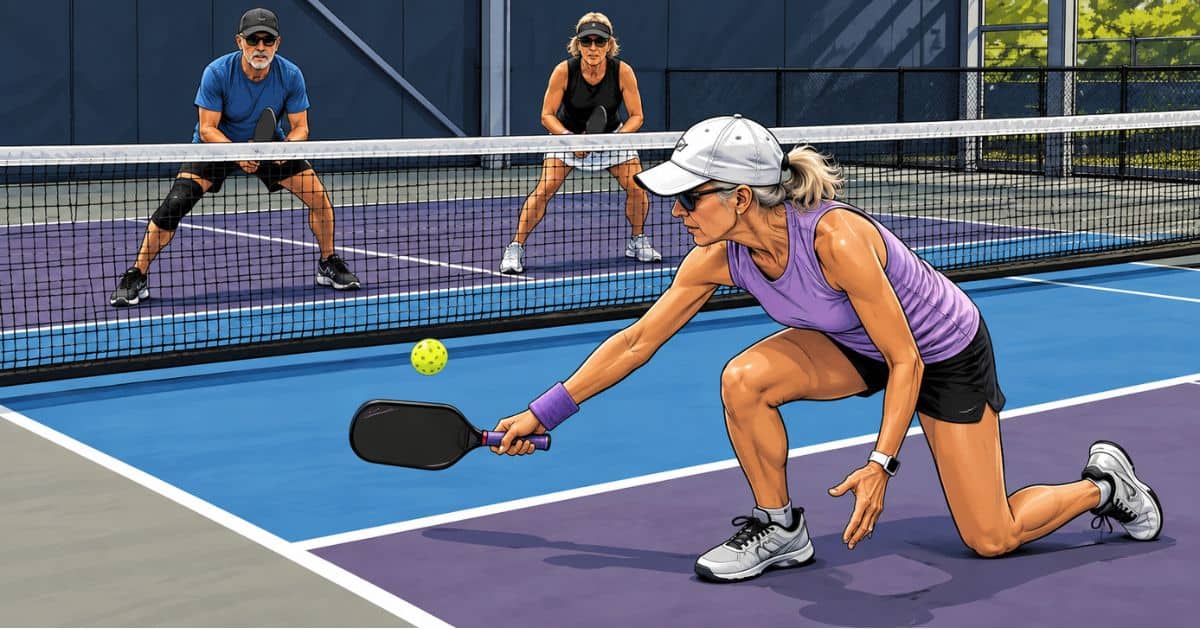
Staying square means your shoulders and hips stay lined up with the direction of your shot instead of twisting your torso to force an angle. Small adjustment steps, rather than one big lunge, keep your base stable enough to control the paddle face precisely.
Between shots, return to a ready position with your paddle up and your weight forward on the balls of your feet. That balance is what lets you shift a step in either direction to line up the next crosscourt dink without lunging or reaching.
Staying square also means respecting the kitchen line. The rules governing the non-volley zone do not relax during a dink rally, and reaching forward for an angle is a common way a foot ends up over the line.
What Is the ATP Risk on a Wide Crosscourt Dink?
The wider a crosscourt dink drifts toward the sideline, the closer it gets to the net post, and that carries its own risk. A ball that lands too close to the sideline gives an opponent room to step around the outside of the post and hit it back into open court.
The guide to what an ATP is in pickleball explains that shot in full, but the practical takeaway here is simple: chasing the absolute sideline on every crosscourt dink trades a small amount of extra margin for a real chance to hand an opponent a wide-open swing around the post.
When Should You Switch to a Straight Dink?
A crosscourt dink loses value once an opponent adjusts to cover it. If a player starts shading toward that diagonal before contact, a straight dink back down the line can catch the space they just left open.
It is also worth switching when a crosscourt dink starts sitting up instead of staying low. Many players fall into a rhythm of always going crosscourt because it is the safer shot geometrically, and an opponent who notices that pattern starts anticipating it. Mixing in a straight dink, or moving into aggressive dinking once a ball sits above the net, keeps the exchange from becoming predictable.
Finding a Coach for This Shot
A crosscourt dink looks simple from the sideline and is hard to groove alone, since small errors in paddle angle or contact point are difficult to see without another set of eyes. A coach who watches your paddle face and footwork up close can usually spot the habit costing you control faster than solo practice will. The directory of pickleball coaches is a place to find one who teaches dinking and net play in your area.
Frequently Asked Questions
What is the difference between a crosscourt dink and a straight dink? A straight dink travels directly across the net to the same side it was hit from, while a crosscourt dink travels diagonally to the opposite side. The crosscourt version covers more court and crosses near the lowest point of the net, which is why many players lean on it as a default shot.
Why is the net lower in the middle of the court? The net measures 34 inches at the center and 36 inches at the sidelines (Section 3). The design gives players slightly more clearance for shots that cross near the middle, including most crosscourt dinks.
Do I need to bend my knees for a crosscourt dink? Yes. Bent knees keep the paddle at a stable height and allow small adjustment steps without lunging, both of which matter for controlling contact on a soft shot.
Can a crosscourt dink go out of bounds? Yes, if it is aimed too close to the sideline or hit with too much pace. Leaving a foot or more of margin inside the line keeps an aggressive angle from turning into an unforced error.
Is crosscourt dinking harder in doubles than singles? The mechanics stay the same in both. Doubles adds a partner to account for, since a crosscourt dink that pulls one opponent wide can open the middle seam between two players and change what the next shot should be.
What grip works best for dinking crosscourt? A continental grip, the same one used for most shots at the net, lets the paddle face open and close without a full grip change, which matters when shifting the angle from crosscourt to straight mid-rally.
How do you stop a crosscourt dink from popping up? Keep the paddle face only slightly open and let the push, not the wrist, generate the ball’s height. A wrist that flicks upward at contact is one of the more common causes of a dink that sits up.
Should beginners practice crosscourt dinking before straight dinking? Either order works, though many coaches introduce the straight dink first since it removes the angle judgment and lets a new player focus on paddle face and contact alone before adding direction.
Written by the Pickler Junction Team.