Padel vs Pickleball: What Is the Difference?
Quick Answer: Padel is a doubles sport on an enclosed court where glass walls stay in play after the bounce, using a tennis-style ball and a perforated paddle. Pickleball is played on an open court with a plastic ball, a solid paddle, and a seven-foot non-volley zone called the kitchen. The court, ball, and scoring differ at every level.
Padel and pickleball share a solid paddle and an underhand serve, which is why people mix them up. Past that, they diverge: padel is a walled doubles game built around long rallies, and pickleball is an open-court game built around quick hands at the net.
What Is the Biggest Difference Between Padel and Pickleball?
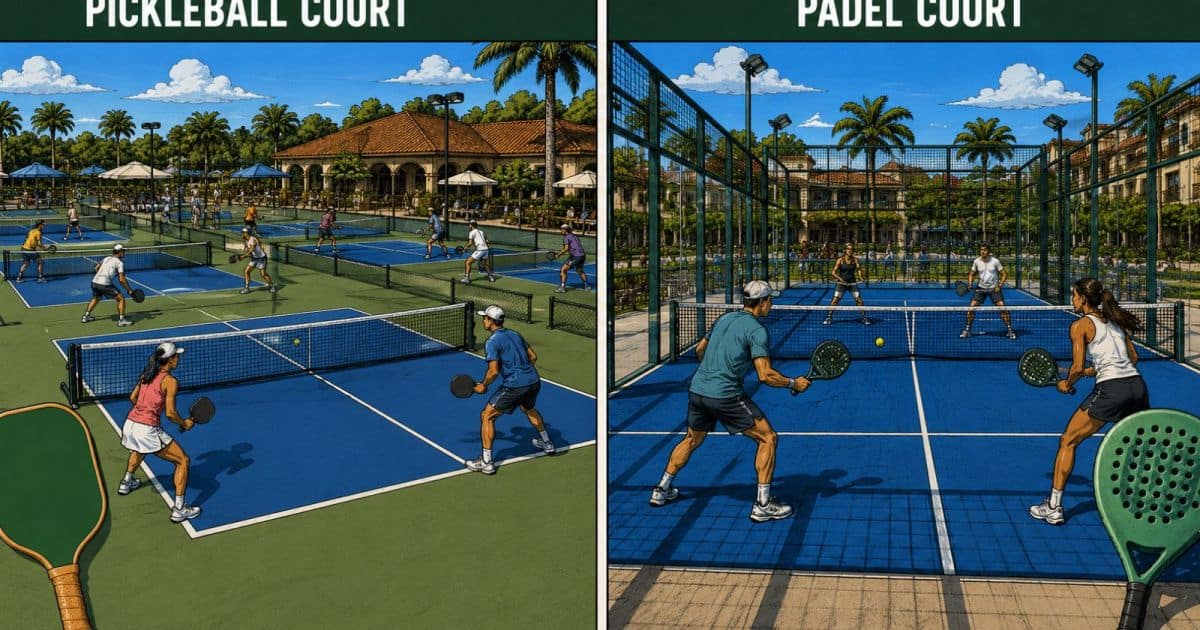
The walls matter most, because they change what a player is trying to do on every point. In padel, the glass and metal fencing around the court are a surface to attack, defend, and plan around. A ball that gets past a player is often still playable off the rebound.
In pickleball, a ball that gets past a player is gone the moment it lands out of bounds. Pickleball rewards placement and quick hands close to the net. Padel rewards moving an opponent out of position over a longer point, then finishing once the court opens up.
How Do the Walls Change the Way Padel Is Actually Played?
Four habits set padel apart, and none has a real equivalent in pickleball.
- The lob is an attacking shot. Whoever holds the net has the advantage, so a lob pushes the other team back. In pickleball, a lob from the kitchen is usually a mistake.
- A flat smash backfires. A hard overhead bounces off the back glass and returns with the pace it was hit, so padel players use the bandeja instead, a controlled slice overhead that keeps the hitter at the net.
- Playing the back wall is a core skill. A deep ball is often left to bounce off the glass before it gets played.
- Points run long. The walls give both teams a second chance on balls that would be clean winners in pickleball.
What Does a Pickleball Point Actually Look Like?
Mostly the opposite. A pickleball point is a race to the net, then a soft exchange until someone sends a ball above net height.
The third shot is often a drop, a soft arcing ball into the kitchen that lets the serving team move up and join the returners at the line. From there, all four players dink, hitting soft balls into the non-volley zone and waiting for one to sit up. When it does, someone speeds it up and a two-second hands battle decides the point.
That soft game is most of what good pickleball actually is. The beginner pickleball drills guide covers the drops and dinks that make it work.
How Big Is Each Court?
A padel court measures 10 meters by 20 meters, about 33 by 66 feet, enclosed by tempered glass and metal mesh, according to FIP rules of padel, in force as of January 2026. A pickleball court measures 20 feet by 44 feet with no walls, under the 2026 USA Pickleball rulebook, Section 3, and USA Pickleball recommends a total footprint of 30 by 60 feet with run-off space included.
Net heights are close. Padel’s net sits 88 centimeters at the center and 92 at the ends, per FIP rules. Pickleball’s net is 34 inches at the center and 36 at the sidelines under the rulebook, Section 3.
See the padel court versus pickleball court comparison for what each one costs to build.
Padel vs Pickleball: The Specs Side by Side
The table below draws from the FIP rules of padel, in force as of January 2026, and the USA Pickleball rulebook.
| Feature | Padel | Pickleball |
|---|---|---|
| Court | 10m x 20m (33 x 66 ft), enclosed | 20 x 44 ft, open |
| Walls | Glass and metal, in play | None |
| Net height | 88cm center, 92cm ends | 34 in center, 36 in sides |
| Ball | Pressurized rubber, 6.35 to 6.77cm | Molded plastic, 26 to 40 holes |
| Paddle/racket | Perforated, up to 45.5cm, wrist cord | Unperforated, 24 in combined size |
| Format | Almost always doubles | Singles and doubles |
| Scoring | 15, 30, 40, deuce, best of 3 sets | Games to 11, win by 2 |
| Serve | Underhand, bounce first, 2 tries | Underhand or drop serve, 1 try |
| Signature rule | Walls stay in play | Two-bounce rule, 7-ft kitchen |
| Invented | 1969, Acapulco, Mexico | 1965, Bainbridge Island |
How Is the Scoring Different?
Padel uses standard tennis scoring, according to FIP rules. Points run 15, 30, 40, and deuce, games make sets, and a match is the best of three sets. Anyone who can keep score at tennis can keep score at padel on day one.
Pickleball is stranger. Under the USA Pickleball rulebook, only the serving side can score. Games go to 11, win by two. Win a rally while receiving, and the reward is the serve, not a point. That is side-out scoring.
Which One Is Harder to Learn?
Pickleball, on day one. The court is small, the plastic ball moves slowly, and a beginner can play real points inside an hour.
Padel takes longer, because of the walls. Every other racket sport trains a player to move to the ball and hit it in front of them. Padel asks for the opposite: let it pass, read it off the glass, then play the rebound.
Over time, the difficulty can flip. Pickleball’s soft game is hard to master. The pickleball skill levels guide breaks down what each rating requires.
Is It Padel, Paddle, or Paddle Tennis?
Three separate things, and the spellings cause real confusion.
- Padel, one d, is the glass-walled doubles sport described here.
- Paddle tennis is a separate American sport on a smaller open court with no walls, using a solid paddle and a depressurized tennis ball.
- Platform tennis, often shortened to paddle in the northeast, is played outdoors on a raised, heated court surrounded by wire screens.
If someone in the United States says paddle, the sport they mean depends on the region.
What Does It Cost to Play Each One?
Public pickleball courts are common and often free to use, and a starter paddle costs far less than padel gear. Padel almost always means booking court time at a private club, since a glass and steel enclosure is a real capital investment. See the padel racket versus pickleball paddle comparison, including how the two balls compare.
Which Sport Should You Try?
It depends on what already feels familiar.
- Tennis players: try padel. The scoring is identical and groundstrokes carry over.
- Pickleball players: padel will feel less familiar than expected, since the lob being an attacking shot inverts a well-built instinct.
- Neither sport: start with pickleball. Courts are common and gear is inexpensive.
- Want a longer workout: padel, since the court is bigger and points run longer.
- Want to play this week: pickleball. Padel courts are still scarce in most areas.
Frequently Asked Questions
Is padel the same as pickleball? No. Padel is a walled doubles sport with tennis scoring. Pickleball is an open-court sport with a plastic ball and a seven-foot non-volley zone under the USA Pickleball rulebook. The overlap is a solid paddle and an underhand serve.
Can you hit the ball off the walls in padel? Yes, after it bounces on the ground first, under FIP rules. A ball that hits the wall before bouncing is out.
Why do padel players lob so often? Whoever controls the net controls the point, and a lob is the most reliable way to push the other team back, under FIP rules. In pickleball, the same shot from the kitchen is usually a gift under the USA Pickleball rulebook.
Which came first, padel or pickleball? Pickleball, by four years. It was invented in 1965 on Bainbridge Island, Washington. Padel was invented in 1969 by Enrique Corcuera in Acapulco, Mexico.
Can you use a pickleball paddle to play padel? No. It is too thin and light to move a pressurized padel ball, and FIP rules require a perforated racket with a wrist cord.
How many people play pickleball in the United States? About 24.3 million Americans played pickleball in 2025, according to the Sports and Fitness Industry Association, as of September 2026 the most recent figure available.
A court settles the question faster than any comparison can. Pickler Junction’s directory of pickleball coaches can connect a new player with someone to learn from.
Written by the Pickler Junction Team.