Illegal Pickleball Serves: Every Serve Fault in the Rulebook
Quick Answer: Illegal pickleball serves fall under Section 7 of the 2026 rulebook: foot faults, an added-spin release, a volley serve above the waist or with the paddle head above the wrist, and a served ball landing out or in the non-volley zone. Wrong-court and wrong-server errors fall under Section 5, and the serve clock falls under Section 6.
Pickleball’s serve draws more disagreement than almost any other shot in the game, mostly because the rules that govern it live in two different sections of the 2026 rulebook rather than one. Section 7 handles the mechanics of the swing itself: where the feet go, how the ball leaves the hand, and what a legal contact point looks like. A separate section covers who is allowed to serve, from where, and what happens when that assignment gets mixed up. Working through both, fault by fault, resolves nearly every serve dispute that comes up on the court.
What Counts as an Illegal Serve in Pickleball?
Section 7 of the 2026 rulebook splits the serve into five lettered parts, and each one creates its own way to commit a fault. Rule 7.A governs the server’s feet, 7.B governs how the ball is released before contact, 7.C sets the mechanics of the standard volley serve, 7.D covers the drop serve, and 7.E covers what happens once the ball leaves the paddle. The full technique behind a legal toss, grip, and swing is covered in the guide to pickleball serving rules; this article works through each of those five parts as a fault checklist, plus two rules outside Section 7 that trip players up almost as often, wrong-court serves and the serve clock.
What Foot Fault and Release Rules Apply to a Pickleball Serve?
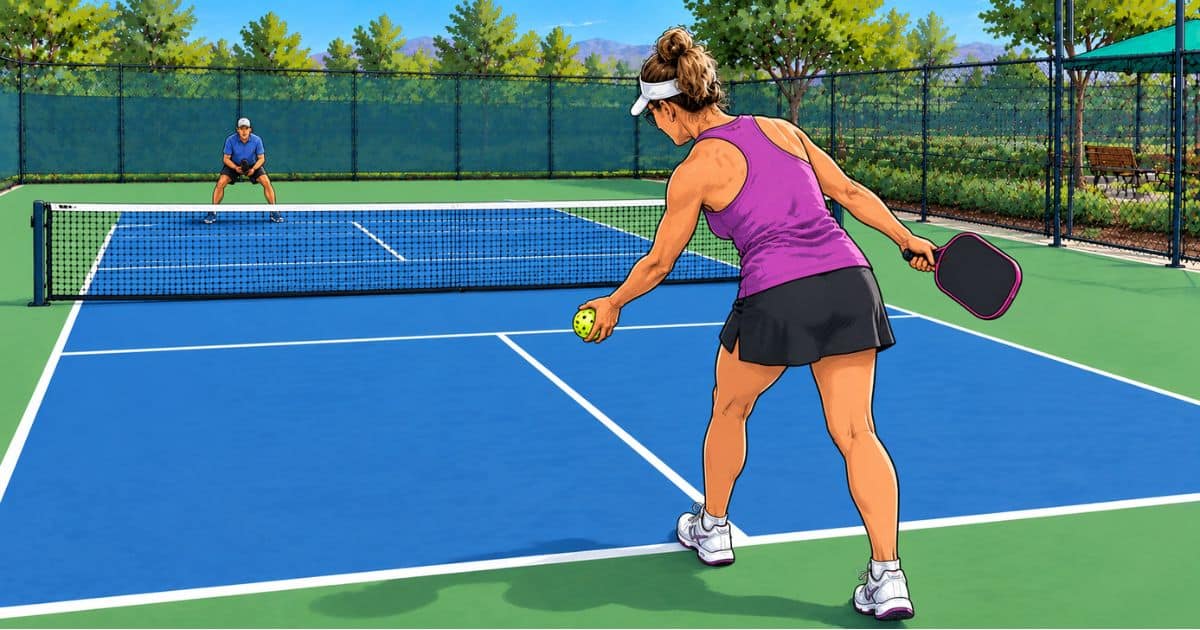
Rule 7.A of the 2026 rulebook covers the server’s feet at the exact instant the paddle contacts the ball, and it creates a fault three separate ways. At least one foot must be touching the correct serving area at contact, and a server who is fully airborne, both feet off the ground at once, faults the moment the paddle meets the ball. Neither foot can touch the court itself, which keeps the server behind the baseline, and neither foot can be planted outside the correct serving area, ruling out drifting wide of the sideline and centerline extensions. Rule 7.B governs the moment just before that swing starts. The ball must be released using only one hand or off the paddle face, which rules out a two-handed toss, and the server cannot manipulate the ball with the body or the paddle to add spin before hitting the serve, though the ball may roll off the paddle face under normal gravity. That pre-spin ban separates two techniques: spin added at contact, through paddle angle and swing path, is legal, while spin added during the release is not. That distinction shows up in the guide to how to spin a pickleball serve and the technique known as the chainsaw serve.
What Makes a Volley Serve Illegal?
Rule 7.C of the 2026 rulebook sets three requirements for a standard volley serve, and all three must be true at the same instant of contact. The paddle has to be moving in a clear upward arc when it strikes the ball, which rules out a level or downward swing. The highest point of the paddle head has to stay at or below the highest point of the server’s wrist joint at contact, and the ball itself has to be no higher than the server’s waist. A serve with a proper upward arc still faults if it strikes above the waist, and a serve struck below the waist still faults if the paddle head flips above the wrist, because all three parts of Rule 7.C apply at once. The guide to serving overhand in pickleball walks through why a full overhand motion cannot satisfy those three requirements at once.
Is the Drop Serve Illegal in Pickleball?
No. The drop serve has been a fully legal, permanent serving option for several rulebook cycles, not a provisional one, and it carries its own requirements under Rule 7.D of the 2026 rulebook. The ball must be released from a natural, un-aided height rather than raised up first, and it cannot be propelled in any direction during release, so a server cannot toss it down hard to force a higher bounce. Once released correctly, almost every other restriction disappears: the ball can bounce any number of times and land anywhere on the playing surface before the server strikes it. The full rundown is covered in the guide to whether the drop serve is legal in pickleball.
What Happens After the Ball Leaves the Paddle, and What About the Wrong Court?
Two more faults sit in Rule 7.E of the 2026 rulebook, and both concern where the served ball ends up. A ball that lands outside the correct service court is a fault, whether it sails long, wide, or into the net, and a ball that lands in the non-volley zone is a fault too, including its boundary line. Serving to the wrong court or out of turn is a different problem, and it does not appear in Section 7’s fault list at all. Rule 5.A.1 ties the correct serving side to the server’s own score, right side on zero or even and left side on odd, and Rule 5.B.1 requires the correct server to serve to the correct receiver from the correct area. A player who stops the rally mid-point and correctly identifies a wrong player or position error gets the rally replayed rather than a fault, while an incorrect claim turns that stoppage into a fault against the player who made it. If nobody catches the error and the rally finishes, the result stands as played. A wrong-court or wrong-server mistake almost never shows up as a serve fault on a scoresheet.
Whatever Happened to the Let Serve, and How Long Do You Have to Serve?
The let serve was removed from the rulebook in 2021, and nothing has brought it back since. Before that change, a served ball that clipped the net and still landed in the correct service court was replayed, the same idea still used in tennis. The current text, Rule 13.A of the 2026 rulebook, states that a ball touching the net or the net cable during play remains live, so a serve that ticks the net and lands in the correct court simply stays in play. The change came out of the same rulemaking process covered in the guide to how pickleball rules are changed, and the term itself is retired enough that most current explanations of what a let is in pickleball frame it as rulebook history rather than a live scenario. Timing carries its own fault as well: Rule 6.D requires the server to put the ball in play within 10 seconds of the score call finishing, and missing that window faults the server. That clock does not start until the score is completely called, and Rule 6.C requires the full score to be announced before the serve is hit, so striking the ball while the score is still being called faults the server too.
Nearly every illegal serve traces back to one of these named rules rather than a vague sense that something looked wrong, which is why calling a fault accurately takes more than a hunch. A coach who drills the specific checkpoints, footwork, release, and contact point, works them into a player’s motion until they hold up under match pressure, and the directory of pickleball coaches lists instructors who teach serve mechanics by city.
Frequently Asked Questions
Is a spin serve illegal in pickleball? No, not by itself. The 2026 rulebook bans adding spin to the ball before contact under Rule 7.B.2, but spin generated during the swing itself remains legal.
Is the chainsaw serve illegal? No. A chainsaw serve gets its spin from paddle angle and swing path at the moment of contact rather than from manipulating the ball beforehand, which keeps it inside the pre-spin ban described above.
Can you serve overhand in pickleball? No, not with a standard volley serve. Rule 7.C of the 2026 rulebook requires an upward paddle arc and contact no higher than the waist, which a full overhand swing cannot satisfy.
What happens if you serve from the wrong side of the court? Under the 2026 rulebook, that is a position error rather than a serve fault: Rule 5.C.1.a requires a replay if a player catches and correctly identifies the error before the rally ends, and Rule 5.C.2 lets the result stand if nobody catches it in time.
Is the drop serve still considered experimental? No. The drop serve has been a permanent, fully legal serving option under Rule 7.D of the 2026 rulebook for several rulebook cycles, with the same fault standing as the volley serve.
Do you still get a let on a serve that clips the net? No. The let serve was removed from the rulebook in 2021, and under Rule 13.A of the 2026 rulebook a served ball that touches the net and lands in the correct court remains in play.
How long do you have to serve after the score is called? Ten seconds. Rule 6.D of the 2026 rulebook requires the server to put the ball in play within that window once the score call finishes, and missing it faults the server.
Is a serve that lands on the non-volley zone line a fault? Yes. Rule 7.E of the 2026 rulebook treats the non-volley zone and its boundary line as one fault area, so a served ball landing on that line is out just like one landing beyond the baseline.
Written by the Pickler Junction Team.