Why Is Pickleball So Loud and How Do You Reduce Court Noise?
Quick Answer: Pickleball sounds loud because a hard paddle striking a hard plastic ball creates a sharp, narrowband impact around 1,000 to 2,000 Hertz that carries and repeats on every hit. Courts are commonly measured near 70 decibels at 100 feet. Owners cut the noise with sound barriers, wider setbacks, court orientation, and USA Pickleball Quiet Category equipment.
Why Is Pickleball So Loud?
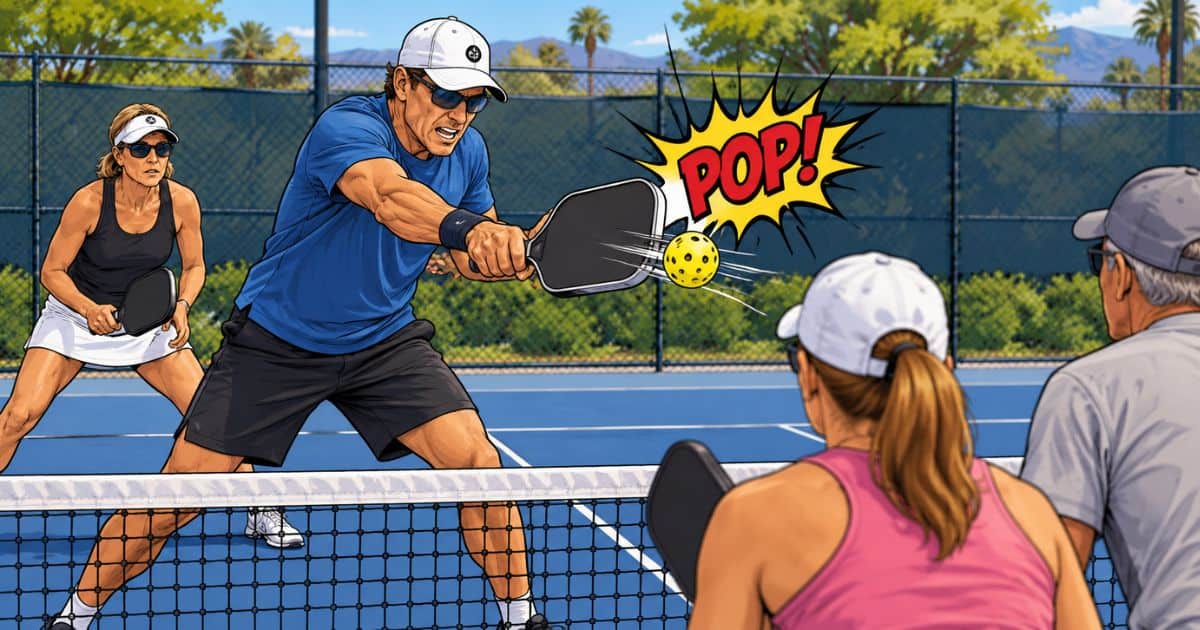
A pickleball paddle is a rigid, hard-faced tool, typically fiberglass, carbon fiber, or graphite bonded to a polymer core, and it strikes a hard, perforated plastic ball. That collision is fast and stiff, so most of the impact energy leaves the contact point in a single short burst rather than spreading out the way a strung tennis racket meeting a felt-covered ball does. Spendiarian & Willis Acoustics & Noise Control, an acoustic consulting firm that has studied pickleball facilities, describes the resulting sound as narrowband, concentrated between 1,000 and 2,000 Hertz, with a “vague sensation of pitch similar to a musical wood block.” That tonal quality, repeated on every rally on every court, is a large part of why the sound cuts through background noise and registers as intrusive even at a moderate volume. Paddle retailer JustPaddles describes the pitch more narrowly, around 1.2 kilohertz, and compares it to the beeping of a reversing garbage truck, a sound associated with an alert rather than ambient noise.
How Far Does Pickleball Noise Actually Travel?
Because the sound is short, sharp, and tonal, it carries differently than steady background noise like traffic. Tennis Warehouse University measured paddle-ball impacts with a calibrated microphone one meter from contact and recorded peak levels between 99 and 106 decibels there, in the same range the source uses to describe a rock concert at about 120 decibels and a car passing at 60 mph at about 70 decibels. As of September 2026, JustPaddles cites a commonly repeated figure for courts overall: about 70 decibels measured 100 feet away, roughly the same loudness as that passing car, though the tonal quality makes it stand out more than steady traffic hum. Real-world measurements back this up. CBS News Colorado reported in April 2023 that Denver’s Congress Park courts measured 71 decibels, 16 decibels over the city noise ordinance limit, which led Denver to close those courts and build replacement courts at Bear Valley Park roughly 400 feet from the nearest homes.
What Is the USA Pickleball Quiet Category?
USA Pickleball, the sport’s national governing body, created the Quiet Category and a related Noise-Reduced Category to identify paddles and balls designed to cut acoustic output while keeping normal play performance. As of September 2026, the program is active, and USA Pickleball has certified its first Quiet Category product, the OWL paddle from OWL Sport. Equipment earning either designation is listed on USA Pickleball’s equipment site, giving court owners and manufacturers a reference point for gear intended for noise-sensitive locations. A thermoformed pickleball paddle uses a different core-and-face bonding process than a traditionally pressed paddle, and construction choices like that are part of what can separate a Quiet Category paddle from a standard one, though the certification itself is a tested designation rather than a construction category on its own.
Can Sound Barriers, Fencing, and Court Orientation Reduce the Noise?
Acoustic consultants who work on court projects say a properly designed barrier helps, though the details matter more than the general idea. Spendiarian & Willis recommends a minimum wall height of eight feet above the playing surface on level terrain, tall enough to block the line of sight to the paddles, with sound-absorbing panels added to walls that face each other across a court. That guidance overlaps with the broader question of pickleball court fence height, since a fence built for containment alone is not automatically built for sound. Distance still matters even with a barrier in place. Spendiarian & Willis treats courts within 150 feet of a residence as needing careful abatement design, courts within 350 feet as often needing some abatement, and any site within 500 to 600 feet of a noise-sensitive area as worth a professional consultation before construction. Setback questions like these frequently come up in the same review as whether a permit is required for a pickleball court, since a local planning department may ask for a noise study alongside the site plan. Orientation is a lower-cost lever than a wall. Spendiarian & Willis notes that positioning a court so the net line, rather than the sidelines, points toward the most noise-sensitive area produces a noticeable reduction in sound pressure level there, a factor worth weighing alongside what direction a pickleball court should face for sun and wind. Surface choice plays a smaller role. The comparison of outdoor pickleball court surface materials covers cushioning and durability, and a softer surface system can take some edge off ball-bounce noise, though it does not change the paddle-on-ball impact driving most complaints.
How Have Cities and HOAs Responded to Pickleball Noise Complaints?
Local governments have handled complaints with a mix of relocation, moratoriums, and revised siting rules rather than a single national standard. Denver’s response to the Congress Park measurements was to close those courts and move new construction to Bear Valley Park, farther from homes, and neighboring Centennial, Colorado placed a moratorium on new courts near residential areas, both reported by CBS News Colorado. Homeowners associations face a narrower version of the same problem, usually inside a single backyard or community amenity space rather than a public park. An HOA board weighing a resident’s request to add a court, or fielding a neighbor’s complaint about an existing one, is making a decision that can end in a formal dispute if the covenant language, hours, and setbacks are not addressed up front, which is why avoiding a pickleball HOA lawsuit starts with clear rules before a court is built rather than after complaints arrive. The broader question of navigating HOA rules for a backyard pickleball court covers how covenants typically set hours, fencing, and buffer requirements beyond what a city ordinance alone would require.
Frequently Asked Questions
Why does pickleball sound louder than tennis? A tennis racket’s strings and a felt-covered ball absorb and release energy over a longer contact time, while a rigid pickleball paddle striking a hard plastic ball releases most of the energy in a short, sharp burst. Spendiarian & Willis Acoustics & Noise Control describes the resulting sound as narrowband and tonal, which makes it stand out from steady background noise even at a moderate volume.
How many decibels does a pickleball court produce? Tennis Warehouse University measured peak paddle-ball impacts between 99 and 106 decibels at one meter from contact. As of September 2026, a commonly cited figure from JustPaddles puts a court at about 70 decibels measured 100 feet away, though readings vary by paddle, ball, and surroundings. Denver’s Congress Park courts were measured at 71 decibels by the city, according to CBS News Colorado.
What frequency makes pickleball noise so noticeable? Spendiarian & Willis places the spectral content between 1,000 and 2,000 Hertz, describing it as similar in pitch to a musical wood block. JustPaddles cites a narrower figure around 1.2 kilohertz. Either way, the sound sits in a tight band that repeats on every hit, which is part of why it reads as more intrusive than a wider, steadier noise source.
What is the USA Pickleball Quiet Category? It is a certification USA Pickleball created for paddles and balls that reduce acoustic output while keeping normal play performance. As of September 2026 the program is active, and the OWL paddle from OWL Sport is the first product certified under it, with additional products listed on USA Pickleball’s equipment site as they qualify.
Do sound barriers actually reduce pickleball noise? Acoustic consultants including Spendiarian & Willis say a properly built wall helps, but height and placement matter. The firm recommends a minimum of eight feet above the playing surface, tall enough to block the sightline to the paddles, with absorptive panels on walls that face each other across the court.
How far should a pickleball court be from homes? There is no single number that fits every site. Spendiarian & Willis treats courts within 150 feet of a residence as needing careful abatement design, courts within 350 feet as often needing some abatement, and anything within 500 to 600 feet of a sensitive area as worth a professional consultation before construction begins.
Does court orientation change how noise is heard? Yes. Spendiarian & Willis reports that orienting a court so the net line, rather than the sidelines, faces the most noise-sensitive direction produces a measurable reduction in sound pressure level there, without any added construction cost.
Can HOAs limit pickleball hours because of noise? HOA covenants commonly set amenity hours, and a community pickleball court is generally treated the same way as a pool or clubhouse in that respect. Disputes tend to arise when hours, fencing, and setback rules were never written down clearly before the court went in.
What can players and court owners do to lower the noise? Choosing a paddle or ball certified under USA Pickleball’s Quiet Category is one option, since those products cut acoustic output while keeping normal play. Court owners can add height-appropriate barriers, respect setback distances, and orient new courts away from the closest homes, reducing the sound that reaches neighboring property without changing how the game is played.
Pickleball’s noise problem has a physical cause and a growing set of physical and procedural fixes, from paddle certification to wall height to court orientation. Anyone planning a new court, whether a backyard project or a multi-court public facility, benefits from working through setback and barrier questions before pouring a slab rather than after the first complaint arrives. For contractors, acoustic consultants, and fencing companies that specialize in this kind of build, the pickleball court construction and infrastructure directory lists providers by location.
Written by the Pickler Junction Team.