What Colors Can a Pickleball Court Be?
Quick Answer: A pickleball court can be almost any solid color. Section 3 of the 2026 USA Pickleball rulebook does not set a required palette. It only requires that the lines contrast clearly with the playing surface. Lines are 2 inches wide, typically white. Beyond that rule, color choice comes down to ball visibility, surface heat, and cost.
That surprises people who assume there is an official court color. There is not. What exists is a contrast requirement and a set of conventions the industry has settled into.
What are the actual color rules?
One rule matters, and it is about contrast, not hue.
Section 3 of the USA Pickleball rulebook covers court and equipment. It states that lines must be a single color and must contrast clearly with the color of the playing surface. Lines are 2 inches wide. White is the standard choice, and textured line paint is common because it keeps the lines from getting slick when wet. If you pick a very light surface, such as tan or off white, your lines need to go dark instead so the contrast still holds.
The rulebook does not name approved surface colors. That decision is left to the builder and the club.
What color combinations do most courts use?
Two tone layouts are common, with a distinct color inside the non-volley zone. Section 3 sets that zone at 7 feet deep on each side of the net.
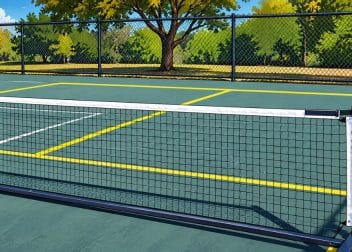
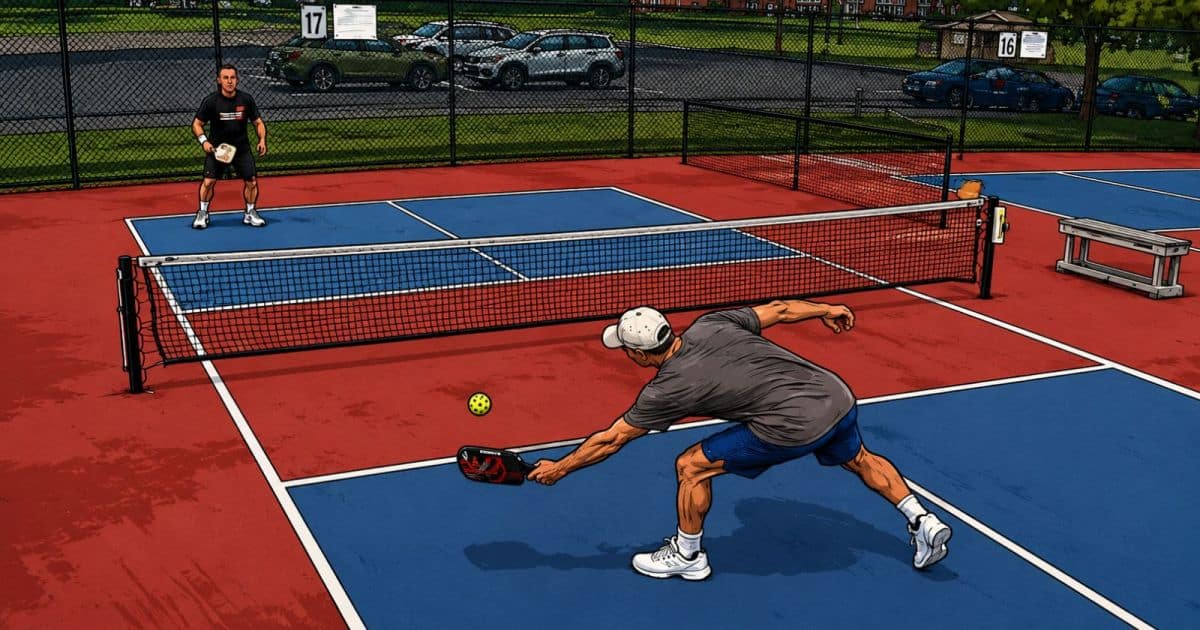
- Blue kitchen, green playing area, white lines. A widely used outdoor combination in the United States. This is an industry convention, not a rulebook requirement.
- Dark blue in, light blue out. Borrowed from tennis courts. High ball contrast and a clean look.
- Green in, green out. A single family of shades. Simple to touch up since there is only one color to match.
- Tan or beige surfaces with dark lines. Popular in hot climates and with homeowner associations that want the court to blend into the landscape.
- Light, vibrant green indoors. Often chosen for indoor courts because it contrasts well with a white or yellow ball under artificial light.
Painting the non-volley zone a different color gives players a visual cue for where the kitchen line sits. That cue can help players judge their position before a volley near the net.
Does court color affect how well you see the ball?
Yes, and this is the decision that affects play the most.
Outdoor pickleballs are sold in yellow, neon green, orange, and other colors. Section 3 only requires that a ball be one uniform color aside from identification markings, so manufacturers offer a range. A neon green ball on a light green court is hard to track, especially under lights or a low sun angle. If your club plays with green balls, avoid a green court. If you are not sure which ball color your players will use, blue contrasts with nearly every ball color sold, which makes it a practical default when the ball is not yet decided.
Does color change the surface temperature?
It does, and in hot climates it is worth real money.
Darker acrylic surfaces absorb more solar energy and run hotter underfoot than lighter ones. In Arizona, Nevada, and Florida, this shows up as courts that are uncomfortable to play on from midday to late afternoon in summer. Lighter greens, tans, and light blues stay meaningfully cooler. Some manufacturers sell heat reflective versions of standard colors for this reason. Court orientation also affects how much direct sun the surface takes on during peak hours; see the guide on what direction a pickleball court should face if heat is a planning concern.
If summer play matters, discuss surface temperature with the contractor before picking a palette, not after. The guide to choosing an outdoor court surface material covers the layer underneath the color.
Can you use custom colors or a logo?
Usually yes on a private court, often no on a public one.
Acrylic court coatings come in a wide range of standard colors, and manufacturers will produce custom shades. Logos at center court or in the corners are common at clubs and resorts. Two cautions apply. Custom colors cost more and are harder to match for future repairs, and any painted logo inside the court of play should not distract from the ball or create a slippery patch.
Municipal courts are often locked to whatever palette the parks department already uses across its facilities, which keeps maintenance simple. That kind of consistency matters even more at a larger site; see the guide to planning a multi-court pickleball complex for how facility wide color decisions get made early.
What does the color choice cost?
Usually very little relative to the full build.
Standard acrylic colors are typically priced the same as one another, so choosing blue over green does not change the quote on its own. Adding a second color for the kitchen adds labor and masking time. Custom color matching adds material cost. Against a full court build, these are small numbers. The breakdown of the true cost to build a pickleball court puts them in context.
The regrets worth avoiding are practical, not aesthetic. A dark surface in a hot state costs afternoons of playable time, and a green surface makes green balls hard to track.
What about lighting and night play?
Color and lighting interact more than people expect.
Lighter surfaces reflect more light back up, which can help visibility at night but can also produce glare if the fixtures are aimed poorly. Darker surfaces absorb light and may need more output to feel bright. If building for evening play, settle the lighting design and the color together. See the court lighting guide for fixture placement and output.
Frequently asked questions
What color can a pickleball court be? Almost any solid color. Section 3 of the USA Pickleball rulebook only requires that the lines contrast clearly with the surface color. There is no required palette.
What is a common pickleball court color scheme? A blue non-volley zone with a green playing area and white lines is a widely used outdoor combination in the United States. It is an industry convention, not a rulebook requirement.
How wide are pickleball court lines? Two inches. Section 3 sets the line width at 2 inches, and textured white paint is the typical choice.
Do courts have to be two colors? No. Under the rulebook, a single color court meets the contrast requirement as long as the lines stand out clearly against it. Two tone courts are popular because they make the kitchen easier to see.
Which court color stays coolest? Lighter shades. Tans, light greens, and light blues absorb less heat than dark blues and dark greens, which matters most in hot climates.
Can you paint a logo on your court? On a private court, generally yes. Keep it out of the path of ball tracking, and make sure the paint finish is not slick.
Does court size change with color? No. Section 3 sets every court at 20 feet by 44 feet regardless of palette. See the guide to pickleball court dimensions.
Pick for contrast first, heat second, and looks third. To find a surfacing contractor in your area, browse the pickleball court construction directory.
Written by the Pickler Junction Team.