What Direction Should a Pickleball Court Face?
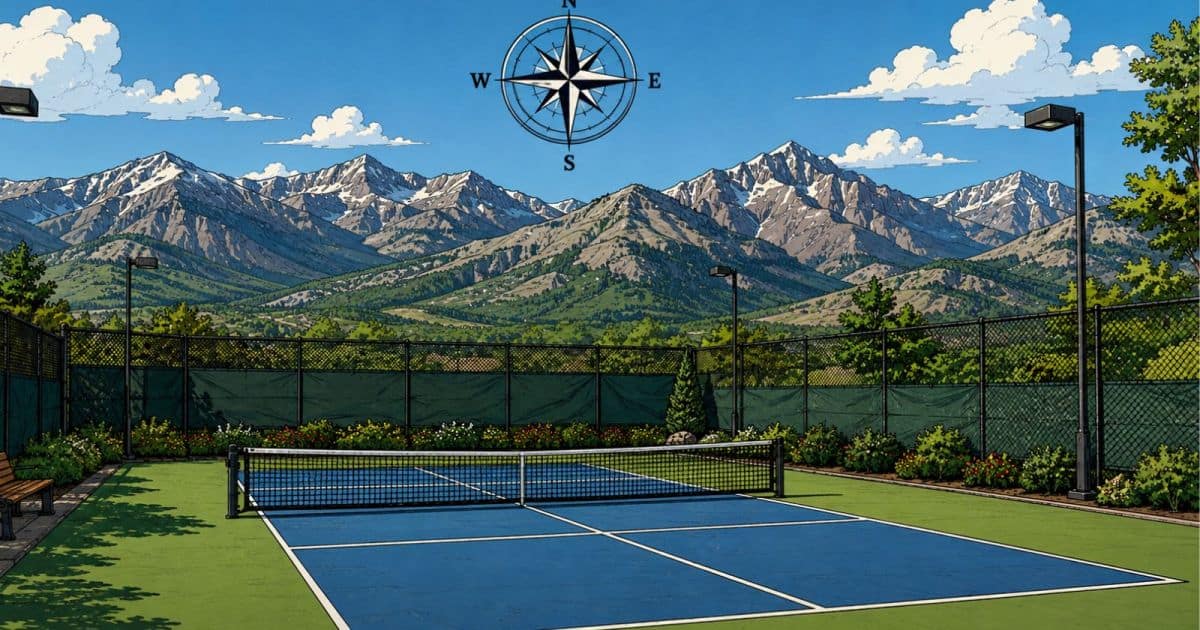
Quick Answer: A pickleball court should be oriented on a north-south axis, meaning the net runs east to west and players face north and south. USA Pickleball recommends this specifically to reduce sun glare, which it names as a common safety hazard during morning and late afternoon play.
Pickleball court orientation is which compass direction the long axis of the court points. It is decided once, during layout, and it cannot be changed without rebuilding.
Why Does Court Orientation Matter?
Because the sun rises in the east and sets in the west, and a court laid out east to west puts it directly in somebody’s eyes for a large part of every playable day.
USA Pickleball does not treat this as a comfort issue. Their construction guidance calls sun glare a common safety hazard, and the reason is straightforward: a player tracking a lob straight into low sun loses the ball completely, and there is another player and a net post nearby.
Orienting the court north to south means the sun travels across the court sideways rather than down its length. Players still get some glare at the extremes of the day, but nobody spends an entire game staring into it.
What Does North-South Actually Mean on Site?
The long axis of the court, the 44 foot direction, runs north and south. The net runs east to west. Players face roughly north and roughly south when they serve.
A few practical notes:
- Perfect alignment is not always achievable. North-south is the orientation both USA Pickleball and the ASBA pickleball court construction manual call for, and neither publishes a degree tolerance, so get as close as the site allows.
- Where the land forces a compromise, favor protecting the morning and evening play windows, since those are the heaviest rec play windows.
- If you are converting an existing tennis court, the orientation is already fixed. Tennis courts follow the same rule, so most conversions inherit a good layout.
What If Your Yard Will Not Allow It?
Then you compensate, and there are three real tools.
Windscreen and backdrop. Dark green or black fabric behind the baselines gives the ball contrast and blocks low sun. This is the cheapest fix and the most effective. Our guide to court fencing covers sizing the posts to carry it.
Shade structures. Sails or canopies on the problem end. Expensive, and they need engineering for wind, but they solve the problem outright.
Scheduling. The least satisfying answer, and a common fallback for home courts. If your court runs east to west, you play mid-morning through mid-afternoon and accept that the golden hour belongs to the sun.
On an east-west court, the last game of every evening is decided by who is serving into the sunset, no matter how well the rest of the court is built.
Does Wind Matter Too?
Yes, though it comes second to sun. If you know the prevailing wind direction at your site, orienting so the wind crosses the court rather than running down its length keeps serves and lobs more predictable.
When sun and wind disagree, follow the sun. You can screen wind with fabric and fencing. You cannot screen the sun out of a badly oriented court without building something over it.
Frequently Asked Questions
Which way should a pickleball court face?
North to south along the long axis, with the net running east to west. USA Pickleball recommends this specifically to reduce sun glare, which it identifies as a common safety hazard.
Is orientation the same for tennis and pickleball?
Yes. Both sports use a north-south orientation for the same reason, which is why converted tennis courts almost always inherit correct alignment. Our guide to converting a tennis court covers the rest of that project.
Does orientation matter for indoor courts?
No. With no sun to manage, indoor courts are laid out to fit the building. Lighting placement replaces orientation as the thing to get right.
How far off north-south can I be?
No governing body publishes a tolerance. As a working rule of thumb, staying within about 20 degrees keeps most of the benefit, and past that glare starts landing in the play window at one end or the other. Past that, glare starts landing in the play window at one end or the other.
What if my lot only allows east-west?
Build it and plan for windscreen behind both baselines from day one, sized into the fence posts and footings. Then expect to lose the first and last hour of daylight for competitive play.
Does the color of the court help with glare?
A little. Darker surrounding color and a lighter playing area give the ball better contrast, which helps in flat light. It does nothing against direct low sun in a player’s eyes.
Does orientation affect resale or property value?
Only through usability. A correctly oriented court is playable more hours per day, and any buyer who plays will notice within one visit.
Should the fence gate be on a particular side?
Put it at a corner behind a baseline, outside the runoff area, and on whichever side gives the easiest walk from the house. Orientation does not change that answer.
Curious how courts near you were laid out? Our directory of public pickleball courts is a quick way to find a few and see which ones get the afternoon right.
Written by the Pickler Junction Team.