What Is a Dead Ball in Pickleball?
Quick Answer: A dead ball is a ball no longer in play under the rulebook. The ball becomes dead the moment a fault is called, a hinder stops the rally, or the ball bounces twice before being returned. Nothing that happens after that moment counts toward the score, including contact with the net or a step into the kitchen.
What Does “Dead Ball” Mean in Pickleball?
Section 2 of the 2026 USA Pickleball rulebook defines a dead ball as a ball that is no longer in play. Once the ball is dead, the point that just happened is locked in, and nothing that occurs afterward, a late swing, a step toward the net, a shout from the sideline, changes the outcome. Section 9, titled Dead Balls, Faults, and Hinders, groups the ways a ball dies into three categories: a fault, a hinder, or a ball that bounces twice before it gets returned.
When Does a Live Ball Become Dead?
A ball dies the instant a fault occurs, whether a player commits it or an opponent or official calls it, under Section 9.B. A fault can be a serve that lands outside the box, a shot into the net, or a violation at the non-volley zone line, and the guide to what counts as a fault in pickleball covers the full list of ways a rally can end that way.
A ball also dies when a hinder is called. Section 2 defines a hinder as a transient element, not caused by a player, that adversely affects play, and Section 9.C states that a called hinder results in a dead ball that must be replayed. Some players still use the older term let for this kind of stoppage, and the guide to how a let works in pickleball explains where that habit still fits alongside the rulebook’s hinder language.
What Happens When the Ball Bounces Twice?
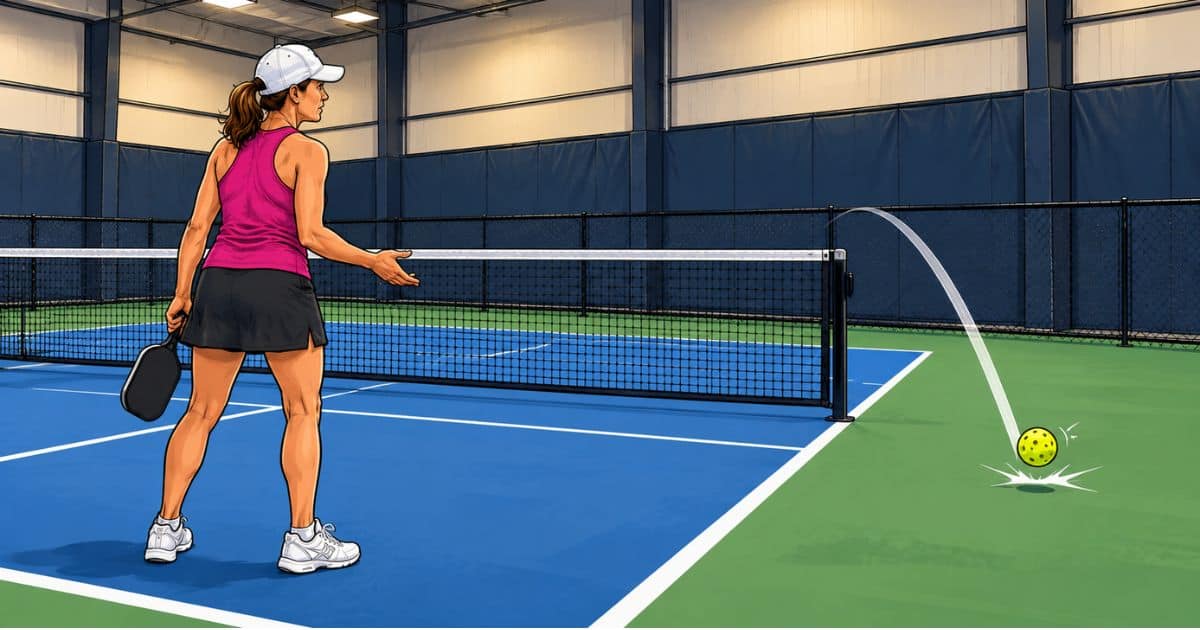
The two-bounce rule, the official term under the rulebook, requires each side to let the ball bounce once before volleying it. Once a ball bounces a second time on one side without being returned, Section 10 treats the miss as a fault against the player who failed to return it, and that fault makes the ball dead under Section 9.B in the same instant.
What If the Ball Hits a Permanent Object, a Player, or Rolls In From Another Court?
The rulebook defines a permanent object as anything on, above, or near the court that can interfere with play, including fences, ceilings, and light fixtures, and Section 10 makes contact with one a fault no matter whether the ball had already bounced in the correct court. The guide to pickleball court rules lays out how those boundaries and structures are set up.
A ball that touches a player, or anything the player is wearing or carrying, is a fault against that player under Section 10.C.3, even if the ball would have landed out of bounds. The rule makes an exception only for the player’s own paddle or the hand gripping it. The guide to whether the ball can hit your body in pickleball walks through how that call plays out on court.
If a ball rolls onto the court from a neighboring game while a rally is underway, that qualifies as a hinder under the rulebook’s Section 2 definition, which lists stray balls among its examples, and Section 9.C.2 requires the point to be replayed rather than awarded to either side. A shout, a rolling ball, or another sudden distraction can trigger the same call, and the guide to the pickleball distraction rule breaks down where officials draw that line.
What Can Players Do While the Ball Is Dead?
Because a dead ball is no longer live, some of the rules that police contact with the net loosen once the point ends. Section 13.G.1 makes it a fault to touch the net or net support system only “while the ball is live,” so once a rally is over, a player can lean on the net or brush the post without being penalized for it. The guide to pickleball net and post rules covers what still counts as a fault while a rally is underway.
Stepping into the non-volley zone works the same way, with one exception. Section 11.A.2 still calls a fault if a volleying player’s own momentum carries the player into the non-volley zone even after the ball becomes dead, so a hard volley that pushes a player over the line right at the end of the point can still cost that rally.
What Other Questions Do Players Ask About Dead Balls?
What is the official definition of a dead ball in pickleball? Section 2 defines a dead ball as a ball that is no longer in play, and Section 9 lists the three ways it gets there: a fault, a hinder, or a second bounce before a return.
Is a let the same thing as a dead ball? A let, more often called a hinder under the rulebook, is one of several events that produce a dead ball, alongside a fault or a second bounce that ends the ball’s life without any hinder being called at all.
Can a player touch the net after the ball is dead? Yes, because Section 13.G.1 restricts the net-contact fault to moments when the ball is live, so contact after the point ends carries no penalty.
What happens if the ball bounces twice before someone hits it? Failing to return the ball before its second bounce is a fault against the player who missed it, and that fault makes the ball dead in the same instant.
Does a ball hitting the ceiling or a fence count as a dead ball? Yes, a ceiling, fence, or light fixture counts as a permanent object, and contact with one is a fault that kills the ball regardless of where it would otherwise have landed.
What is the difference between a live ball and a dead ball? A live ball is still part of an active rally and can be volleyed or returned, while a dead ball is no longer in play and nothing that happens to it changes the score.
Can a player step into the non-volley zone after the ball is dead? Generally yes, except when a volley’s own momentum carries the player across the line, which Section 11.A.2 still treats as a fault even after the ball becomes dead.
What happens if a ball rolls onto the court from a neighboring game? That is a hinder under the rulebook, and Section 9.C.2 requires the rally to be replayed rather than scored for either side.
Does a dead ball always mean the rally gets replayed? No. A hinder leads to a replay, but a fault or a second bounce simply ends the rally and awards the point or the serve according to the normal scoring rules.
A coach who spends time on officiating scenarios, not just strokes, can make these calls second nature during a match, and the directory of pickleball coaches is a place to find one nearby for a lesson that covers rules alongside technique.
Written by the Pickler Junction Team.