Can the Ball Hit Your Body in Pickleball?
Quick Answer: If the ball hits any part of your body other than your paddle hand below the wrist, you lose the rally. Getting hit anywhere, the chest, arm, leg, or head, is a fault against you. The only body contact that stays in play is the ball striking your paddle hand at or below the wrist. Everything else ends the point.
This rule surprises new players the first time a fast ball catches them in the chest and the other team celebrates. Getting hit by a live ball is a fault on you, and the point goes to the other team. The body-contact rule is simple once you know it, and it shapes how you defend at the net.
What happens if the ball hits your body?
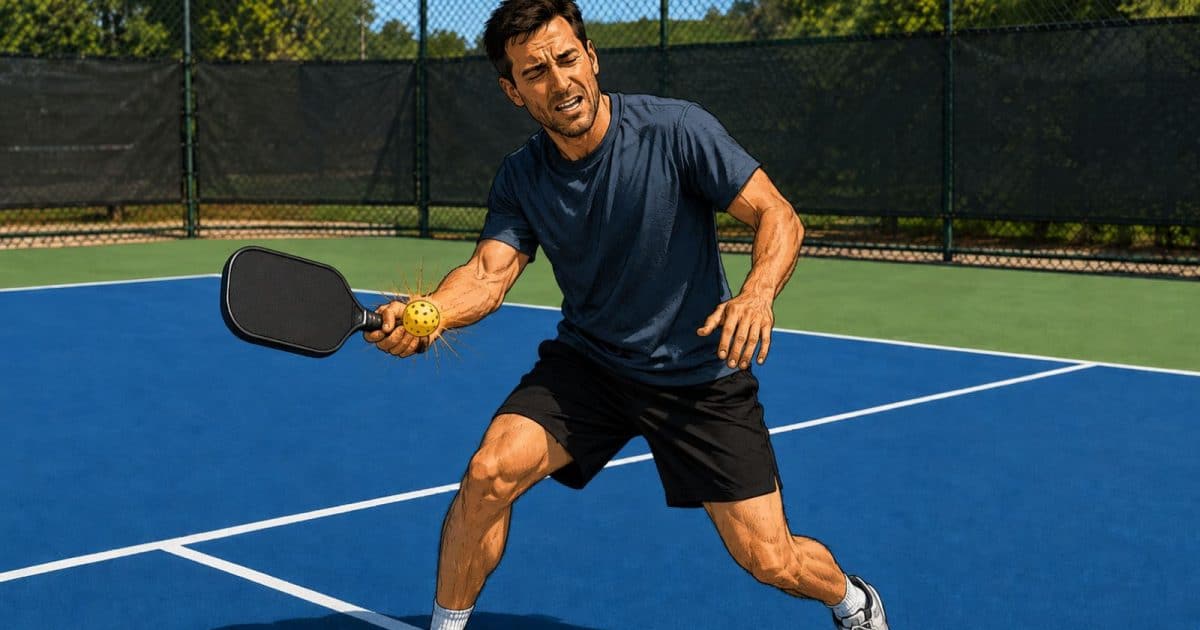
You lose the point, full stop. If a ball that is in play strikes any part of your body or clothing, other than the paddle hand below the wrist, you have committed a fault and the rally goes to your opponent. It does not matter whether it hurt, whether it was an accident, or whether the ball was heading out.
That last part catches people off guard. Here is the key detail:
- If a ball would have landed out but hits you first, it is still your fault.
- You cannot let a ball hit you and then claim it was going long.
- The moment the ball touches your body, the rally is over and you lose it.
I learned this one the hard way, wearing a ball off my shoulder while ducking a shot I was sure was sailing out. It was out. It did not matter. The point was theirs because it hit me first. Now I get my paddle up and let borderline balls pass cleanly.
Is it legal for the ball to hit your hand?
Only your paddle hand, and only at or below the wrist. This is the one exception to the body rule, and it trips people up. Your paddle hand is treated as an extension of the paddle up to the wrist, so a ball that hits your fingers or hand there stays in play.
The lines are specific:
- Ball hits the paddle: in play, normal.
- Ball hits your paddle hand at or below the wrist: in play, still good.
- Ball hits your paddle hand above the wrist, on the forearm: fault.
- Ball hits your other hand or any other body part: fault.
So a ball that clips your knuckles while you are gripping the paddle is live, but the same ball hitting your forearm ends the point against you. Knowing this helps you play close volleys with confidence, which connects to the non-volley zone rules at the kitchen line where hands battles happen.
Why does the body-contact rule exist?
To keep the net game fair and honest. Without it, a player could simply block balls with their body or refuse to move out of the way. The rule forces you to actually play the ball with your paddle and to move your body out of the path of shots aimed at you.
It also rewards accuracy. A well-aimed shot at an opponent’s body is a legitimate tactic, not a cheap shot, because the rules make getting hit a losing outcome. This is exactly why a good speed-up targets the body, and it is worth reading how to defend one in the guide to the speed-up. The body rule is what makes that target so effective.
Does it matter where on the body the ball hits?
No. Any body part counts the same. Chest, stomach, leg, foot, shoulder, or head, if the ball in play touches you anywhere except the paddle hand below the wrist, it is a fault. There is no safe zone and no difference between a soft touch and a hard hit.
One related situation confuses people. If the ball hits you after it has already bounced twice or is otherwise dead, there is no penalty, because the rally was already over. Body contact only matters while the ball is live. For the rest of the rally basics that surround this, the 5 basic rules of pickleball is the right starting point.
FAQ
Do you lose the point if the ball hits you in pickleball?
Yes. If a live ball hits any part of your body or clothing, other than your paddle hand below the wrist, you lose the rally. It counts as a fault against you.
What if the ball was going out but hit me first?
It is still your fault. You cannot let a ball strike you and then argue it was heading out of bounds. Once the ball touches your body, the point is over and your opponent wins it.
Can the ball legally hit my hand?
Only your paddle hand, and only at or below the wrist. That part of your hand is treated as an extension of the paddle. A ball hitting your other hand or your forearm is a fault.
Is it a fault if the ball hits my clothing or hat?
Yes. Contact with anything you are wearing counts the same as contact with your body. If a live ball hits your shirt, hat, or shoe, you lose the rally.
Can I get hit on purpose to win a point?
No. Getting hit is always a fault on you, so there is no advantage to it. This is exactly why aiming at an opponent’s body is a smart, legal tactic in fast exchanges.
What if the ball hits me after it bounces twice?
Then there is no penalty, because the rally already ended when the ball bounced twice. The body-contact rule only applies while the ball is still live and in play.
Does getting hit hurt, and how do I avoid it?
A fast ball can sting a little. The best defense is keeping your paddle up in front of your body at the net so you can block balls aimed at you rather than wearing them.
Want quicker hands so you stop wearing those net shots? The coaching category in the Pickler Junction directory lists instructors who drill reaction volleys and blocks for players at every level.
Written by the Pickler Junction Team.