
What Happens When the Ball Hits the Net Post in Pickleball?
Quick Answer: A ball that touches a net post or the net support system before crossing the net is a fault under Rule 13.B.1 of the 2026 rulebook, since posts count as permanent objects. A ball that hits the net cord and lands in bounds stays in play, and the around-the-post shot is legal under Rule 13.C.
Is Hitting the Net Post a Fault in Pickleball?
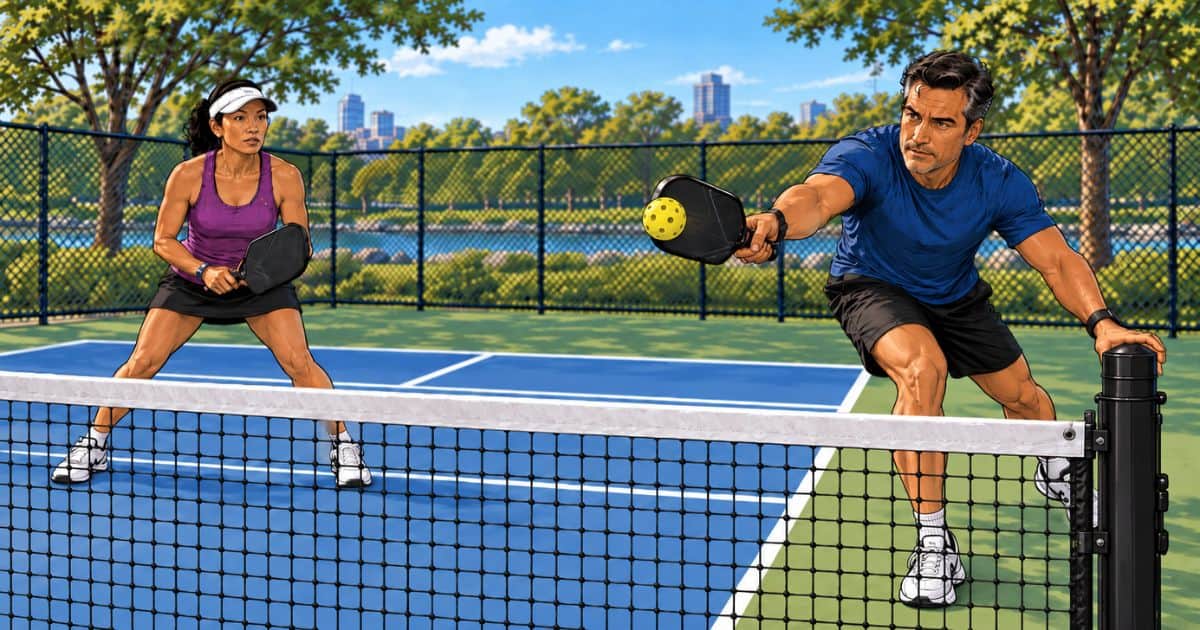
A pickleball court has two posts holding up the net, positioned just outside each sideline. Under the rulebook, those posts are not part of the net itself. Rule 2 classifies net posts, along with their connected wheels, arms, legs, and support cable, as permanent objects, the same category as fences, lighting fixtures, and spectator stands. A ball that touches a net post, or any other part of the net support system, before it crosses over the net is a fault against the player who hit it, under Rule 13.B.1. That holds whether the ball hits the post on a serve, a rally shot, or a return, and it applies even if the ball would otherwise have landed in bounds.
What Rule Covers the Net Support System?
Section 3 of the rulebook sets the net specifications that make this rule matter. The posts sit 22 feet apart, measured from the inside of one post to the inside of the other, under Rule 3.B.2. The net itself must stand 36 inches above the court at the sidelines and 34 inches at the center, under Rules 3.B.6 and 3.B.7, a detail covered in more depth in the guide to the height of a pickleball net. Because the posts sit outside the 20 by 44 foot playing area, contact with them falls under Rule 10.C.4, which treats any ball that hits a permanent object before bouncing on the court as a fault, and Rule 13.B.1, which addresses the net support system specifically. The two rules point to the same outcome: a player loses the point, called the same way as any other fault, a topic covered in the guide to what counts as a fault in pickleball.
How Does the Around-the-Post Shot Work?
Not every ball that avoids going over the net between the posts is illegal. Rule 13.C of the rulebook allows a ball to be returned around the outside of the net post, a shot commonly called the around-the-post return, or ATP. The rulebook sets no height requirement for this shot and no rule requiring the ball to pass below the top of the post, so a player can send it well above post height as long as it travels outside the post rather than over the net and lands in the opponent’s court. The distinction matters because it separates a legal, if unusual, shot from a fault. Hitting the post itself kills the point under Rule 13.B.1, while going around it, outside the sideline, keeps the ball alive. The mechanics and strategy behind the shot get a fuller explanation in the guide to what an ATP is in pickleball.
What Happens When the Ball Goes Under the Net Instead of Over It?
A ball can also miss the net entirely by traveling underneath it rather than over the top or around the post. Rule 13.E.1 of the rulebook treats this as a straightforward fault: when a player hits the ball under the net, the point ends against that player. This differs from the around-the-post shot because the ball never travels the required path outside the post and into the opposing court through legal airspace. It passes through the gap at ground level instead, an outcome the rulebook does not treat as playable.
Is a Serve That Hits the Net Cord Still Playable?
This is one of the more common points of confusion, since pickleball once mirrored tennis and volleyball, where a serve that clips the net gets replayed. USA Pickleball removed the let serve rule in 2021, and the rulebook reflects that change. Section 7 contains no let provision, and Rule 7.E states that a served ball must clear the non-volley zone, with or without touching the net, and land in the correct service court. A serve that ticks the net cord and lands in the right box is simply in play, no different from any other legal serve, a change explained further in the guide to what a let is in pickleball. Rule 13.A extends the same treatment to rally shots: when the ball contacts the net or the cable at the top between the posts, it stays in play. None of that changes what happens if the ball hits the post itself. The net cord is part of the net; the post is not, and a ball that strikes the post is still a fault under Rule 13.B.1, regardless of where in the rally it happens.
Do Portable Nets Create Different Post Rules?
The rulebook applies the same fault rule to every net that meets the court specifications in Section 3, and it does not set separate post rules for portable versus permanent installations. What changes in practice is upkeep. A permanent net keeps its post height steady once installed, since the posts do not move unless the ground itself shifts. A portable net’s telescoping post joints, locking collars, and center strap clip loosen with regular use, and a loose center strap can let the middle of the net rise two to three inches above the regulation 34 inches instead of holding the required dip. That does not change what counts as a fault when a ball hits the post, but it does mean a club or player running matches on a portable setup should check the net height at the sidelines and center before play, a step covered in the guide comparing portable and permanent pickleball nets. Contact with the post while the ball is live is a fault regardless of setup. Contact with the net itself, including a hand or paddle brushing it during a live ball, is a separate question addressed in the guide to touching the net in pickleball.
FAQ
Is it a fault if the ball hits the net post, on a serve or in a rally? Yes. The rulebook treats the net post as part of the net support system under Rule 13.B.1, and any ball that touches it before crossing the net is a fault against the player who hit it, whether the contact happens on a serve or during a rally.
What is the around-the-post shot? The around-the-post shot, or ATP, is a return that travels around the outside of the net post instead of over the net between the posts. The rulebook permits it under Rule 13.C as long as the ball lands in the opponent’s court.
Does the ball have to stay below the height of the post on an ATP? No. The rulebook sets no height limit for an around-the-post shot, so the ball can pass above or below the top of the post as long as it travels outside the post and lands in bounds.
Is a serve that clips the net cord and lands in still good? Yes. The rulebook carries no let provision in Section 7, following USA Pickleball’s 2021 elimination of the let serve rule, so a served ball that touches the cord and lands in the correct box remains in play.
What counts as a fault for hitting the ball under the net? The rulebook calls this a fault under Rule 13.E.1. When a player sends the ball under the net rather than over it or around the post, the point ends against that player.
Are net posts considered part of the playing court? No. Rule 2 of the rulebook defines net posts, along with their support cable and hardware, as permanent objects, the same category as fences and spectator stands, not as part of the court surface.
Do portable nets get different post rules than permanent nets? No. The rulebook applies the net support system fault the same way to every net that meets the Section 3 specifications, regardless of whether the net is portable or permanent.
Why do players confuse a net post fault with a legal shot? The confusion usually comes from the around-the-post shot, which travels outside the post at any angle and can look similar from a distance to a ball that clips the post itself. The two produce opposite outcomes: one keeps the ball alive, and the other ends the point instantly.
Net post faults come up often enough in casual and league play that they are worth knowing before a close match turns on the call. A coach can walk through the difference between a post fault, an around-the-post winner, and a legal net cord serve in a single lesson, and pickleball players looking for that kind of instruction can find one through the directory of pickleball coaches.
Written by the Pickler Junction Team.