What Happens If the Ball Hits the Ceiling in Indoor Pickleball?
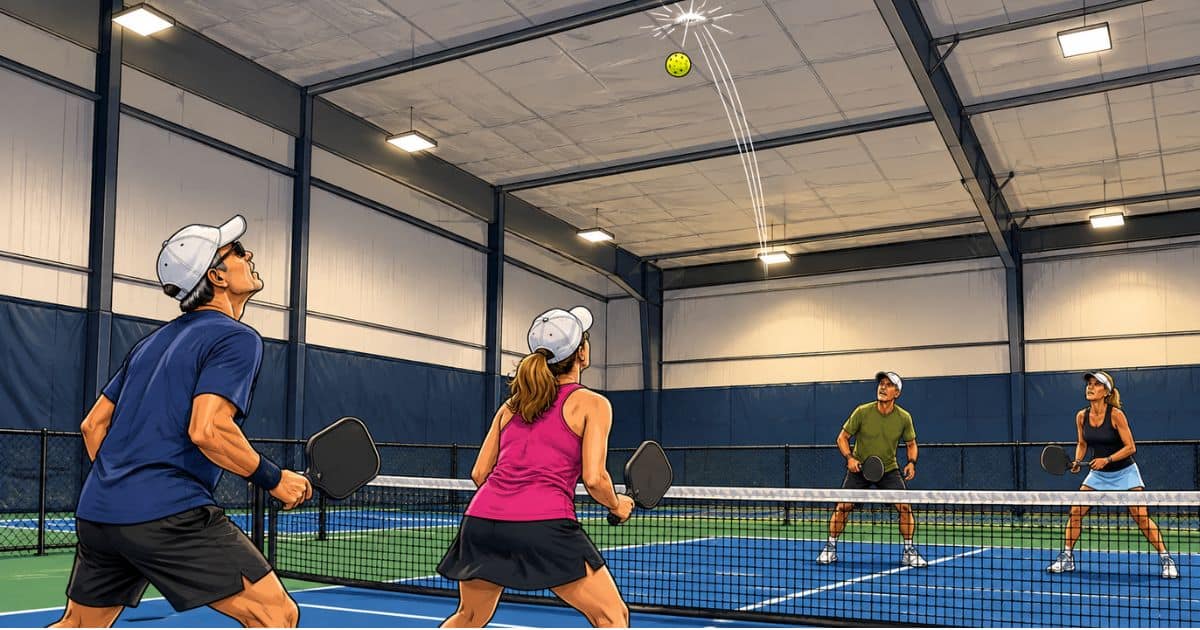
Quick Answer: A ball that touches a permanent object, such as the ceiling, lights, or rafters, before landing is a fault against the player who hit it, on a rally shot or a serve. USA Pickleball sets no minimum ceiling height, so gyms vary and low ceilings call for flatter shots.
What Counts as a Permanent Object Above an Indoor Pickleball Court?
Section 2 of the 2026 USA Pickleball rulebook defines a permanent object as any object on, above, or near the court that can interfere with play, and its own list of examples names ceilings and lighting fixtures right alongside walls, fencing, and net posts. Indoors, that definition stretches upward into whatever the building has hanging over the court. Exposed rafters, HVAC ductwork, hanging speakers, a raised basketball backboard, and a low light fixture all qualify the same way a drop ceiling tile does. Outdoors this section barely comes up, since there is no ceiling to hit, but in a converted gym, fieldhouse, or warehouse facility it can end a rally on almost any high shot.
Is Hitting the Ceiling a Fault in Pickleball?
Yes. Rule 10.C.4 makes it a fault against the player who hit the ball whenever that ball contacts a permanent object before bouncing on the court, and a ceiling, light fixture, or rafter counts as a permanent object under the Section 2 definition. A companion rule, 10.C.5, covers a ball that has already bounced in a player’s court and is not returned before it hits a permanent object, which is also scored as a fault against the player who failed to return it. Neither rule distinguishes between an accidental clip and a shot that was simply hit too high. The ball touched the fixture, so the rally ends there. That works the same way as any other dead-ball fault, a category covered in more detail in the guide to what counts as a fault in pickleball.
What Happens If a Served Ball Hits the Ceiling?
The serve draws its own rule. Rule 7.E.3 makes it a fault against the server when a served ball contacts a permanent object before landing, regardless of how high the gym’s ceiling sits. A serve that clears the net, drifts toward the sideline, and clips an exposed sprinkler head or light fixture on the way down is a service fault, scored the same way a serve into the net or past the baseline would be.
What About a Lob That Clips the Rafters?
Lobs are where the ceiling rule shows up most often, since a defensive lob or an overhead lob volley sends the ball on the highest arc of any shot in the game. If the ball brushes a rafter, a duct, or a hanging basketball hoop on the way up or down before it lands, Rule 10.C.4 makes it a fault against the player who hit it, not a let and not a replay. That is a real constraint in low buildings: a lob that would clear cleanly outdoors can be unplayable in a gym with a low ceiling. Players adjusting their overhead shots for a gym ceiling can find more detail in the guide to how to hit a lob in pickleball, and the difference in ball flight and bounce between the two settings is covered in the comparison of indoor and outdoor pickleballs.
Do Gyms Set Their Own Ceiling Rules?
USA Pickleball’s rulebook does not set a minimum ceiling height for indoor play, and Section 3, which covers court and equipment dimensions, is silent on overhead clearance. That leaves ceiling height up to whatever building the courts sit in, whether that is a repurposed basketball gym, a fieldhouse, or a retail space converted into a pickleball facility. A facility can post its own house rule treating a ball that strikes a specific low obstruction, such as a scoreboard, as a dead-ball replay rather than a fault, but that kind of house rule only applies at the venue that posts it, since it is not part of the official rulebook itself. Anyone checking a new facility’s layout before a session can start with the guide to finding indoor pickleball courts, which also compares court dimensions across venues in the breakdown of indoor pickleball court sizing.
How Should Players Adjust to a Low Indoor Ceiling?
A low ceiling changes shot selection more than it changes the rules. Flatter drives, dinks, and drop shots stay well clear of most overhead obstructions, while a full-height lob or an aggressive overhead swing is the shot most likely to end in a fault under Rule 10.C.4. Players who look up at a gym’s ceiling before the first serve, checking for low light fixtures or exposed beams, can plan shot selection around a known trouble spot the way they would plan around a short baseline. It also helps to separate a ceiling fault from a let. A let under the rulebook covers specific replay situations, such as a serve that clips the net and still lands in, and that distinction is laid out in the guide to what counts as a let in pickleball. A ball contacting a permanent object above the court is never one of those replay situations; it is a fault, full stop. For a fuller rundown of how faults, lets, and scoring fit together, the guide to pickleball court rules covers the full rule set beyond just the ceiling.
A coach who has played the same gym for a season knows exactly which rafter to avoid on a lob, and that kind of local knowledge is hard to replace with a rulebook alone. Players working around a stubbornly low ceiling, or simply looking for someone to sharpen a flatter shot selection, can find pickleball coaches who already know the quirks of the local indoor courts.
Frequently Asked Questions
Is a ball hitting the ceiling a fault in pickleball? Yes, a ball that contacts a permanent object such as the ceiling before landing is a fault against the player who hit it, under Rule 10.C.4.
What happens if a serve hits the ceiling? Rule 7.E.3 makes a served ball that hits a permanent object before landing a fault against the server, the same as a serve hit into the net.
Is the ceiling considered a permanent object? Yes, the rulebook’s Section 2 definitions list ceilings by name as an example of a permanent object, alongside walls, fencing, and lighting fixtures.
Does hitting a light fixture count the same as hitting the ceiling? Yes, a lighting fixture is named directly in the Section 2 definition of a permanent object, so a ball that clips one before landing draws the same fault under Rule 10.C.4.
Is there a minimum ceiling height required for indoor pickleball courts? No, the rulebook’s Section 3 court and equipment specifications set net height and court dimensions but do not set a minimum overhead clearance, leaving ceiling height up to the building the courts are installed in.
Can a gym make its own rule about the ceiling? A facility can post a house rule for a specific low obstruction, but the rulebook itself does not include any ceiling-specific exception, so any house rule only applies at the venue that posts it.
Is hitting the ceiling the same as a let? No, a let under the rulebook covers specific replay situations such as a serve that clips the net and still lands in, and a ball contacting a permanent object above the court is scored as a fault under Rule 10.C.4 rather than as a let.
What should a player do if the gym ceiling is very low? Favor flatter drives, dinks, and drop shots instead of a full-height lob, since a shot that touches a rafter or duct before landing is a fault under Rule 10.C.4 regardless of how the ball was meant to land.
Does the ceiling rule apply to warm-up hits before a match? The rulebook’s fault rules govern rally and serve play, so a warm-up hit that is not part of a scored rally is not assessed as a fault under Rule 10.C.4, though a gym may still ask players to keep warm-up shots low as a courtesy.
Written by the Pickler Junction Team.