
What Grip Should You Use in Pickleball?
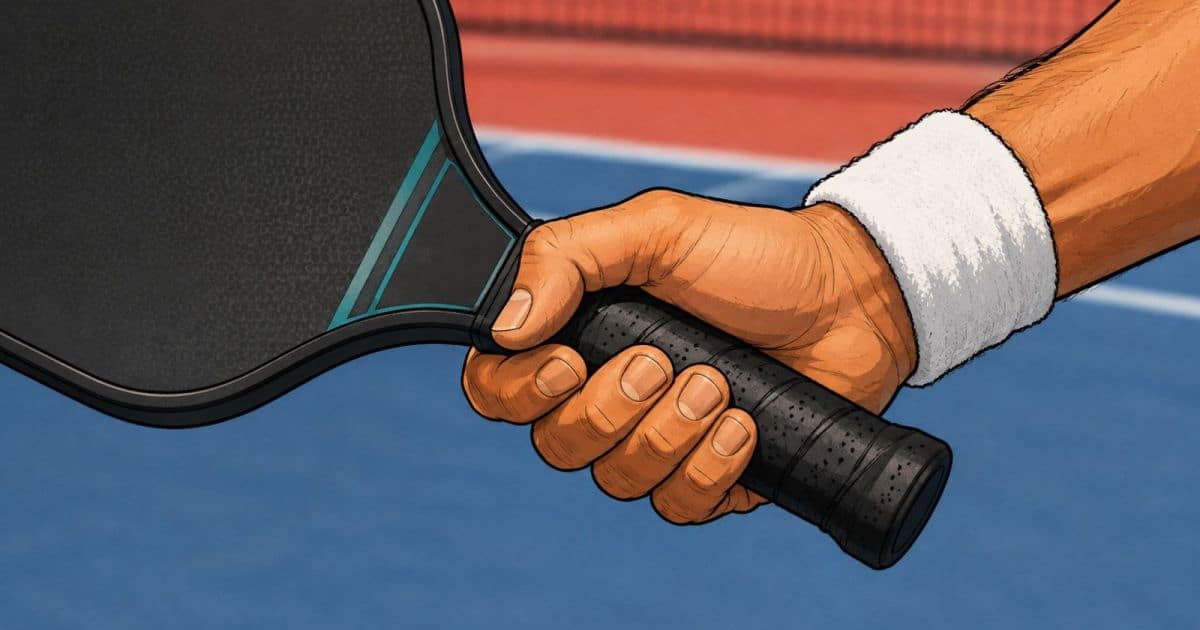
Quick Answer: Use the continental grip. Hold the paddle like a handshake, so the base knuckle of your index finger rests on the second bevel. This single grip plays forehands, backhands, dinks, and volleys without a change, which is why coaches teach it first. Pair it with the right handle size and a soft hold.
A grip is how your hand sits on the handle, and in pickleball it decides how fast you can switch between shots. Tennis players change grips often between forehands and backhands. Pickleball rallies at the kitchen line move too fast for that kind of switch.
What is the continental grip and why is it the default?
The continental grip is the neutral hand position that covers nearly every shot without a change.
Hold the paddle out as if you were about to shake hands with it. The base knuckle of your index finger should land on the second bevel of the handle. From there the paddle face sits close to vertical, which works for a dink, a volley, and a block. The continental grip is the same hand position tennis and racquetball players use at the net.
Speed is the reason it wins. Hands battles at the non-volley zone line happen faster than a grip change can keep up with. A grip that has to move between a forehand volley and a backhand volley arrives late on the second ball. The continental grip removes that decision before the point even starts.
When would you use anything else?
Mostly when you want more topspin on one shot and are willing to trade speed for it.
- Continental. Neutral, fastest to switch, and the standard choice for dinks, volleys, resets, and blocks.
- Eastern forehand. Rotated slightly toward the forehand side. Adds topspin and a more comfortable drive, but weakens the backhand volley and slows the switch back to neutral.
- Western. Rotated much further toward the forehand. Heavy topspin on forehand drives, but poor at the net and rare in pickleball.
Some players shade slightly off continental for a serve or a forehand roll, then return to neutral before the next shot. That kind of refinement makes more sense once your soft game at the net is already dependable.
How do you know if your grip size is right?
Measure your hand, then confirm it with a simple test on the paddle itself.
Grip size is the circumference of the handle. Paddle handles typically run from about 4 inches to 4.5 inches around, and a size near the middle of that range fits many adult hands. To measure your own hand, run a ruler from the crease in your palm to the tip of your ring finger and read the number in inches. Handle length matters too, so pair this with the guide on paddle weight for a beginner if you are shopping for your first paddle.
Then check it on the paddle. Take your normal grip and try to slide the index finger of your other hand into the gap between your fingertips and your palm. A snug fit means the handle is close to right. No gap at all means it is too small. A loose gap means it is too large.
Does grip size actually matter?
Yes, mostly for your arm rather than for shot quality.
A handle that is too small forces you to squeeze harder to keep the paddle from twisting in your hand. According to the Mayo Clinic, poor equipment is one factor that raises the risk of tennis elbow in racket sports, and a handle that does not fit your hand is part of that equipment fit. A handle that is too large limits wrist action and can slip on a mishit. If you are between two sizes, sizing down is the safer move, since you can build a grip up with an overgrip but cannot shrink one down.
Adjusting grip size does not put a paddle out of bounds, either. Under Section 3.D.6.g of the 2026 USA Pickleball rulebook, a grip size insert is listed as an approved alteration, so changing the fit of your handle does not affect a paddle’s tournament legality. An overgrip is usually the simpler route, and the guide to pickleball paddle grip tape covers the options.
How hard should you hold the paddle?
Softer than most new players expect, and this single fix changes the most games.
Grip pressure is often ranked on a scale of one to ten in lessons and clinics. Dinks and resets call for something around three or four. Drives and overheads can climb higher for a moment, then relax again. A common error is holding at eight all the time, which kills touch, pops resets up into an easy attack, and tires the forearm over a long session. Off court strength work, covered in the guide on whether pickleball players should lift weights, builds forearm endurance that helps keep that pressure low late in a match.
Floating dinks are often a grip problem rather than a technique problem. Squeezing the handle stiffens the wrist and opens the paddle face, and loosening the grip does more for a soft game than most drills.
Does the grip change for a dink or a third shot drop?
The grip stays the same. The pressure and the swing path change.
For a dink, keep the continental grip, soften your hand, and lift the ball with the shoulder rather than flicking the wrist. For the third shot drop, use the same grip again, with a longer low to high swing path. Keeping one grip across both shots is the entire point of learning it well.
How long does it take to get comfortable?
A few sessions if you are new to racket sports, longer if you are converting from tennis.
Switching from tennis to continental can feel strange on the forehand at first, since it produces a flatter ball than an eastern or semi western grip does. The adjustment is real but short for most people. Play through it rather than reverting to an old grip, since reverting costs the backhand volley all over again.
Frequently asked questions
What grip should a beginner use in pickleball? Continental. It plays forehands, backhands, dinks, and volleys without a change, which matters because kitchen exchanges happen too fast to switch grips mid point.
How do I find the continental grip quickly? Shake hands with the paddle. The base knuckle of your index finger should sit on the second bevel of the handle, with the paddle face close to vertical.
What grip size do most paddles use? Paddle handles generally run from about 4 inches to 4.5 inches in circumference, with sizes near the middle of that range fitting the widest number of adult hands.
Should I size up or down if I am between two grip sizes? Size down. An overgrip adds a small amount of thickness per wrap, but nothing removes material from a handle that already measures too large.
Can the wrong grip size cause pain? It can contribute to it. The Mayo Clinic notes that poor equipment raises the risk of tennis elbow in racket sports, and a handle that forces constant over squeezing is part of that equipment fit. Persistent pain deserves a clinician, not just a new paddle.
Do players change grips for a serve? Most stay in continental for the whole point. Some shade slightly toward an eastern grip for extra spin on the serve, then return to neutral before the return of serve arrives.
Does the paddle itself affect grip choice? Handle length and shape do. A longer handle suits a two handed backhand better than a short one. See the guide on how to choose a pickleball paddle for more on handle shape.
Is changing your grip size against the rules? No. Under Section 3.D.6.g, a grip size insert is listed as an approved paddle alteration, so adjusting handle fit does not affect a paddle’s legality for sanctioned play.
One grip, sized to your hand and held loosely, covers the game from a first open play session through advanced competition. To find a certified instructor who can check your grip and paddle fit in person, browse the Pickler Junction coaches directory: https://picklerjunction.com/single-category/pickleball-coaches/?directory_type=general.
Written by the Pickler Junction Team.