
What Is a Dink in Pickleball?
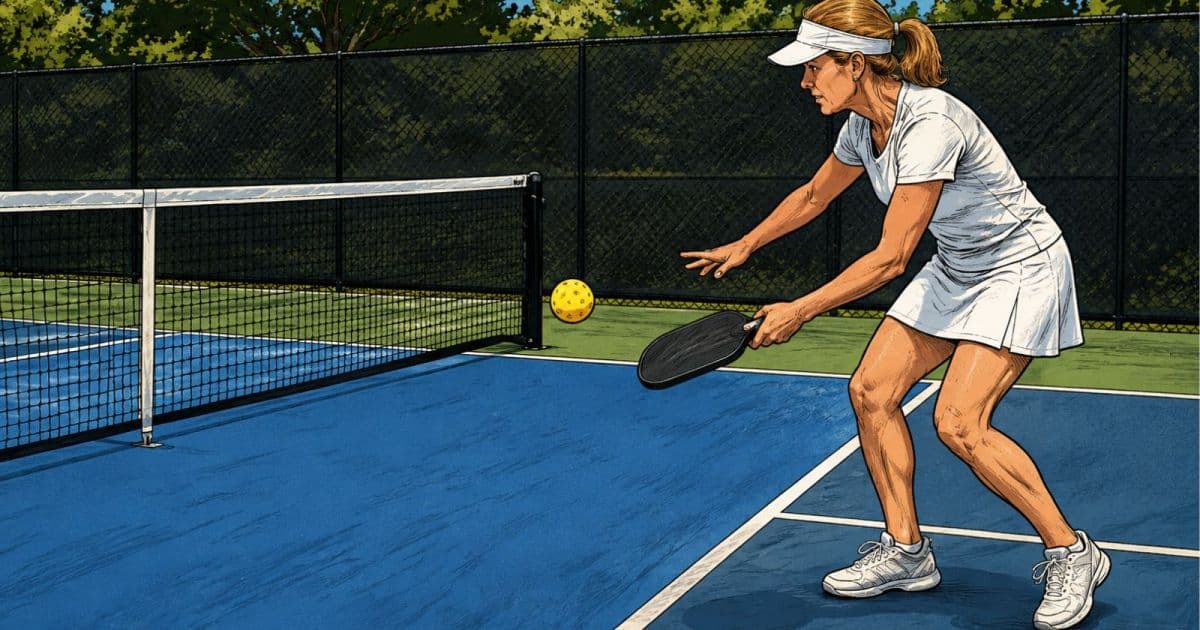
Quick Answer: A dink is a soft shot hit near the kitchen line that arcs low over the net and lands in the opponent’s non-volley zone. Players use it because a ball that bounces in that zone is nearly impossible to attack. Dinking is how points get built once all four players reach the net.
The shot exists because of one rule. You cannot volley a ball while standing in the non-volley zone, so a ball that lands in that zone has to be hit after it bounces, from a low position that makes it hard to attack.
Why does the dink exist at all?
Because the kitchen turns a soft shot into a safe one.
The non-volley zone runs 7 feet back from the net on each side, under Rule 3.A.4.c of the 2026 rulebook. A ball that lands inside it forces your opponent to let it bounce or to retreat, and either way they end up hitting upward from below net height. Nobody can drive a ball upward with much force and keep it in play. The dink weaponizes that geometry.
The explainer on why the non-volley zone is called the kitchen covers the rule in full, and the guide on stepping in the kitchen answers the question that usually comes next.
What separates a dink from a drop?
Where you are standing when you hit it.
A third shot drop is hit from the baseline or the transition area, traveling a long way before it settles softly in the kitchen. A dink is hit at or near the kitchen line, traveling only a few feet. Both shots share the same goal, keeping the ball low enough that the other side cannot attack it, but the mechanics differ because the distances differ. The guide to the third shot drop covers the longer version in full.
How do you actually hit a dink?
Low to high, from a soft hand, with the shoulder doing the work.
- Keep the grip loose. A tight hand closes the paddle face and sends the ball long. See what grip to use for the full breakdown.
- Make contact out in front. Let the ball drop to a comfortable height and meet it ahead of your body, not beside your hip.
- Push, do not swing. The stroke comes from the shoulder with a quiet wrist. A wrist flick is a common reason a dink sails long.
- Open the paddle face slightly. Just enough to lift the ball over the net, not enough to launch it.
- Bend your knees, not your back. Getting low from the legs keeps your balance for the next shot. Bending at the waist does not.
Where should a dink land?
Inside the kitchen, and usually crosscourt.
Crosscourt is the safer target for two reasons. The net sits 34 inches high at the center and 36 inches at the sidelines, per Rule 3.B.6 and 3.B.7, so a crosscourt dink crosses the lower part of the net. The diagonal is also the longest line on the court, which gives you more room for error.
That does not make crosscourt automatic. Dinking at your opponent’s feet, at the backhand, or straight down the middle to create confusion between partners are all legitimate patterns once your depth control is solid.
How long should a dink rally last?
As long as it takes for someone to make a mistake. That is the point.
Beginners often treat dinking as a stalling tactic, get bored, and attack a ball that was never attackable. That is how a lot of recreational points end. Patience is not passivity in this exchange. You are waiting for a ball that rises above net height, and only then should the pace pick up.
Impatience in a dink rally costs more close games than a missed shot does. Counting to eight before you consider an attack is a simple way to build the patience the exchange requires.
When should you attack instead?
When the ball rises above the height of the net.
That is the trigger to watch for. A ball at net height or lower has to be lifted, and lifting hard is how balls sail past the baseline. A ball above the net can be driven down instead of pushed up. Wait for that ball before you speed anything up.
What are the most common dinking mistakes?
Standing too far back, hitting too hard, and reaching instead of moving.
Players who hover a step behind the kitchen line get caught by balls landing at their feet. Players who swing rather than push send dinks deep past the baseline. Players who reach sideways instead of stepping lose their balance for the shot that follows. Fixing the footwork first usually fixes the shot.
Frequently asked questions
What is a dink in pickleball? A dink is a soft shot hit at or near the kitchen line that lands in your opponent’s non-volley zone, played low enough that it cannot be attacked.
Is a dink the same as a drop shot? No. A dink is hit near the kitchen line. A third shot drop is hit from the baseline or transition zone with the same intent but a longer flight.
Can you volley a dink? Yes, if you are standing outside the non-volley zone when you make contact. Under Rule 11.A, all volleys must be initiated outside the non-volley zone. Many players take dinks out of the air on purpose to take away their opponent’s time.
Why dink crosscourt? The net measures 34 inches at the center and 36 inches at the sidelines, per Rule 3.B.6 and 3.B.7, so a crosscourt ball crosses the lowest point, and the diagonal gives you the most court to work with.
How low should a dink be over the net? Low enough that your opponent has to hit upward. A few inches of clearance is plenty when the shot is in balance.
Why do dinks keep going long? Usually grip pressure or a wrist flick. Softening your hand and pushing from the shoulder instead of swinging fixes most long dinks.
Do you have to dink to win at the rec level? Not always, but the higher the level of play, the more points get decided in dink rallies, because hard drives keep coming back.
How wide is the non-volley zone? Under Rule 3.A.4.c, the non-volley zone runs 7 feet back from the net on each side, spanning the full width of the court.
A dink is not a defensive shot. It is the shot that decides who gets to attack first. To find a coach who can sharpen your soft game, browse the pickleball coaches directory.
Written by the Pickler Junction Team.