How to Choose a Pickleball Paddle
Quick Answer: To choose a pickleball paddle, match four things to your game: core thickness (thicker for control, thinner for power), face material (raw carbon fiber for spin, fiberglass for pop), weight (lighter for quick hands, heavier for stability), and shape (standard for forgiveness, elongated for reach). Beginners often start with a thicker, standard-shape paddle in the middle of the weight range.
A pickleball paddle is a solid paddle with a foam or honeycomb core between two flat faces. That is the entire product. Every other spec on the box is a variation on those two parts, and knowing what each variation does makes the wall of paddles at the pro shop easier to read.
What Actually Matters When You Buy a Paddle?
Four specs decide how a paddle plays: core thickness, face material, weight, and shape. Grip size matters too, but an overgrip fixes that after the fact. Color, brand story, and whichever pro is on the box do not change how the ball comes off the face.
Newer paddles also tend to outperform older ones at the same price, since foam cores and raw carbon faces have moved down from flagship models into midrange ones over the past two seasons.
How Thick Should the Core Be?
Thicker cores favor control. Thinner cores favor power. A thick core absorbs pace and keeps the ball on the face a fraction longer, which makes drops and resets easier to place. A thin core sends the ball off the face faster, rewarding a player who already controls the swing.
Several brands sell the same model in more than one core thickness. JOOLA offers its Pro V and Pro IV lines in both 14mm and 16mm cores, according to joola.com. The thicker of the two is the safer starting point for most players, since it gives back a soft touch at the kitchen line that a thin core does not.
Which Face Material Should You Pick?
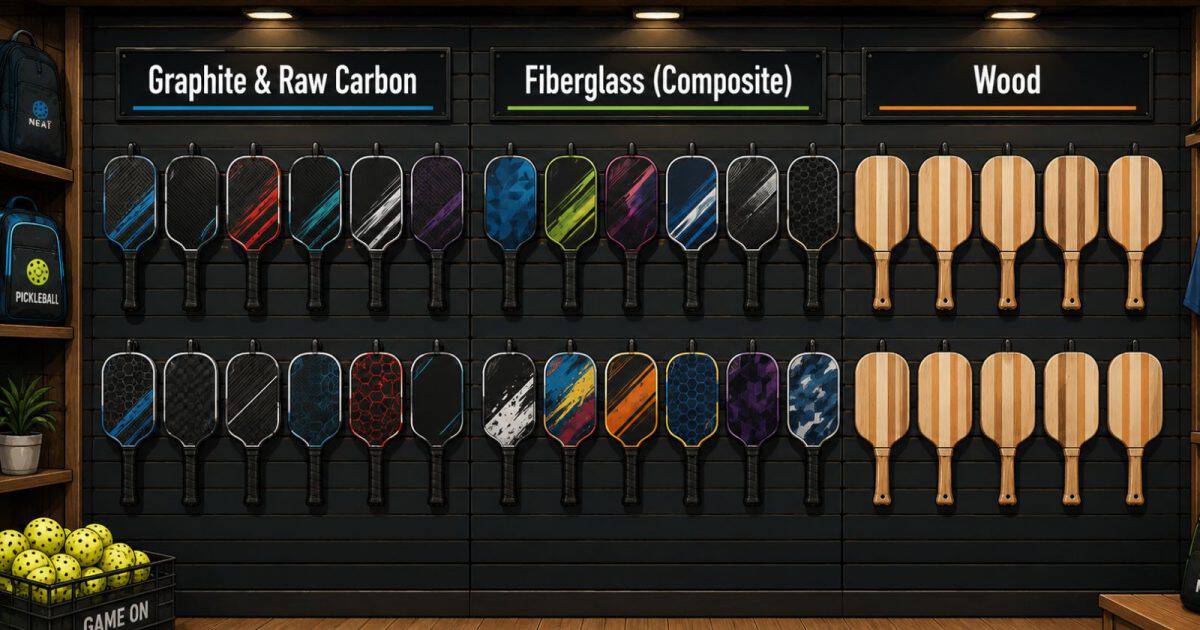
Raw carbon fiber faces are common on higher-spin paddles because the unfinished, textured surface grips the ball longer at contact. Fiberglass faces are livelier and often priced lower, trading some spin for more pop. Composite faces blend the two.
Topspin drives and dipping third shots favor raw carbon. Blocking, dinking, and free power without a hard swing favor fiberglass.
How Much Should a Paddle Weigh?
Weight changes how a paddle feels in a fast exchange more than any other spec. A lighter paddle moves faster at the net and stays in position when a ball comes back quickly. A heavier paddle carries more mass into contact, for more pace on drives and better stability on a mishit.
Swing weight, a number some brands now publish alongside static weight, predicts how heavy a paddle feels in motion. PJ’s guide on paddle swing weight explains why two paddles with the same static weight can feel very different in a hands battle.
Anyone with a history of elbow or shoulder soreness should lean toward the lighter end of a paddle line and add mass later with tape. Removing weight is not practical, so starting light is the easier path.
Does Paddle Shape Matter?
Shape affects reach and forgiveness more than most players expect. Under Rule 3.D.2 of the 2026 USA Pickleball rulebook, a legal paddle’s length cannot exceed 17 inches and its combined length and width cannot exceed 24 inches. Every shape fits inside that limit; they divide the space differently.
- Standard or widebody. Close to the widest legal build, with a wide sweet spot and forgiving off-center contact.
- Elongated. Closer to the length limit and narrower, for more reach and leverage on drives, with a smaller sweet spot.
- Hybrid. Splits the difference, a common next step once a player knows which trait matters more.
Handle length follows the same tradeoff: longer suits a two-handed backhand, shorter leaves more face for a one-handed swing.
What Grip Size Do You Need?
Measure from the crease in the palm to the tip of the ring finger. That measurement, in inches, is a reasonable estimate of the grip size to look for on a spec sheet.
Too small forces a tighter squeeze to keep the paddle from twisting, which tires the forearm. Too large cuts down on wrist snap for serves and dinks. Between two sizes, the smaller one is the safer pick, since building a grip up with an overgrip is simple and shaving one down is not possible.
How Much Should You Spend?
Three price bands cover most of the market. According to Pickleheads, as of September 2026, budget paddles run about 40 to 100 dollars, midrange paddles run about 100 to 180 dollars, and premium paddles run about 180 to 300 dollars.
Those bands line up with what two larger brands sell today. JOOLA’s Pro IV lists at 229.95 dollars, with some models on sale near 149.95, and its Pro V lists at 299.95, according to joola.com. Selkirk sells paddles under 100 dollars alongside premium models like the LUXX Control Air at 280, according to selkirk.com.
A midrange paddle today plays close to what a premium paddle did two seasons ago, since better cores and faces move into cheaper lines over time.
Do You Need a USAP Approved Paddle?
Only for sanctioned tournament play. USA Pickleball maintains an Approved Equipment List at equipment.usapickleball.org, and any paddle used in a sanctioned event must be on it. Recreational and most local league play does not require checking that list.
USA Pickleball certifies submitted paddles against limits in its Equipment Standards Manual, including a coefficient of restitution measurement and a spin rate test, according to its equipment program. Nearly every paddle from an established brand clears that bar.
How Do You Test a Paddle Before Committing?
A demo program answers this better than a spec sheet, and most direct-to-consumer brands run one. Three checks on court cover most of what matters:
- Hit 20 cross-court dinks. A ball that keeps popping up means the paddle is livelier than the current touch can control.
- Hit 10 third-shot drops. Counting how many land in the kitchen shows whether the core thickness matches the swing.
- Play one fast hands battle at the net. A paddle that feels late is carrying more swing weight than is comfortable.
That takes about ten minutes and tells a player more than a spec sheet. If the drops are the weak point, PJ’s beginner drills guide has reps built around exactly that shot.
Frequently Asked Questions
What paddle should a beginner buy?
A standard-shape paddle with a thicker core and a raw carbon or composite face, in the middle of a brand’s weight lineup, is a common starting point. It is forgiving on mishits and holds up past a first season. PJ’s guide on what paddle weight a beginner should use walks through matching weight to a first purchase.
Is a more expensive paddle actually better?
Up to a point. Budget paddles run 40 to 100 dollars and premium paddles run 180 to 300 dollars, per Pickleheads. The jump from budget to midrange is significant; midrange to premium is smaller, and buys more quality control than raw performance.
What is the difference between a 14mm and a 16mm core?
Thickness. A 14mm core returns more energy off the face, so shots carry more pace with less swing effort, and soft shots are harder to control. A 16mm core absorbs more of that energy, which makes dinks, drops, and resets more consistent. JOOLA sells its Pro V and Pro IV lines in both thicknesses, according to joola.com.
Can I use the same paddle indoors and outdoors?
Yes. The paddle does not need to change, the ball does. Outdoor balls are harder with smaller holes, and indoor balls are softer with larger holes, which changes how a shot behaves off the face. PJ’s breakdown of indoor versus outdoor pickleballs covers what else changes between the two.
What is a thermoformed paddle?
A paddle built with its edges fused under heat and pressure instead of glued, usually with a foam-injected perimeter. PJ’s explainer on thermoformed pickleball paddles covers the tradeoffs.
Should a beginner buy a paddle set or a single paddle?
A single paddle, chosen to fit the specs above, is the better starting point. Two-paddle sets are built for guests and gift-giving, and the paddles inside them are typically a brand’s most basic model.
Ready to see a few paddles in hand before buying? PJ’s pickleball gear and accessories directory lists paddle retailers by location, so a player can find a wall of demos or a specialty shop nearby before spending on a new paddle.
Written by the Pickler Junction Team.