
What Are Hand Signals in Pickleball Doubles?
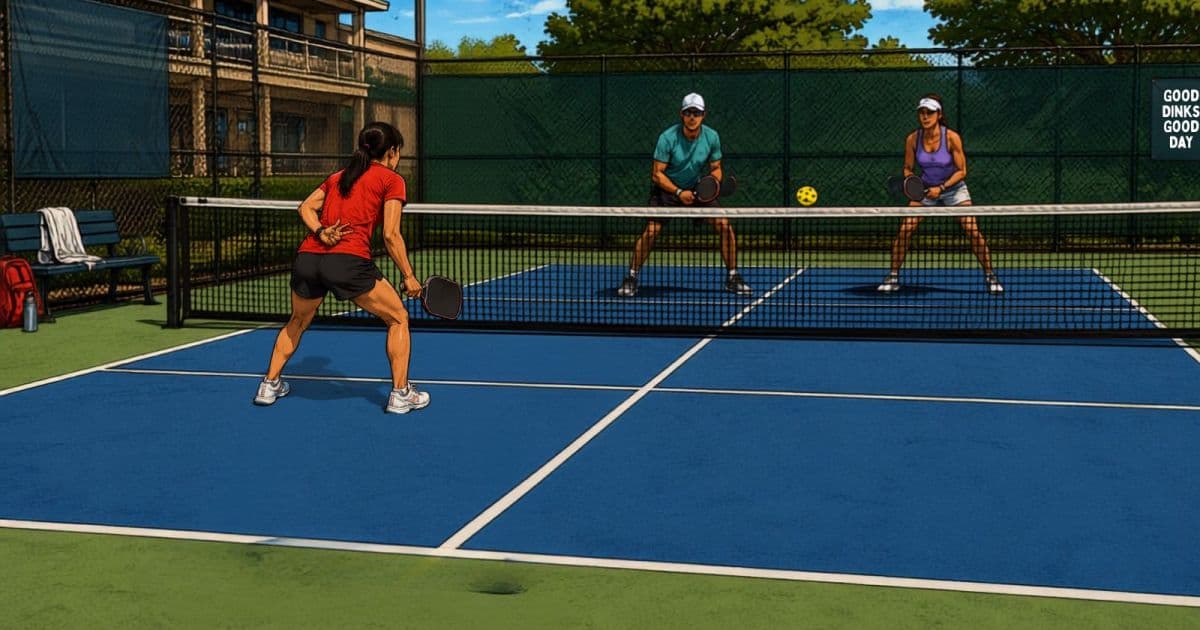
Quick Answer: Hand signals let doubles partners agree on what happens after the serve without telling the opponents. The two universal ones are a flat open hand meaning switch, and a closed fist meaning stay. They are given behind the back, before the serve, by the player at the net.
Nothing about them is official. They are a convention, and the only requirement is that you and your partner mean the same thing.
Why do partners use signals at all?
Because the plan has to be set before the ball is live, and saying it out loud tells everyone.
Doubles is decided by who covers the middle and who ends up on which side. Both of those need to be agreed in advance. Once the serve is struck there is no time to negotiate, and calling switch out loud gives the opponents a free half second to aim at the gap.
What are the standard signals?
Two are near universal, and a third is common.
- Open hand, flat palm. Switch. As soon as the ball is struck, you and your partner swap sides.
- Closed fist. Stay. Hold your current positions.
- Two fingers in a V. Fake. Start to move as though switching, then return to your original side.
- One finger. Commonly used for poach, meaning the net player is crossing and the server covers the vacated side.
- Thumbs up. Often used as a confirmation, or in some systems as an aggressive mode signal.
Beyond the first two, systems vary from partnership to partnership. That is fine, provided you settle it before the match rather than during it.
Who gives the signal and when?
The player at the net, behind their back, before the serve.
On the serving team, the net player signals to the server before the serve is delivered. The hand goes behind the back so only your partner can see it. On the receiving team, the returner’s partner signals in the same way. The signal is given, acknowledged, and then the point starts.
Acknowledgement matters more than people think. A nod or a quick word confirms it was seen. An unacknowledged signal is the most common cause of two players ending up on the same side of the court.
How do signals relate to stacking?
Signals are how stacking gets communicated point by point.
Stacking means positioning both players on preferred sides regardless of whose turn it is to serve or receive, usually to keep a forehand in the middle or to protect a weaker backhand. Because you are not always stacking, you need a way to say whether this point is a stacked one. That is what the open hand does. Our guides to stacking and stacking with a lefty partner cover the positioning itself.
What about poaching signals?
Same idea, different information.
A poach signal tells your partner that you intend to cross and cut off the return, so they need to cover the space you leave. Without the signal, a poach is a gamble that leaves half the court open. With it, it is a planned trap. The essential part is not which finger you hold up, it is that both players know who owns the vacated side.
Poaching without signalling is the fastest way to frustrate a partner, because they cannot cover the court you just left. It was not the poaching. It was that they had no idea it was coming.
Are hand signals legal?
Yes, entirely.
Nothing in the rules restricts partners from communicating before or during a point, including by hand. Concealing the signal from opponents is also legal. What you cannot do is use signals to delay the serve, because once the score has been called the server has 10 seconds to serve or a fault is declared.
Do you need signals in recreational play?
Not at first, and they are worth learning earlier than most players do.
In casual open play with rotating partners, elaborate systems create more confusion than they solve. Two signals, switch and stay, are usually enough with someone you just met. Save the fuller system for a regular partner. Our guide to open play etiquette covers how much system to bring to a drop in session.
How do you set up a system with a new partner?
Ninety seconds before the first serve.
Agree on three things. What open hand means, what closed fist means, and who covers the middle by default. That is enough to play a full match cleanly. Add a poach signal only if you both actually poach. Systems fail when they are more complicated than the partnership needs.
Frequently asked questions
What do pickleball hand signals mean? An open flat hand means switch sides after the serve. A closed fist means stay in position.
Who gives the signal? The player at the net, on either the serving or receiving team, held behind the back so only their partner sees it.
Are hand signals allowed in tournaments? Yes. Partner communication, including concealed hand signals, is legal.
What signal means poach? There is no universal one. A single finger is common. The meaning matters more than the gesture, so agree in advance.
Do I need signals to stack? Practically, yes. Signals are how you tell your partner whether this particular point is stacked.
Should beginners use hand signals? Two signals are plenty at the start. Complex systems slow beginners down more than they help.
What if my partner misses the signal? Require an acknowledgement. A nod costs nothing and prevents the most common doubles breakdown.
Two signals, acknowledged every time, will fix more doubles problems than a new shot will. To find a coach who can build doubles systems with your partner, browse our pickleball coaches directory.
Written by the Pickler Junction Team.