
How to Hit the Third Shot Drop in Pickleball (And Why It Changes Everything)
Quick Answer: The third shot drop is a soft, arcing shot hit near the baseline that lands in the opponent’s kitchen. Relax the grip, swing low to high with an open paddle face, and lift the ball with the legs instead of the arm, clearing the net by about 6 to 12 inches. It neutralizes the net team’s advantage.
The third shot drop is the soft third shot of a rally, hit after the serve and the return, designed to land in the non-volley zone. It is the shot that separates intermediate players from beginners, and learning it changes how points get won.
What the third shot drop does
After the serve and the return, the returning team usually gets to the kitchen line first, where the net gives them the advantage. Under the 2026 USA Pickleball rulebook, the non-volley zone is a 7-foot by 20-foot area on each side of the net, and Rule 11 covers faults for entering it to volley. The third shot drop is the serving team’s answer to that positioning gap. A soft ball that arcs over the net and settles into that zone forces the returning team to hit up, which buys the serving team time to move forward.
Why it changes everything:
- It neutralizes the net advantage the returning team gets by arriving at the kitchen line first.
- It buys time to advance to the kitchen line so both teams are on even footing.
- It forces a defensive reply, since a low ball in the kitchen is hard to attack.
- It shifts the point from defense toward neutral or offense.
Points in pickleball are usually decided at the kitchen line, and the third shot drop is how the serving team gets there against opponents who already hold it. Skip the drop, and the point often turns into a baseline drive battle that favors whoever is already at the net. A shot selection guide covers when the drop is the right call.
How to hit the third shot drop
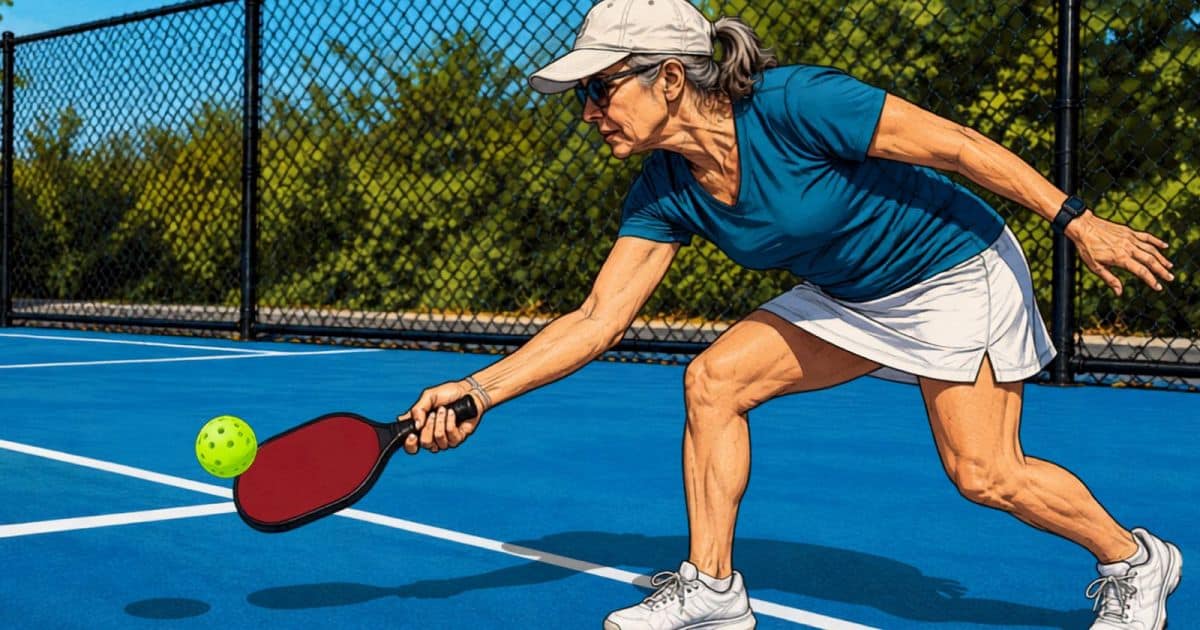
Lift the ball softly with a low-to-high swing and let the legs, not the arm, generate the shot. The drop is about touch, not power, and swinging hard is the most common instinct, which is exactly wrong here.
Step by step:
- Relax the grip. A tight grip kills feel. Hold the paddle loosely, around a 3 or 4 out of 10 on a tightness scale.
- Get low with the legs. Bend the knees and drop the body, rather than scooping with the arm.
- Open the paddle face slightly so the ball lifts on a gentle arc.
- Swing low to high, a smooth lift from below the ball toward the target.
- Contact the ball out in front, slightly below waist height, not beside or behind the body.
- Aim for net clearance of about 6 to 12 inches, a benchmark used in a solo third shot drop guide from The Dink Pickleball, so the ball still peaks on your side and falls into the kitchen.
- Follow through low and out in front, toward the target, not up toward the shoulder, then move forward.
The goal is an arc that lands in the back half of the kitchen, ideally down the middle, with the ball already descending as it crosses the net so it cannot be volleyed aggressively. A guide on hitting down the middle explains why that target line causes more confusion between opponents than a sharp angle does. Think lift and float, not hit.
The common mistakes and how to fix them
Too hard, too low, and too tense. Almost every third shot drop error traces back to one of these three, and each has a simple fix.
Common errors:
- Hitting it too hard, so it sails deep and gets attacked. Fix: take pace off and aim higher over the net, letting the arc do the work.
- Hitting it too low, into the net. Fix: open the face more and lift, aiming for clear net height.
- Gripping too tight, which removes touch. Fix: loosen the grip and use the legs instead of the arm.
- Reaching or contacting late. Fix: contact the ball out in front, moving the body into the shot rather than stretching for it.
How to drill it, using the progressive benchmarks from a solo third shot drop guide published by The Dink Pickleball:
- Stage one: stand at the baseline with a partner or ball machine feeding from the kitchen, and work toward 10 consecutive drops landing anywhere in the kitchen.
- Stage two: once stage one is consistent, aim for 10 consecutive drops landing in the back half of the kitchen specifically.
- Stage three: add movement, stepping side to side or forward between feeds, and work toward 10 consecutive drops while moving.
- Wall and basket reps: the same guide suggests 50 continuous soft contacts against a wall, or 100 or more basket reps, as practice volume between live-feed sessions.
That progression takes about four to six weeks of deliberate practice to show up as a noticeable change, according to the same guide. See the beginner drills guide for more structured reps, and the how to improve at pickleball fast guide for the bigger picture. A third shot drive versus drop comparison is worth reading once the drop feels dependable.
Frequently asked questions
What is the third shot drop in pickleball?
It is a soft, arcing shot hit from near the baseline, the third shot of the rally, that lands in the opponent’s non-volley zone. Under the rulebook, that zone is a 7-foot by 20-foot area on each side of the net, and landing a drop inside it neutralizes the returning team’s net advantage.
Why is the third shot drop so important?
Because points are usually decided at the kitchen line. The drop lets the serving team move forward safely against opponents who already control the net, shifting the point from defense toward neutral.
How do I stop hitting my drops too hard?
Take pace off, loosen the grip, and aim higher over the net so the arc carries the ball into the kitchen. Use the legs to lift rather than swinging hard with the arm.
Should I drop or drive the third shot?
Both have a place. The drop is the higher-percentage neutralizer against opponents already at the line. A drive works when the return sits up, and it is often followed by a reset if the opponent handles it.
Is the third shot drop hard to learn?
It takes practice because it is a touch shot, but it is learnable with repetition. A solo third shot drop guide from The Dink Pickleball tracks four to six weeks before players notice a real change, and two to three months before it holds up under match pressure.
Where should the third shot drop land?
In or near the kitchen, ideally in the back half and down the middle, with the ball already descending as it crosses the net so it cannot be attacked.
How high should a third shot drop clear the net?
About 6 to 12 inches, based on the net-clearance benchmark in a solo third shot drop guide from The Dink Pickleball. Clearing much higher gives an opponent more time to react; clearing much lower risks the net.
What is the two-bounce rule and how does it set up the third shot?
Under Rule 10.A, the serve and the return of serve must each bounce before being played. That two-bounce rule is what creates the third shot in the first place, since the serving team must let the return bounce, and the drop is the shot most commonly used to answer it.
Pick a partner or a wall, count ten drops in a row, and move the target once that gets easy. If the motion still feels off after a few sessions, a coach can usually spot the fix faster than more solo reps will, and a clinic versus private lesson comparison can help decide which format fits. Search the pickleball coaches directory to find one near you.
Written by the Pickler Junction Team.