Pickleball Singles Strategy: How to Win the One-on-One Game
Quick Answer: Singles rewards court coverage over the soft game, since one player cannot hold the kitchen line alone. Serve deep, recover to the middle of your opponent’s angles after every shot, and move your opponent side to side before hitting behind them. The two-bounce rule and court size, set by Section 3.A.1 of the 2026 USA Pickleball rulebook, stay identical to doubles.
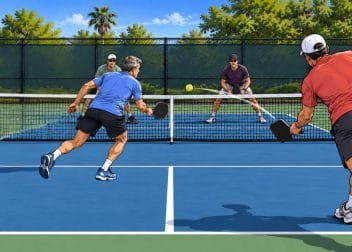
Singles looks like doubles with fewer people and plays like a different sport. The court does not shrink, so the same court that two players share in doubles becomes one player’s responsibility alone.
Why does singles play so differently?
Because you cannot cover the court from the kitchen line by yourself.
In doubles, two players at the net hold the line and dink patiently, since between them they cover the width. Alone, standing at the kitchen line means conceding a lob or a passing shot to either side. The result is that singles gets played further back and more aggressively.
That single fact reshapes everything. The dinking exchanges that decide doubles points barely happen in singles, and deep, penetrating shots do the work instead.
The court itself does not change. Under Section 3.A.1, the regulation court is 20 feet wide and 44 feet long for every format, and the non-volley zone stays 7 feet deep on each side of the net. The two-bounce rule under Rule 10.A applies exactly as it does in doubles, and games are still played to the same target, first to 11 points and winning by at least 2. See what score you need to win in pickleball for every scoring format the sport uses.
What does change is the serving sequence. Section 5.A.2 has a singles server keep serving, alternating the right and left serving areas after each point won, until losing a single rally. Section 5.B gives each doubles team two servers before a side-out, except at the start of the game. One missed rally ends a singles turn to serve, while a doubles team gets a second server first. A guide to playing pickleball singles covers the full format, and pickleball singles vs doubles breaks down every other difference between the two.
What is the serve worth in singles?
Considerably more than in doubles, and it is the biggest tactical difference.
With no partner to lean on, a deep serve pushes your opponent back and buys you time to set up. A short serve invites them forward and hands over the initiative. Depth matters more than pace, and consistency matters more than either.
Where you serve from still follows your own score. Under Section 5.A.1, the serve goes in the right serving area when your score is zero or even, and the left serving area when your score is odd. Keep this straight in singles especially, since you are tracking only your own score, not a shared team total.
The return follows the same logic. A deep return keeps the server pinned and lets you take the middle of the court. A short return in singles is close to giving away the point, because your opponent steps in and hits forward while you are still recovering. A guide to returning serve covers the mechanics, and the depth principle applies doubly here.
Serving to the backhand is the standard pattern in most racquet sports, since most players’ backhands produce a weaker, shorter reply than their forehands.
Where should you recover to?
The middle, every time, before the next ball arrives.
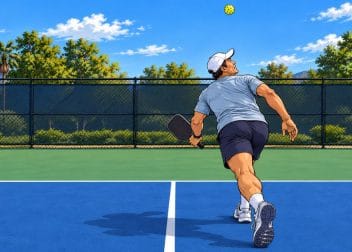
Recovery position is the whole game in singles. After hitting a wide shot, the geometric middle of your opponent’s possible replies is where you need to be, and getting there is a footwork problem more than a shot problem.
Three habits do most of the work:
- Move immediately after contact. Watching your own shot is how you end up out of position for the reply.
- Recover to the middle of the angles available, which shifts with where your opponent is hitting from, not the literal center line.
- Split step as they strike. The pause that keeps you balanced matters more in singles than anywhere else, because you have farther to travel.
Players who lose singles despite hitting well are almost always losing it on recovery, not on strokes. If footwork fundamentals need work before adding the patterns below, start with pickleball strategy for beginners.
What patterns actually win points?
Move them side to side, then hit behind them.
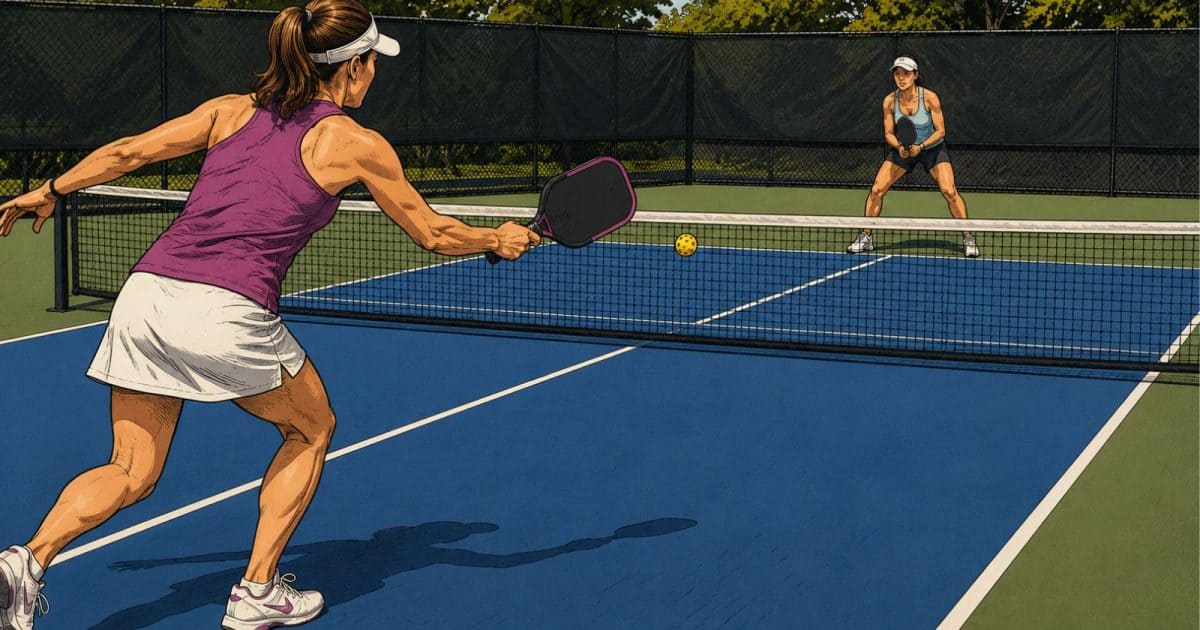
The core singles pattern is simple. Use angles to pull your opponent wide, then hit either into the open court or, better, back behind them as they recover. The behind-them ball wins points because it catches a player already moving the other way.
Two more patterns worth having:
- Deep and wide, then short. Push them behind the baseline repeatedly, then drop one short. The change of depth is harder to cover than the change of direction.
- Attack the short ball. Any shot that lands short in singles is an invitation to come forward and finish, and the drive is the shot for it.
What does not work is trying to win by patience alone. The soft game rewards two players holding the line together. Alone, a soft ball just brings your opponent forward with time to spare.
How should you train for it?
Fitness first, then patterns.
Singles is physically demanding in a way doubles is not. Covering the full court alone means far more distance per point, and matches are decided by who is still moving well late in a match.
For practice, skinny singles is the best available drill. Playing half the court lengthwise forces placement under pressure and keeps the running manageable, which makes it a genuinely useful format rather than a compromise for odd numbers.
Wall work builds compact, repeatable shots but does nothing for the footwork singles demands, which is worth knowing before relying on it. A guide to practicing against a wall covers what it does and does not teach.
FAQ
How is singles strategy different from doubles? Singles is a court-coverage game played further back, with deep, aggressive shots. Doubles is a soft game played at the kitchen line. The dinking exchanges that decide doubles points barely happen in singles.
Should you go to the kitchen line in singles? Only to finish a point off a short ball. Holding the line alone concedes a lob or a passing shot to either side, since one player cannot cover both angles.
Where should you serve in singles? Deep, and usually to the backhand. Depth pushes your opponent back and buys time to set up, and a weaker backhand reply gives an easier next shot.
How does score determine where you serve from? Under Section 5.A.1, the serve goes in the right serving area when the server’s score is zero or even, and the left serving area when the score is odd, the same rule that governs doubles serving position.
Where should you stand after hitting? Recover to the middle of the angles your opponent can hit from, which is not always the literal center line. Move immediately after contact rather than watching your own shot.
What is the best singles pattern? Move your opponent wide with angles, then hit behind them as they recover. Catching a player moving the wrong way wins more points than hitting into open court.
Does the court get smaller for singles? No. Under Section 3.A.1, the court stays at 20 feet by 44 feet for singles and doubles alike, which is what makes singles the more demanding format physically.
Do the rules change in singles? Mostly the serving sequence. Under Section 5.A.2, a singles player serves until losing a rally, while Section 5.B gives each doubles team two servers before a side-out. The two-bounce rule under Rule 10.A and the non-volley zone under Section 11 stay identical in both formats.
Want the movement patterns coached rather than discovered on court? The coaches in the Pickler Junction directory work on singles court coverage, serve depth, and recovery footwork directly.
Written by the Pickler Junction Team.