Pickleball Singles vs Doubles: What Changes
Quick Answer: Singles and doubles share the same court, net, and two-bounce rule, but scoring changes from two numbers to three, doubles servers work through a 0-0-2 start, and singles demands far more court coverage and cardio. Under the 2026 rulebook, singles rewards depth and endurance, while doubles rewards net positioning, dinking, and partner coordination.
How Does the Score Call Differ in Singles and Doubles?
Under the 2026 rulebook, Section 6, a singles score is called as two numbers: the server’s score first, then the receiver’s score. A doubles score uses three numbers instead, the serving team’s score, the receiving team’s score, and the server number, one or two, so a rally might open with a call like “3-5-2.” Every doubles game begins with the score called as “zero, zero, two,” a reminder that the first team to serve only gets one server before the first side out. Section 6 also requires the full score to be called before the serve is struck, in both formats. The guide to pickleball singles rules and the breakdown of how pickleball scoring works cover both calls in more depth.
Who Serves First, and How Does the Rotation Work?
Serving position in singles tracks the server’s own score. When that score is zero or even, the serve comes from the right side of the court; when it is odd, the serve comes from the left. Doubles serving works through the 0-0-2 start named in Section 7 of the 2026 rulebook: the player who begins the game on the right is treated as the team’s second server, so that side only gets one turn to serve before the first side out. After that opening side out, each team’s players serve in sequence, first server then second server, before the ball changes hands again. The pickleball serving rules cover the full mechanics of when to switch sides and how the count moves.
Does the Court or Equipment Change Between Formats?
No. The court measures 20 feet by 44 feet, the net sits 36 inches at the sidelines and 34 inches at the center, and the non-volley zone, or kitchen, extends 7 feet from the net on both sides, regardless of whether one player or two are on each side. The two-bounce rule in Rule 10.A of the 2026 rulebook also applies identically in both formats: the serve and the return of serve must each bounce once before either side is allowed to volley. What changes is not the field of play but how two people, or four, choose to occupy it.
How Does Court Coverage and Movement Change?
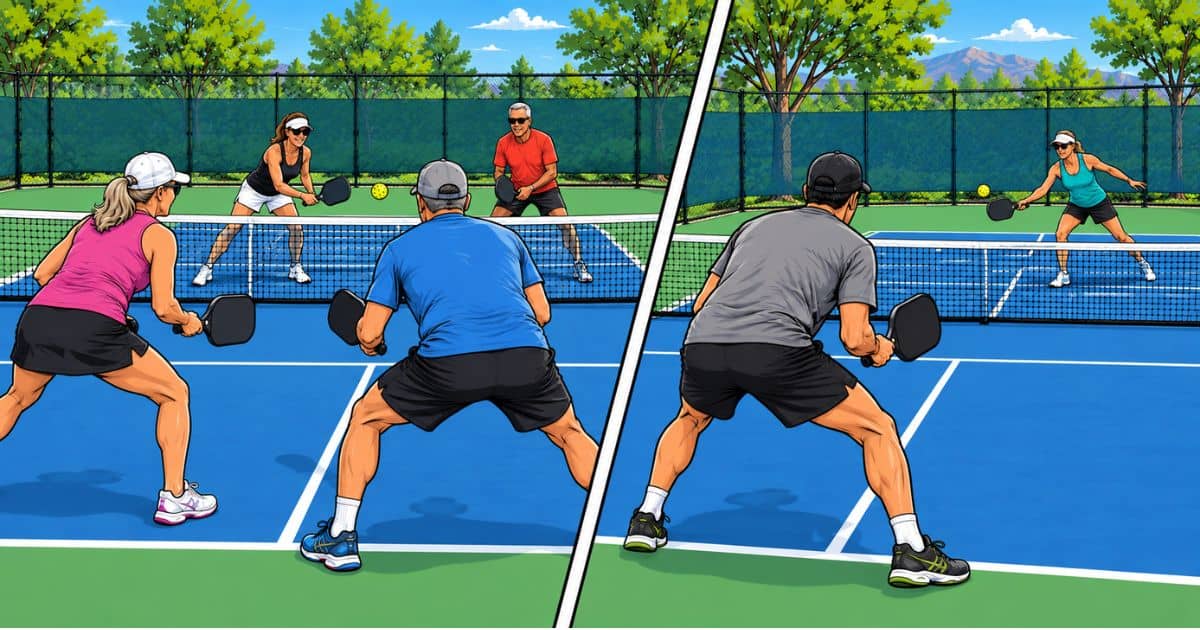
This is where the formats diverge the most physically. A singles player has to cover the entire 20-by-44 court alone, which means more running corner to corner and more transitions from baseline to net on every point. A doubles team splits that same footprint between two players, so each partner is typically responsible for roughly half the court and leans on the other to cover gaps down the middle or at the net. That shared coverage is also why doubles partners lean so heavily on communication and hand signals to divide responsibility before the point even starts, a system covered in the guide to hand signals in pickleball doubles.
What Shot Selection Changes Between the Two Formats?
Because a singles court has more open space to attack, singles rallies feature more groundstrokes, deeper drives, and lobs aimed at pulling the lone opponent out of position. Doubles rallies compress toward the net faster, since two players close down the middle and the non-volley zone together, which makes soft, patient dinking and the third shot drop far more valuable than a hard drive. The two-bounce rule still forces every rally to open the same way in both formats, with a bounced serve and a bounced return before anyone can step in and volley. Players moving between the two styles often find their doubles instincts do not transfer directly, which is why the strategy notes in pickleball doubles strategy focus so heavily on positioning at the kitchen line rather than power.
How Much Harder Is Singles on Fitness?
Singles is the more demanding format on the body, and the research on court time backs that up. A 2018 study led by exercise researcher Lance Dalleck measured middle-aged and older adults wearing portable metabolic sensors during real gameplay and recorded roughly 355 calories burned per session. A separate 2022 study by Webber and colleagues found recreational players averaging a heart rate around 111 beats per minute, about 70 percent of age-predicted maximum, during typical play. Singles pushes players into moderate-intensity heart rate zones up to about 80 percent of playing time, compared with roughly 50 percent of the time in doubles, since a singles player never gets a break while a partner covers the point. Anyone curious how their own sessions stack up can work through the full numbers in the guide to how many calories you burn playing pickleball.
How Do Tournament Formats and Ratings Differ?
DUPR, one of the ratings systems used across sanctioned play, calculates and tracks singles and doubles ratings independently, since the two formats reward different strengths, court coverage and serve depth in singles versus net control and partner timing in doubles. Tournament brackets follow that same split: singles events are seeded on a player’s singles rating, doubles and mixed doubles events use the doubles rating, and it is common for a player to carry a noticeably higher rating in one format than the other. Standard scoring in both formats is games to 11, win by 2, under the 2026 rulebook, with a rally scoring option listed only as a variation in Section 14.
What Is Skinny Singles, and How Does It Bridge the Two?
Skinny singles, often called mini-singles, is a two-player drill that borrows the doubles mindset without needing four people on the court. Players use only half the court, splitting it along the centerline, while the non-volley zone stays fully in play just as it would in a full game. Every shot is hit cross-court into the opponent’s half, and because that lane narrows to roughly 10 feet wide per player, hard passing shots stop working the way they do in full-court singles. That forces the same drop shots, dinking patience, and net presence that define doubles play, which is why players use it to rehearse doubles patterns with only one hitting partner. The primer on can you play pickleball singles and the deeper look at what skinny singles is cover how to set the drill up on a shared court.
Frequently Asked Questions
Is the court a different size for singles than for doubles? No. Both formats use the same 20-by-44-foot court, the same net height, and the same 7-foot non-volley zone under the 2026 rulebook.
How is a doubles score called compared to a singles score? A singles score is called as two numbers, the server’s score then the receiver’s score, while a doubles score adds a third number for which server is up, under the 2026 rulebook, Section 6. Every doubles game starts with the call “zero, zero, two” under that same section.
What does the 0-0-2 start mean in doubles? It means the team serving first in a game only gets one server before the first side out, because that starting player is counted as the team’s second server under the 2026 rulebook, Section 7. After the first side out, both partners on each team serve in turn.
Does the two-bounce rule work differently in singles? No. Rule 10.A requires the serve and the return of serve to each bounce once before either side may volley, and that requirement is identical in singles and doubles under the 2026 rulebook.
Is rally scoring standard in singles or doubles? No. The standard format in both singles and doubles is side-out scoring to 11, win by 2, under the 2026 rulebook. Rally scoring only appears as an optional variation listed in Section 14 of that rulebook.
Which format burns more calories, singles or doubles? Singles tends to demand more from the body because one player covers the full court alone, reaching moderate-intensity heart rate zones roughly 80 percent of playing time compared with about 50 percent in doubles, based on research summarized by DUPR. A 2018 study led by researcher Lance Dalleck recorded about 355 calories burned per session among middle-aged and older players.
Do singles and doubles use the same skill rating? No. DUPR tracks singles and doubles ratings separately, and it is common for a player to rate noticeably higher in one format than the other since the two reward different strengths.
What is skinny singles used for? Skinny singles, also called mini-singles, is a two-player drill played on half the court along the centerline, with the non-volley zone still in play, used to practice the dinking and net patterns of doubles without needing four players.
Can a strong doubles player struggle in singles, or the reverse? Yes, and separate DUPR ratings reflect that gap directly, since singles rewards court coverage and depth while doubles rewards net control and partner timing rather than raw movement.
Outside of the scoring call, the serve rotation, and how much ground one player has to cover, singles and doubles run on the same rulebook: same court, same net, same two-bounce rule, same non-volley zone. What separates a strong singles player from a strong doubles partner is usually fitness and shot selection built through repetition, and a coach who has watched both formats can spot which habits to keep and which to retire. The directory of pickleball coaches lists instructors who work with players on both sides of that transition.
Written by the Pickler Junction Team.