What Is a Drive in Pickleball?
Quick Answer: A drive is a fast, low shot hit with a full swing, usually from the baseline or midcourt. Players use it to rush opponents, punish a ball that sits up, or push forward on the third shot after the two-bounce rule takes effect. It trades the safety of a soft shot for pace and pressure.
Drives are the shot most new players hit by instinct, and the shot most intermediate players learn to hit less often, and with more intention. Understanding what a drive is actually for is what separates the two stages.
What makes a shot a drive?
Pace and trajectory define a drive, not the swing itself.
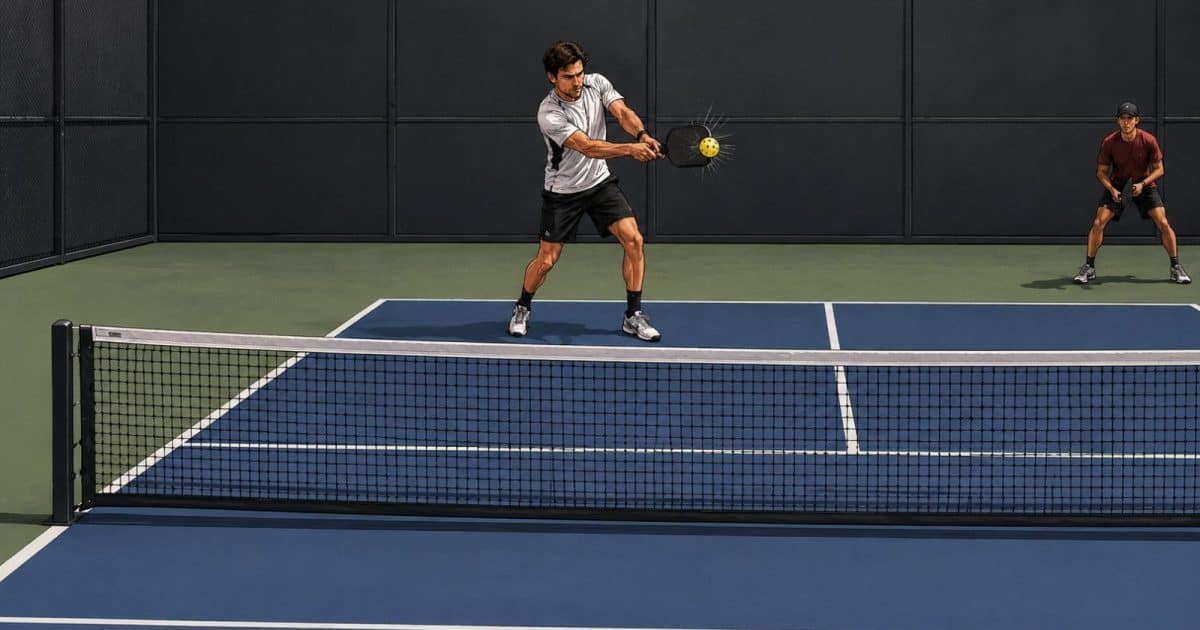
A drive travels fast and low over the net, usually clearing the tape by a foot or less. It comes off a full swing, with topspin in most cases, and it is aimed to arrive at the opponent’s feet or body rather than to land deep and float.
That distinguishes a drive from the sport’s other main shots. A drop travels high and soft to land in the kitchen. A lob travels high and deep over the opponents. A dink is soft and short, hit from near the non-volley zone. A drive is the one shot built to arrive before anyone is set, which is exactly its purpose.
What is a drive actually for?
Three jobs, and they are more specific than “hit it hard.”
- Forcing a weak reply. A hard, low ball at an opponent’s feet is difficult to handle cleanly. A popped-up answer gives the driving team the next attack.
- Buying time to advance. A drive that is not put away lets the team that hit it move forward behind the shot, which is the point of a third shot drive.
- Punishing a high ball. Any ball that floats above net height is drivable, and taking that chance is basic percentage play.
The third shot deserves its own note. Under Rule 10.A of the 2026 USA Pickleball rulebook, the serve and the return of serve must each bounce once before either side can volley, a rule known as the two-bounce rule. Once that requirement is satisfied, the serving team’s third shot can be either a soft drop or a hard drive, and the drive is not a lesser option just because it gets discussed as one. Driving the third shot, then closing in behind the opponents’ block, is a standard pattern, particularly for players with reliable topspin. The guide to the third shot drop covers the soft option a drive competes with, and the comparison of the third shot drive versus the third shot drop breaks down when each one wins the point more often.
When should you drive and when should you drop?
Drive when the ball sits up and the opponents are not yet set. Drop when the ball is low and they are already at the kitchen line.
Contact height is the most reliable read. A ball struck at waist height or above supports a drive, because the paddle can travel down through it and keep the shot low. A ball at ankle height does not support a drive, because lifting it into play sends the ball up, and a lifted drive is an easy target for a player standing at the net.
Opponent position is the second input. Two opponents already established at the non-volley zone line will block a low drive back at the feet of whoever hit it, which hands them the advantage. Opponents still moving forward toward the kitchen have less time to react and less balance to block cleanly, which is when a drive tends to pay off.
The mistake to watch for is driving a low ball from deep court because hitting hard feels productive in the moment. That is a common way to give back a point already in hand. The fix is a single rule about contact height, not a change in swing technique.
How do you hit a good drive?
Low to high with the legs, brushing up the back of the ball, and finishing out in front of the body.
Topspin is what makes a drive safe to hit. A flat, hard-hit ball has almost no margin over the net, while a topspin drive can clear the net by more and still dip down inside the baseline. Contact out in front of the body matters for the same reason. It lets the paddle move upward through the ball instead of swatting at it from the side.
Target selection does more work for a drive than raw pace does. A drive aimed at the opponent’s dominant-side hip is hard to answer, because neither a forehand block nor a backhand block feels comfortable from that spot. A drive aimed at the middle of a doubles team creates hesitation between the two players over who takes the ball. A drive aimed at open court with no target in mind tends to come back at the hitter’s feet.
A drive is only half a plan. The shot that usually follows a blocked drive is a soft reset, and the guide to the reset in pickleball covers how that shot converts pressure into position at the net.
FAQ
What is a drive in pickleball? A drive is a hard, low shot hit with pace, usually from the baseline or midcourt, meant to rush opponents or force a weak reply.
What is a third shot drive? A third shot drive is a drive hit as the serving team’s third shot, once the two-bounce rule under the rulebook has been satisfied, as an aggressive alternative to the third shot drop.
Is a drive better than a drop? Neither shot is better on its own. Drives suit high contact points and opponents who are not yet set. Drops suit low contact points and opponents already established at the net.
When should a player not drive? A player should not drive when the ball is at ankle height or when both opponents are set at the kitchen line. A lifted drive from a low contact point is an easy target to put away.
Does a drive need topspin? Topspin helps considerably. It gives a drive net clearance while still bringing the ball down inside the baseline, which a flat drive struggles to do.
Where should a drive be aimed? A well-aimed drive targets the opponent’s dominant-side hip, the feet, or the middle of a doubles team. A drive aimed at open court gives opponents time to react.
Can a serve return be driven? Yes. A driven return is a common way to pressure the serving team into a rushed or weak third shot, before the two-bounce rule requirement even ends.
Why do points get lost on a drive? Points are usually lost on a drive because of contact height. Driving a ball below net level requires lifting it, and a lifted ball gets attacked by a player at the net.
A drive is a tool, not a habit, and knowing when to reach for it is most of the skill. Working with a coach who drills drive and drop selection on live points speeds that read up considerably, and the pickleball coaches directory is a place to find one nearby.
Written by the Pickler Junction Team.