Can You Put a Pickleball Court on a Driveway?
Quick Answer: You can put a pickleball court on a driveway, but few driveways hold a full one. The USA Pickleball rulebook sets playing lines at 20 by 44 feet, with 34 by 64 feet recommended overall. A typical two car driveway runs about 20 by 20 feet, enough for dinking and half court drills, not full doubles.
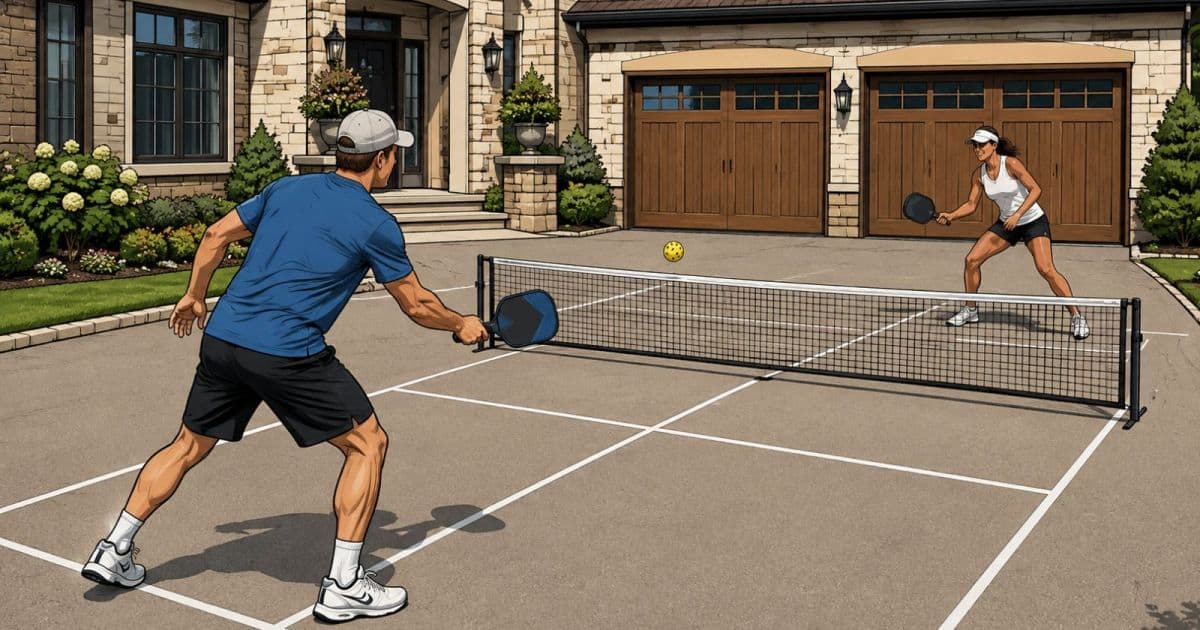
A pickleball court on a driveway is usually a portable net plus painted or taped lines on the concrete or asphalt slab you already have. Nothing structural changes, which is why it is the cheapest way to play at home.
Will a Regulation Court Fit on a Driveway?
Rarely. Measure your own slab before you buy any equipment.
Under the 2026 USA Pickleball rulebook, Rule 3.A.1 sets the playing court at 20 by 44 feet. Rule 3.A.3 recommends 34 by 64 feet of total space for a new build, though the stated minimum is 30 by 60 feet.
- Playing lines: 20 by 44 feet
- Recommended total space: 34 by 64 feet
- Typical two car driveway: roughly 20 by 20 feet
- Long single driveway: often 10 to 12 feet wide by 40 to 60 feet
Width is what kills it. A long driveway can supply the 44 feet of length, but 20 feet of usable width is rare outside a wide apron or a three car pad. If you have a large turnaround or a sport court pad, measure it. Those sometimes work.
What Can You Actually Play on a Driveway?
Plenty, and this part is easy to underestimate. A 20 by 20 foot driveway holds the entire non-volley zone and a stretch of the transition area, which covers most of what decides a pickleball point.
Under the USA Pickleball rulebook, Rule 3.A.4.c sets the non-volley zone, known as the kitchen, at 7 feet deep on each side of the net across the full 20-foot width. That is 14 feet of kitchen depth alone, before you count any transition zone.
What works well on a driveway:
- Cross-court dinking, a valuable rep for building touch
- Serve targets, if your driveway has the length
- Volleys and hands battles at the line
- Skinny singles on a half court
What does not work: full doubles, deep drives, and anything that needs a real baseline. The Pickler Junction guide to beginner pickleball drills covers which reps translate to real games, and most of the ones that matter fit inside a driveway.
A driveway nowhere near regulation size still collects more dink reps than a real court ten minutes away, for one simple reason. It sits thirty feet from your kitchen door.
How Do You Mark the Lines?
You have four options, cheapest first.
- Chalk. Free, washes away in the rain, good for testing a layout before you commit to anything.
- Throw-down marker kits. As of September 2026, these run about $25 to $40. An A11N kit sells for $39.99 and lays out a full court without tape or paint.
- Full regulation non-slip line sets. These cost more, up to about $330 for a set like the OnCourt OffCourt Deluxe Pickleball Line Set. That is a different product from a throw-down marker kit, built to stay flat and grip the surface through a season of play.
- Painted lines. Permanent, with a neat finished look, worth doing only once you are certain about the layout.
If you paint, use an acrylic line paint made for sport surfaces rather than a standard latex house paint. Acrylic sport court paint is formulated to bond to sealed concrete and asphalt, which is not what an interior or exterior latex product is designed to do.
What About the Slope and the Surface?
Driveways slope to shed water, and they slope more than a court should. A residential driveway generally needs a minimum slope of about 2 percent for drainage. A built court surface runs flatter, with sport surface contractors citing a standard slope near 1 percent, since anything steeper starts to feel uneven underfoot. In practice, a typical driveway can run close to double the slope of a real court. You will feel it. One end plays downhill, and drives that would land in on a flat court fly long here.
The surface itself is the other variable. Broom finished concrete is rougher than an acrylic court surface, so balls skid less and wear faster. Sealed concrete plays closer to true court speed. Neither surface stops you from drilling, but both are noticeable if you are trying to simulate real match conditions. Ball choice matters more on a driveway than it does on a finished court, since outdoor balls hold up better on rough concrete. See the Pickler Junction breakdown of indoor versus outdoor pickleballs before you stock up.
Frequently Asked Questions
How much space do you need for a driveway pickleball court?
Under the USA Pickleball rulebook, a full court needs 20 by 44 feet of playing lines and 34 by 64 feet of total space. Most driveways deliver a half court instead, and a 20 by 20 foot slab is enough for dinking, volleys, and skinny singles.
Can you paint pickleball lines on your driveway?
Yes, using an acrylic line paint made for sport surfaces. Clean and dry the concrete first, tape your edges, and apply thin coats. Avoid standard latex house paint, which is not formulated to bond to sealed concrete the way acrylic sport court paint is.
Will a portable net work on a driveway?
Yes, and a portable net is the right call for a driveway. Look for a wide, stable base, since a driveway offers nothing to anchor a net post to. The Pickler Junction comparison of portable versus permanent pickleball nets covers what to look for.
Does driveway slope ruin the game?
It changes it. Under typical construction guidance, a driveway commonly slopes around 2 percent for drainage, close to double the roughly 1 percent standard for a built court surface. For drilling, the slope barely matters. For a competitive game, it does.
Will playing damage your driveway?
No. Paddles and plastic balls do nothing to concrete or asphalt. The wear runs the other way. Rough concrete shortens the life of your balls and scuffs paddle edge guards faster than a finished court would.
Do you need a permit for a driveway court?
Almost never. Painted lines and a portable net are not construction, so most jurisdictions do not require a permit for either one. Setting a permanent net post into the slab may change that, and HOA rules on visible sport equipment sometimes apply. Check with your local building department and HOA before installing anything permanent.
What about the neighbors and the noise?
This is the real constraint on driveway play. Pickleball produces a sharp, carrying sound, and a driveway puts that sound closer to houses than a backyard court would. Set your own hours for driveway sessions before a neighbor sets them for you.
Is a driveway court worth it if it is not regulation size?
Yes, for practice. A half court thirty feet from your door removes most excuses not to drill. It will not replace a real court for match play, but it replaces not practicing at all.
A driveway setup is the cheapest way to keep a paddle in your hand, but it has a ceiling. When you decide to go bigger, whether that means a backyard slab, a shared court, or hiring a crew to build it right, the Pickler Junction guide to the true cost to build a pickleball court in 2026 shows what that costs, and the directory of pickleball court construction and infrastructure pros can connect you with people who do it for a living.
Written by the Pickler Junction Team.