What Slope Should a Pickleball Court Have for Drainage?
Quick Answer: A pickleball court should slope about one percent, which is roughly 1.2 inches of drop per ten feet, in a single flat plane. The workable range is 0.83 to 1 percent, or one to 1.2 inches of drop per ten feet. Slope in one plane, side to side or end to end, and never crown the middle.
Pickleball court slope is the deliberate tilt built into the surface so rainwater leaves on its own. It gets set when the base is graded, and it cannot meaningfully be changed afterward.
What Slope Does a Pickleball Court Need?
One percent is the working standard. That is a 1.2 inch drop for every ten feet of run, so a 34 foot wide court falls about four inches from one side to the other.
The tolerance is tighter than people expect. The accepted band runs from about 0.83 percent to 1 percent. Under that, water sits. Over one percent, players start to feel that one side of the court is downhill.
The plane matters as much as the number. The whole court should tilt as one flat surface. A crowned court, high in the middle and falling off both ways, is correct for a road and wrong for a sport court, because the two halves then play differently.
Which Direction Should the Court Drain?
Side to side, across the width, is standard for a single court or a pair. It gives the shortest run for the water and keeps the slope consistent across both halves of the court.
End to end is the usual choice when three or more courts sit in a row, because the geometry of a long bank of courts makes side to side impractical. It means water crosses the full 64 foot length, and it puts one baseline lower than the other, which is noticeable underfoot on serves.
Whichever direction you choose, know where the water goes after it leaves. A court that drains perfectly into a flowerbed that cannot absorb it has just moved the problem four feet.
Why Does Standing Water Matter So Much?
Three reasons, in ascending order of expense:
- Safety. A wet acrylic surface is slick, and puddles grow algae, which is worse.
- Surface life. Water sitting on a coating breaks it down and lifts it away from the base.
- Base failure. Water that gets through a crack softens the sub-base, which causes settling, which causes bigger cracks.
That last one is the expensive one. Surface problems cost a few thousand dollars. Base problems cost tens of thousands, because the only real fix is tearing it out. With correct slope and no standing water, a base reaches the top of its range: asphalt runs 8 to 15 years, concrete 15 to 20, and post-tensioned concrete 25 to 30.
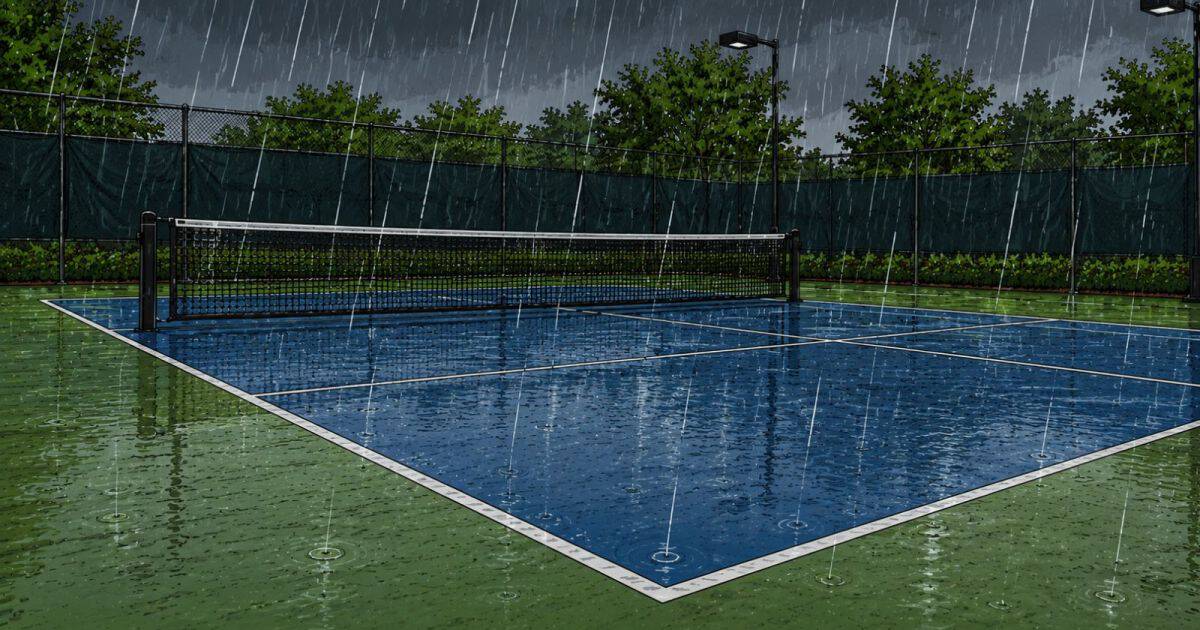
The standard rule of thumb: no puddle deeper than a nickel one hour after the rain stops. If you can see standing water an hour later, the grade is wrong.
Can You Fix Drainage on an Existing Court?
Partially, and none of the options are cheap. Patching low spots with a leveling compound handles isolated birdbaths and is the standard repair. Adding a trench drain along the low edge helps water leave faster once it gets there.
What you cannot do is re-slope a slab. If the whole court was poured flat, the real fix is an overlay or a rebuild. This is why grading deserves your money and attention during construction, and it is a big part of why the DIY route only makes sense over a slab that was already done right. Our look at court kits covers that judgment call, and concrete versus asphalt covers which base holds its grade better.
Frequently Asked Questions
How much slope does a pickleball court need?
About one percent, or 1.2 inches of fall per ten feet, in one continuous plane. The accepted band is roughly 0.83 to 1 percent, where one inch per ten feet sits at the 0.83 percent low end. That is enough for water to clear on its own and small enough that players do not feel it.
Should a pickleball court be crowned?
No. A crown makes the two halves of the court play differently and creates a ridge at the net line. Sport courts use a single sloping plane instead.
Is concrete or asphalt better for drainage?
Concrete holds its grade better over time because it does not deform under heat and load the way asphalt can. Asphalt is cheaper up front and more forgiving of minor base movement. Both need the same one percent slope.
How long should water take to clear?
Within an hour of the rain stopping, with no puddle deeper than about a nickel. Longer than that means a low spot or insufficient slope.
Can you use a drain in the middle of a court?
Avoid it. A center drain means the surface falls toward the middle of the playing area, which affects ball bounce and puts hardware right where players run. Drains belong at the perimeter.
What about indoor courts?
Indoor courts are built flat, because there is no rain to shed. Slope is purely an outdoor requirement.
Does slope affect how the ball bounces?
At one percent, not in any way players detect during a rally. At two percent or more, yes, and it becomes an unfair advantage for whoever is on the high end.
Who checks the slope during construction?
The contractor should shoot grades with a laser level before and after paving, and you can ask for those numbers. A reputable court builder hands them over without hesitation. If they will not, that tells you something.
Wondering whether a court near you drains properly? Show up an hour after the next rain at a few local public courts and you will learn more than any spec sheet can tell you.
Written by the Pickler Junction Team.