Why Does My Knee Hurt After Playing Pickleball?
Quick Answer: Knee pain after pickleball usually comes from repeated stopping, twisting, and crouching near the net, not one bad step. The American Osteopathic Academy of Orthopedics found adults 50 and older make up 91 percent of pickleball emergency department injuries. Mild pain often eases with rest, but fast swelling or a knee that will not bear weight needs a clinician.
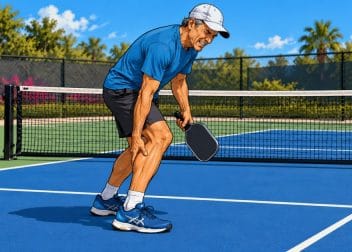
Knee pain after pickleball is soreness, aching, or sharp pain around the joint during or after play, usually tied to the sport’s stop-and-go movement rather than one memorable injury.
Why pickleball bothers knees more than walking or jogging
Walking loads the knee at a steady pace in one direction. Pickleball asks it to brake, change direction, and push off again, often several times per rally, and that deceleration is where load spikes.
The kitchen line adds to it. The non-volley zone runs 7 feet out from the net, and long dinking exchanges hold players in a half-crouch inside that strip before the knee fires backward the moment the ball comes back deep. Most outdoor courts also sit on concrete or asphalt under a thin acrylic coat, with almost no cushioning.
The kinds of knee pain that show up
The location and pattern of the pain point toward different causes.
- A dull ache in front of the knee, worse on stairs or after sitting with the knee bent, fits the pattern AAOS OrthoInfo describes for patellofemoral pain, sometimes called runner’s knee, caused by overuse, a sudden jump in activity, or weak hip and thigh muscles.
- Stiffness, swelling that builds over two to three days, and catching, locking, or giving way points toward a meniscus tear, according to AAOS OrthoInfo. That source notes a tear often follows a pivoting or cutting injury, sometimes with a felt pop, and that in older adults an awkward twist getting up from a chair can tear an aging meniscus.
- A pop, sudden instability, or a knee that will not hold weight overlaps with the warning signs Mayo Clinic lists for knee injuries and calls for prompt evaluation rather than waiting.
The same American Osteopathic Academy of Orthopedics review found fractures and sprains each made up 27 percent of pickleball emergency department injuries, as of a 2025 report, and 83 percent of patients were treated and released the same visit. Most pickleball knee pain is mechanical, not an emergency.
What to do the day it starts hurting
Stop playing that session. Mayo Clinic notes that many types of minor knee pain respond well to self-care measures, and pushing through pain is a common way a short-term problem becomes a longer one.
- Rest the leg rather than finishing the session on a knee that already hurts.
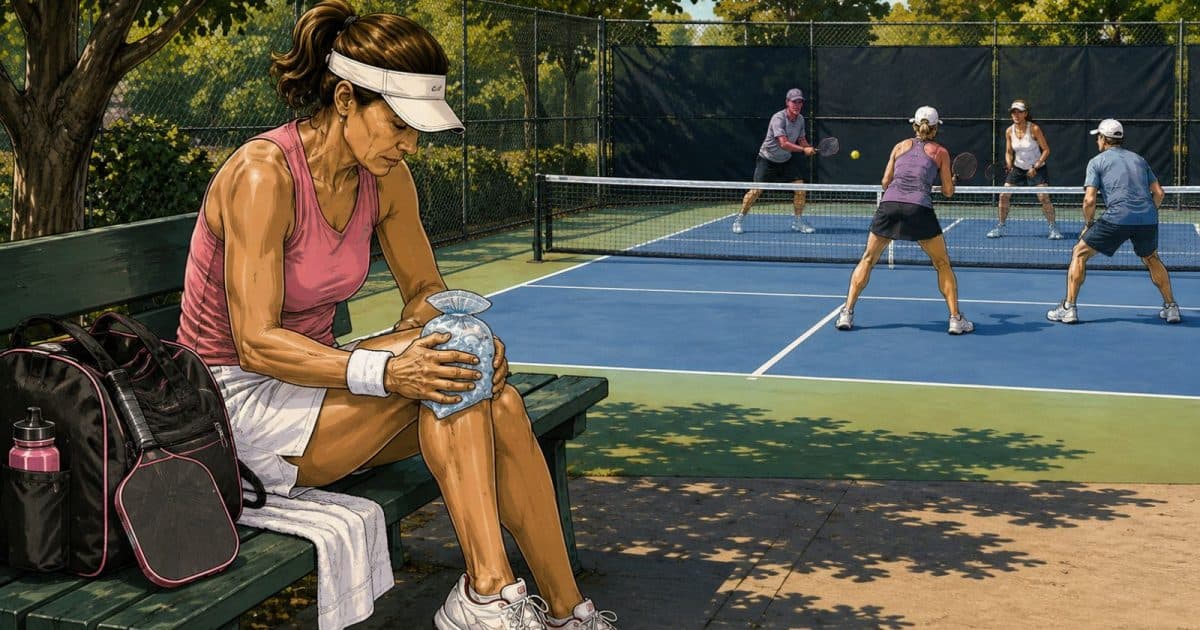
- Ice the knee that evening if there is swelling or sharp pain.
- Keep it moving gently. Slow walking and easy range of motion beat sitting still.
- Skip the next session rather than testing the knee right away.
- Return at reduced volume, such as two games instead of a full afternoon.
- Check the shoes. Court shoes have lateral structure for side-to-side loading; running shoes are built for forward motion.
Ease back in gradually rather than jumping straight back to full sessions.
When knee pain is a reason to see someone
Mayo Clinic lists signs that call for a doctor rather than another week of home care:
- The knee cannot bear weight, or feels unstable or gives out.
- There is marked swelling in the knee.
- The knee cannot fully extend or bend.
- There is an obvious deformity in the leg or knee.
- There is a fever along with redness, pain, and swelling.
- The pain is severe and tied to a specific injury.
Short of those signs, a physical therapist can often work through mechanical pain, tight hips, or poor movement patterns in a session or two. For anything on the list above, a physician is the right first call. The guide to preventing pickleball injuries covers warm-up habits that head off many of these problems early.
Playing while a knee is healing
Often, with changes. Playing doubles instead of singles cuts roughly in half how much court one player has to cover, and a partner willing to take more of the middle helps more than most gear does. Shortening how long a session runs matters more than shortening individual rallies.
An ongoing knee issue is more often about managing load over time than about a single new injury. The guide to playing pickleball with bad knees goes deeper on adapting an ongoing issue.
Whether a knee brace helps
Sometimes, and less than people hope. AAOS OrthoInfo describes a compression sleeve as adding warmth and joint position sense, with no real mechanical stability. A support brace, per AAOS OrthoInfo, helps carry load across the whole joint, often during recovery from a ligament injury, while an unloader brace is a hinged design that shifts weight away from one side of the knee, most often for arthritis centered there. None of these fix the underlying strength or movement problem behind the pain. The guide to knee braces for pickleball walks through which type fits which problem.
FAQ
Is it normal for your knees to hurt after playing pickleball? Mild soreness after a hard session is common, especially early on. Mayo Clinic notes that many types of minor knee pain respond well to self-care measures. Pain that sharpens, swells quickly, or lasts past a week falls outside that pattern.
What is patellofemoral pain? AAOS OrthoInfo describes it as a dull ache in front of the knee that worsens with stairs, squatting, or sitting with the knee bent, tied to overuse, a sudden jump in activity, or weak hip and thigh muscles.
Could your knee pain be a meniscus tear? Possibly, if stiffness and swelling build over a couple of days along with catching, locking, or giving way, according to AAOS OrthoInfo. That source notes a tear often follows a pivot or cutting motion, and in older adults, even a simple twist getting up from a chair can tear an aging meniscus.
Why does the kitchen line seem to bother knees the most? The non-volley zone extends 7 feet from the net, and long dinking rallies there hold the knee in a half-crouch before the next shot asks it to fire backward from a near stop.
Should you see a doctor or a physical therapist first? For mechanical pain with no swelling or instability, a physical therapist is usually faster. Mayo Clinic’s warning signs, including a knee that cannot bear weight, marked swelling, or fever with redness and pain, point toward a physician instead.
Do stretches after playing help with knee pain? Loosening the muscles around the knee can ease next-day stiffness, and the guide to stretches after playing pickleball covers a routine to try. Stretching will not fix an underlying injury, so pair it with rest and, if needed, a professional opinion.
Can someone play pickleball after a hip or knee replacement? Return to the court after a hip or knee replacement follows the timeline and restrictions the surgeon who did the procedure sets, not a general rule of thumb. The guide to pickleball after a hip or knee replacement covers the questions players bring to that conversation.
How is normal soreness different from an injury? Soreness that fades within a day or two, without swelling or instability, is the pattern Mayo Clinic associates with minor pain that responds to self-care. The guide to being sore after pickleball covers what typical next-day soreness feels like.
If knee pain keeps interrupting a regular game, a physical therapist or physician who understands the sport’s demands is a better next step than guessing at home care. The Pickler Junction directory of physicians and physical therapists lists providers by location. This article is general information, not medical advice.
Written by the Pickler Junction Team.