Where Should You Stand in Pickleball Doubles?
Quick Answer: Your position changes four times in a normal point. Serving, you stand behind the baseline. Returning, you stand behind the baseline and move in immediately. In between, you pass through the transition zone without stopping in it. At the kitchen line, you stand roughly two feet back from the line, level with your partner. The kitchen line is where you want to end every point, and everything else is the route there.
Positioning is the cheapest improvement available in doubles. It requires no new stroke, costs nothing to change, and decides more points than shot quality does at recreational levels.
Where do you stand when your team is serving?
Both partners start behind the baseline, and only one of you gets to leave early.
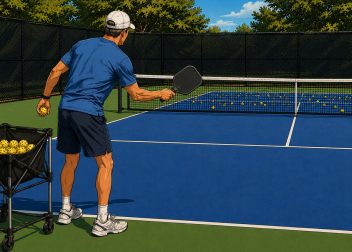
The server stands behind the baseline in the correct service half. The server’s partner also starts behind the baseline, not at the kitchen line, because the two-bounce rule means the return has to bounce before anyone can volley it. A partner standing at the net has nothing to do and no way to help.
That is the structural disadvantage of serving. The receiving team gets to the kitchen line first, and the serving team spends the third shot trying to catch up.
After the serve, the server stays back and waits for the return to bounce. Rushing forward before the ball has landed leaves you caught mid-court with a low ball at your feet, which is the worst place to make contact.
Where do you stand when your team is returning?
The returner starts deep, and the returner’s partner starts at the kitchen line.
This is the asymmetry worth exploiting. The returner’s partner has no obligation to wait for a bounce, so they take the kitchen line before the point starts. The returner stands well behind the baseline, hits a deep return, and walks in behind it.
Standing on the baseline rather than behind it is a common error. A deep serve landing at your feet forces an awkward, cramped contact. Starting a step or two further back lets you move forward into the ball instead of backing away from it.
Depth on the return is what buys the trip forward. A short return lets the serving team step in and hit down, and you never get to the line at all.
What about the middle of the court?
Nobody stands there. It is somewhere you pass through.
The area between the baseline and the kitchen line is the transition zone, and it is sometimes called no man’s land for a reason. A ball landing at your feet in that zone can only be hit upward, which hands the attack to the team already at the net.
The rule is to keep moving through it. Take a split step when your opponent strikes the ball, absorb whatever comes, and continue forward when you get a ball that lets you. If a hard shot pins you there, the answer is a soft reset into the kitchen rather than a drive, because a drive from a low contact point in the transition zone is the shot most likely to end the rally against you.
Getting stuck happens to everyone. Staying stuck, and trading shots from mid-court for the rest of the rally, is the mistake.
Where do you stand at the kitchen line?
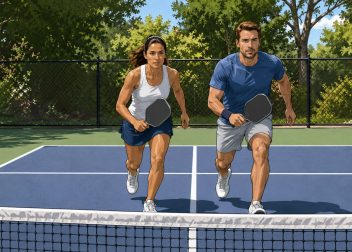
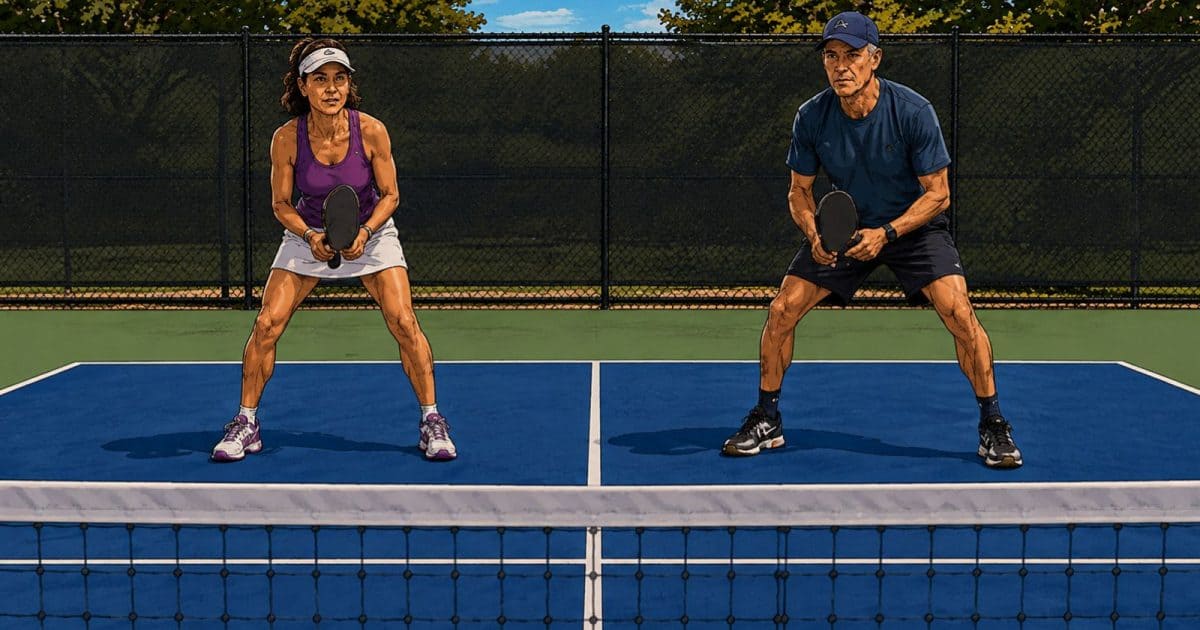
About two feet behind the line, level with your partner, with roughly the width of the court between you.
Two feet back rather than toes on the line is deliberate. It gives you room to handle a ball at your feet without stepping into the non-volley zone, and it means a lob does not automatically go over your head. Standing right on the line looks committed and gets punished by both.
Level with your partner is the part most teams get wrong. One player up and one back opens a diagonal lane straight through the middle, and it is the most punished formation in doubles. If your partner is pushed back, drop back with them. If your partner advances, advance.
The width between you is not fixed. The player nearer the ball covers the line, and the far player slides toward the middle rather than guarding an empty sideline. Which of you takes the middle in the first place is worth agreeing in advance, and our guide to which side the stronger player should take works through how to decide.
Does the score change where you stand?
Only for the serving team, and only which half you start in.
In doubles, the serving team’s score decides which side the server starts from: even score, right side; odd score, left side. The receiving team lines up to match. Everything after the first two shots is about the ball, not the score.
If you want to hold a particular side regardless of the score, stacking is the tool for it. It is a positioning trick rather than a rule change, and it exists mostly to keep two forehands in the middle or to make a lefty-righty pair work properly.
The habit of moving together, once positions are set, is a skill of its own, and our guide to moving with your partner covers it.
FAQ
Where should you stand in pickleball doubles? Behind the baseline when serving, behind the baseline and moving in when returning, and about two feet back from the kitchen line for the rest of the point, level with your partner.
Should the server’s partner stand at the net? No. The two-bounce rule requires the return to bounce, so a partner at the net has nothing to volley. Both serving partners start behind the baseline.
Should the returner’s partner stand at the net? Yes. They are under no obligation to wait for a bounce, so they take the kitchen line before the point starts.
How far back from the kitchen line should you stand? About two feet. It gives you room for a ball at your feet without a non-volley-zone fault, and it makes you harder to lob.
What is no man’s land in pickleball? The transition zone between the baseline and the kitchen line. It is somewhere to pass through rather than stand, because balls landing at your feet there can only be hit upward.
Should both partners always be at the same depth? Yes, as a default. One up and one back opens a diagonal lane through the middle and is the most punished formation in doubles.
Where do you stand for a lob? Deep enough that you rarely have to backpedal. Standing two feet off the kitchen line rather than on it is most of the answer, and turning to run rather than stepping backward is the rest.
Does where you stand matter more than how you hit? At recreational levels, usually yes. Positioning costs nothing to change and decides more points than shot quality does.
Want your positioning watched rather than guessed at? The coaches in our directory spot a formation problem in a single game, and the camps and clinics in our listings drill court movement directly.
Written by the Pickler Junction Team.