Should You Hire a Personal Trainer for Pickleball?
Quick Answer: A personal trainer for pickleball is worth it in four situations: you keep getting hurt, your fitness limits your game and self-directed work has stalled, you are starting strength training later in life and want it done safely, or you have competitive goals. Otherwise, free resources cover most recreational needs.
The trainer question is really a triage question. Everyone playing this sport benefits from off-court fitness; only some people benefit from paying a professional to run it, and the difference is worth being honest about before money moves.
What does a trainer do that a pickleball coach does not?
Different job entirely, and confusing the two wastes money in both directions. A pickleball coach improves your shots, patterns, and decisions on court. A personal trainer improves the body that executes them: strength, mobility, movement quality, conditioning.
The tell for which professional you need is where the problem lives. Losing because your third shot sits up is coach territory, and our guide to finding a pickleball coach covers that search. Losing because your legs are gone in game three, because your knee complains after every session, or because you cannot get down to low balls anymore, that is trainer territory. Plenty of improving players eventually use both, typically a coach continuously and a trainer in blocks.
A sports-literate trainer working with a pickleball player runs a recognizable program: movement assessment first, then leg and hip strength, rotational core work, shoulder durability, and the braking-and-bursting patterns the sport spends. Nothing exotic, executed consistently, adjusted to your body’s history.
When is hiring a trainer clearly worth it?
Four cases, in rough order of urgency.
- Recurring injuries. The same knee, elbow, or calf complaint after play means your body has a weak link your sport keeps finding. A trainer, sometimes after a physical therapist clears the acute problem, builds the capacity that stops the cycle.
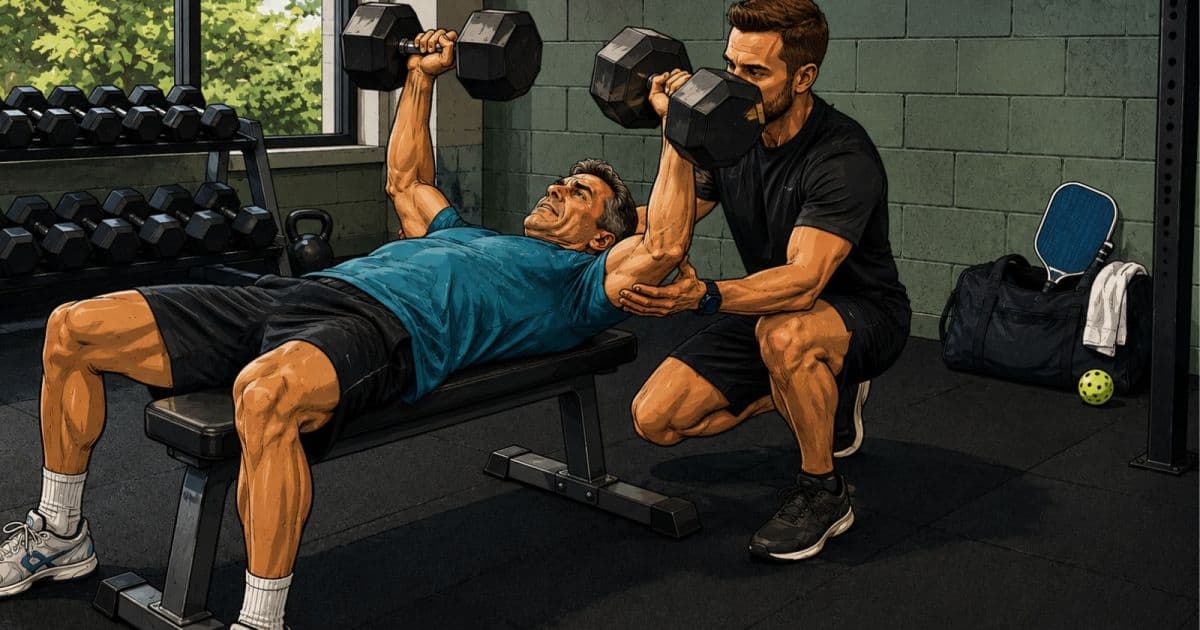
- Starting strength work after 50 or after a long break. The case for lifting is strongest exactly when the cost of doing it wrong is highest. A block of supervised sessions installs safe patterns, squat, hinge, press, that a lifetime of self-training then spends. The underlying argument lives in our guide on whether pickleball players should lift weights.
- A real plateau with a fitness signature. When you lose to players you out-skill because they out-move or out-last you, and your own gym efforts have flatlined, programming is the missing ingredient, and programming is the product trainers actually sell.
- Competitive goals. Tournament players juggling practice, matches, and fitness benefit from someone periodizing the load so peak weeks and heavy legs stop coinciding.
There is a fifth, softer case that fills more trainer calendars than any of these: accountability. If sessions only happen when someone is expecting you, that is a fact about you worth paying for rather than arguing with.
When should you skip the trainer?
When you are consistent, uninjured, and progressing, which describes more recreational players than the fitness industry suggests.
A healthy player who trains twice a week, enjoys it, and sees gradual improvement is already doing the thing. The standard program for this sport is genuinely simple, and the whole recreational menu, strength, mobility, conditioning, fits in our guide to the best off-court workouts for pickleball players plus ordinary persistence. Paying someone to watch you do what you already do is a luxury, not a plan.
Skip, too, the trainer who is wrong for the job: anyone who cannot explain how a program serves lateral movement and rotational power, anyone whose plan for a 62-year-old is the same as for a 25-year-old, and anyone allergic to the word “assessment.” Bodybuilding-style splits and boot-camp exhaustion sessions are fine products for other goals; they are not court-sport preparation.
And skip paying indefinitely for what should be a block. For most players the trainer’s highest value is front-loaded: assessment, program, technique, a few progressions. Six to twelve weeks of that, then independence with occasional check-ins, is a reasonable shape and buys most of the benefit at a fraction of the annual cost.
How do you choose one, and what should it cost you in time?
Choose for assessment quality, court-sport literacy, and age-appropriate programming, in that order, and expect two supervised sessions a week during a block, dropping to check-ins after.
The interview is short and revealing. Ask what their first session with you looks like: the right answer involves watching you move, asking about injuries and playing volume, and goals, before any workout happens. Ask how they would train someone for a lateral, reactive sport played in long sessions: the right answer mentions single-leg strength, deceleration, and rotation, not just “we’ll do legs.” Ask about experience with players your age and any credentials in strength coaching or athletic training. Certification floors exist and matter less than the answers; pattern-matching to your situation matters most.
Logistics are flexible: gyms, independent studios, and remote programming all work, and remote-plus-occasional-in-person has become a legitimate budget path where the trainer reviews movement on video and adjusts monthly.
The block model is the honest recommendation: a short run of sessions with a trainer after a recurring strain, producing a boringly effective programme you then run alone. The value is in the programme you keep, not in the subscription.
FAQ
Is a personal trainer worth it for pickleball? For recurring injuries, late starts to strength work, fitness-shaped plateaus, or competitive goals, yes. For consistent, healthy recreational players, free resources usually suffice.
What is the difference between a pickleball coach and a trainer? Coaches improve shots and strategy on court; trainers improve strength, mobility, and movement off court. Different problems, different hires.
How much time does trainer-led work take? Typically two sessions a week during a program block, often six to twelve weeks, then independent training with occasional check-ins.
What should I ask a prospective trainer? How they assess new clients, how they train lateral and rotational sports, and their experience with your age group. Vague answers to any of the three are disqualifying.
Do trainers help with pickleball injuries? With prevention and with capacity-building after rehab, yes. Active pain goes to a physical therapist or physician first; trainers build on the cleared foundation.
Are online training programs good enough? Generic ones beat nothing; personalized remote coaching with video review is a real middle option. In-person wins for learning new lifts safely.
Am I too old to start with a trainer? The opposite: late starts are the strongest case for short-term supervision, because safe technique matters most when joints have history.
Can I stop after a few months? That is the plan working. A good trainer builds your independence; a block of sessions plus periodic check-ins captures most of the value.
Ready to interview someone? The fitness professionals in our directory work with court-sport athletes, and the health and fitness centers in our listings are where most of those blocks happen.
Written by the Pickler Junction Team.
*This article is general information, not medical advice. Talk with your doctor about your own health before starting a new sport.