Agility Training for Pickleball Players
Quick Answer: Pickleball agility training means short, sharp bouts of lateral and reactive movement, shuffles, direction changes, first-step bursts, done fresh, not exhausted. Two 10 to 15 minute blocks a week is a reasonable target, and the reactive versions, where you respond to a signal, transfer best to real points.
Agility is the sport-speed layer of fitness: strength builds the engine, footwork installs the patterns, and agility training runs those patterns faster than rallies ever ask, so that game speed starts feeling slow.
What is agility, and why does pickleball reward it so much?
Agility is the ability to change direction quickly under control, and pickleball is nearly all direction change. The court is only 20 by 44 feet, so no one sprints far; instead you burst two steps left, stop, push back right, close forward, and retreat, dozens of times a game. The player who wins those two-step races wins most of the 50-50 balls.
The control half of the definition matters as much as the quick half. Direction change is really braking plus re-acceleration, and braking is where unprepared bodies get hurt and where prepared ones turn defense into offense. A clean stop at the kitchen line is what makes the next volley playable.
Agility decays quietly with age while remaining highly trainable at every age, which makes it worthwhile physical work, the highest-leverage physical work for the sport’s core demographic. The gains come fast, too: direction-change speed responds within weeks because much of it is skill and timing rather than raw fitness.
What drills build pickleball agility?
Short patterns at high intent, organized from planned to reactive. Planned drills groove mechanics; reactive drills teach those mechanics to answer the unexpected, which is what a rally is.
- Lateral shuffle repeats: shuffle hard between two markers 8 to 10 feet apart for 15 to 20 seconds, staying low, never crossing feet. Rest fully, repeat 4 to 6 times.
- The 5-cone X: four corners and a center cone; move corner to center to corner in every combination, mixing shuffles, sprints, and backpedal-free retreats.
- First-step bursts: from a split-step landing, explode two steps in a chosen direction and stop clean. The stop is half the drill.
- Reactive shuffles: a partner points or calls directions mid-drill, converting the patterns above into decisions. This is the version that transfers.
- Ball-drop chases: partner holds a ball at shoulder height and drops it; you start two large steps away and catch it after one bounce. Brutally honest about first-step quickness.
- Line touches at the kitchen: rapid small-step touches along the non-volley line, simulating the constant re-positioning of net play.
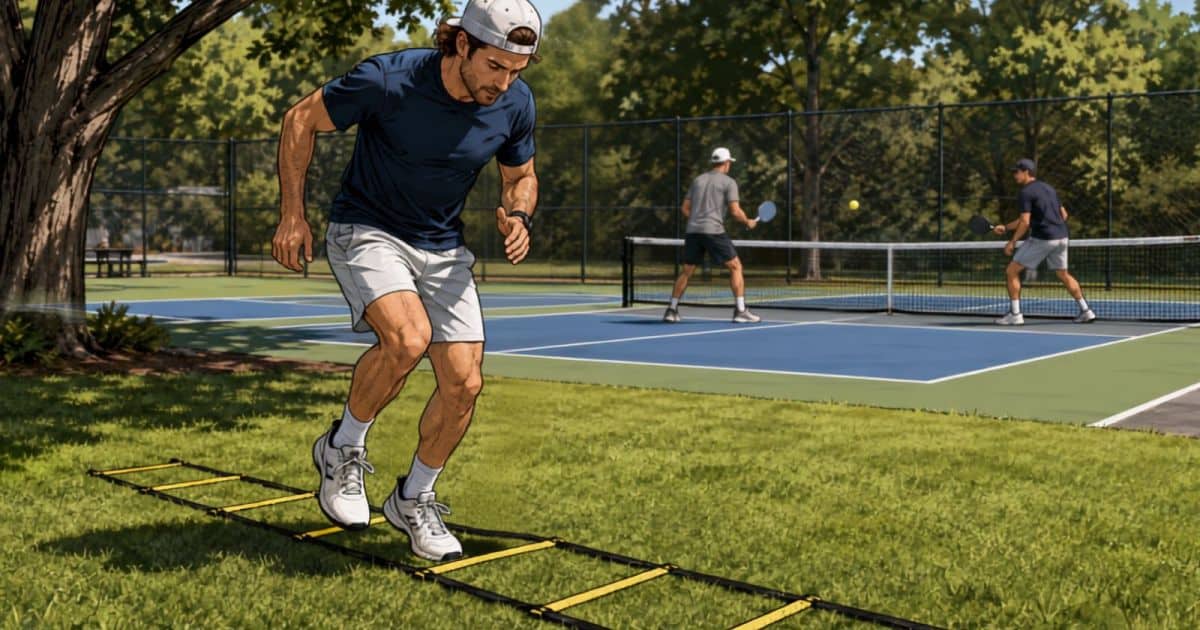
Ladders and dot drills earn a small slot for foot rhythm, with one caveat: they train patterned quickness, not decisions, so they belong early in a session as a warm-up for the reactive work rather than as its substitute.
The technique layer underneath all of this, split step timing, adjustment steps, shuffle form, is its own subject, covered in our guide to improving footwork for pickleball, and it comes first. Agility training makes good patterns faster; it makes bad patterns worse, faster.
How should agility work fit a training week?
Fresh, brief, and before anything tiring, twice a week. Agility is speed work, and speed practiced tired trains slowness with excellent form.
A workable template, offered as a recommendation rather than a protocol: after a thorough warm-up, 10 to 15 minutes of drills at full intent with generous rest between bouts, quality gated by crispness, the session ends when movements stop being sharp, not when you are exhausted. Attach the blocks to existing habits: before a lifting session, before a playing session, or as the first act of a practice day. Never as a finisher.
Pair it sensibly with the rest of the program. Strength work, the squats and single-leg patterns from our off-court workouts guide, supplies the force that agility spends, and the two belong in the same week rather than in competition. The reaction half of quickness, eyes and hands rather than feet, is a separate trainable thread picked up in our guide to improving reaction time for pickleball.
Older players change the dose, not the menu: longer warm-ups, fewer bouts, flat non-slip surfaces, and full permission to build stopping strength for a few weeks before chasing sharp direction changes. The braking comes before the racing at any age, and especially past it.
What mistakes waste agility training?
Four, all common and all cheap to fix.
Training it exhausted is the big one, covered above: quality dies quietly and the session becomes conditioning wearing agility’s clothes. Skipping the reactive layer is second; a player can be ladder-fast and rally-slow because no drill asked them to decide anything. Third is ignoring deceleration, all gas and no brakes, which is how agility training produces the very injuries it should prevent. And fourth is training in the wrong shoes: lateral bursts in running shoes undo every safety margin the drills build.
There is also a fifth, gentler mistake: doing none of it because it seems like athlete stuff. Two short blocks a week, at whatever speed is currently yours, is the entire buy-in.
The ball-drop drill makes the progress visible: needing the ball dropped from shoulder height at two steps away in March, and catching it from waist height a few months later, is the kind of change this work produces without anything else in a routine changing.
FAQ
What is agility training for pickleball? Short, high-intent bouts of lateral movement, direction change, and reactive footwork, done fresh, that make court-speed movement faster and safer.
How often should pickleball players train agility? Twice a week for 10 to 15 minutes is a reasonable target, before anything tiring. Frequency and freshness beat volume.
Are agility ladders good for pickleball? As a warm-up and rhythm tool, yes. They train patterns, not decisions, so pair them with reactive drills that make you respond to signals.
What is the single best agility drill for pickleball? Reactive shuffles, where a partner calls or points directions mid-movement. They combine the sport’s dominant movement with its dominant demand: deciding fast.
Can seniors do agility training? Yes, with longer warm-ups, smaller doses, and an early emphasis on controlled stopping. Direction-change ability is trainable at every age and protects against falls.
Should agility work come before or after playing? Before, as part of a warm-up, or on separate days. Speed practiced on tired legs rehearses slowness.
Does agility training prevent injuries? Deceleration and braking work is a standard component of neuromuscular injury-prevention programmes, though no pickleball-specific study measures the effect. It does protective work for knees and ankles, provided they are trained deliberately and in court shoes.
How fast will I notice a difference? Direction-change speed often improves within three to six weeks, because much of the early gain is timing and skill rather than fitness.
Want the drills coached rather than self-taught? The fitness professionals in our directory run court-sport speed sessions, and many coaches in our listings fold agility blocks into on-court lessons.
Written by the Pickler Junction Team.
*This article is general information, not medical advice. Talk with your doctor about your own health before starting a new sport.