How to Improve Footwork for Pickleball
Quick Answer: Good pickleball footwork comes from three habits: a split step timed to your opponent’s contact, small adjustment steps instead of long reaches, and lateral shuffles that keep your chest facing the net. Ten focused minutes of drilling per session builds these habits faster than an hour of unstructured play, because repetition beats volume.
Footwork is the least flashy skill in pickleball, and one of the easiest to spot from across the courts. Watch a match with the sound off, and the players with quiet, efficient feet are almost always the ones controlling the point.
What does good pickleball footwork actually look like?
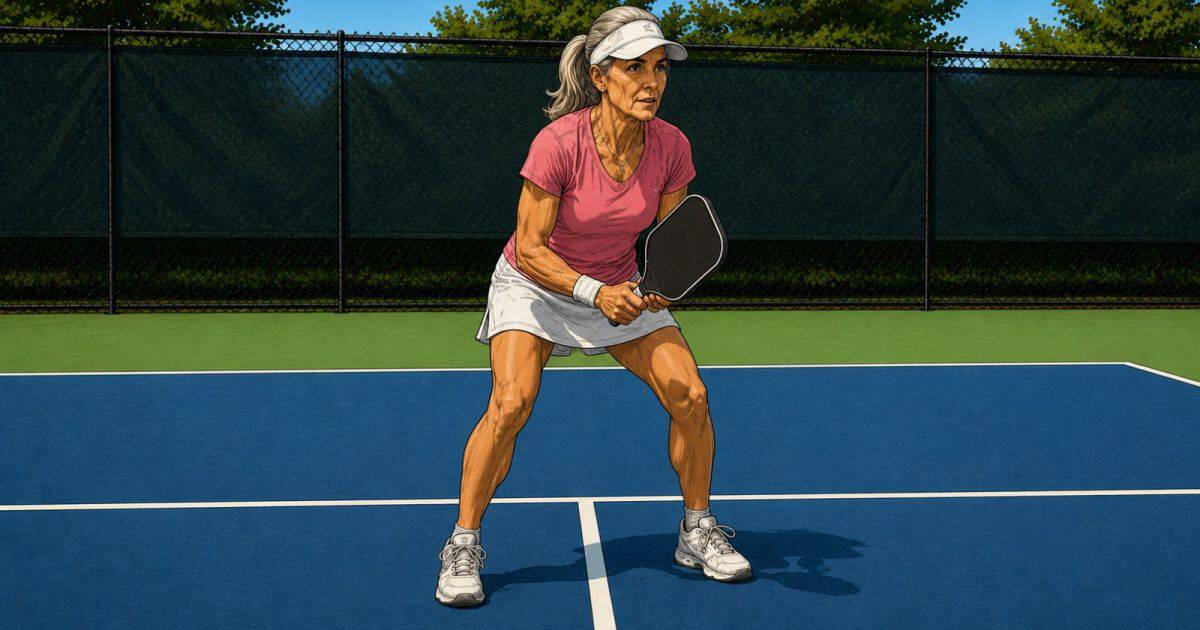
Good footwork looks small, not fast. The common assumption is that quick feet mean sprinting after every ball. In practice, the best movers rarely look rushed, because they are rarely late.
A few pieces make up the whole:
- The split step: a small hop onto the balls of both feet, timed to land as the opponent makes contact. It loads the legs to push off in any direction, and many coaches teach it before anything else because it does the most to fix lateness.
- Adjustment steps: several short steps that arrive at the ball balanced, rather than one long stride that ends stretched out.
- The lateral shuffle: sideways movement without crossing the feet, chest square to the net, so the body stays ready mid-travel.
- Drop steps and crossovers: turn-and-go patterns for lobs and balls hit behind the body, where turning the hips first beats backpedaling.
- Recovery steps: the move back to a ready position after every shot, since the last shot’s location is usually the worst place to stand for the next one.
None of these require special athleticism. They require a decision to do them on every point, which is why footwork can close the gap between younger legs and older experience.
Why is the split step worth singling out?
Because it fixes lateness at the source. What feels like being slow on a pickleball court is usually a timing problem, not a speed problem. The split step works as a timing device rather than a step toward the ball. It syncs the body to the opponent’s contact, so the first real step pushes off loaded legs instead of flat ones.
Timing is the entire skill. A hop that lands too early leaves the feet flat again before the ball is struck. A hop that lands too late arrives after the ball is already past. The goal is a small hop, an inch or two off the ground, landing at the instant the opponent’s paddle meets the ball. From that loaded position, the push-off borrows the landing’s spring, and a step that used to be reactive becomes close to automatic.
At the kitchen line, the split step shrinks down to a quick weight reset between exchanges rather than a visible hop. That distance matters: the non-volley zone extends 7 feet from the net on each side under Section 11 of the 2026 USA Pickleball rulebook, a short space where a fraction of a second of lateness is the difference between a clean volley and a reach. Quick feet at the line pair directly with quick hands, a relationship covered from the other side in the guide to improving reaction time for pickleball.
The easiest way to build the habit is to attach it to a cue that is already there: every time an opponent’s paddle touches the ball, hop. It feels mechanical for a week or two, then it disappears into the game.
What drills actually improve footwork?
Short, specific sessions beat long, unfocused ones. Ten minutes of drilling with full attention does more than thirty minutes done half-heartedly.
A useful rotation:
- Shadow drilling: moving through split step, shuffle, and recovery patterns with no ball, to groove the mechanics before adding speed or a target.
- Line drills: shuffling along the kitchen line and touching each sideline, for lateral economy without crossing the feet.
- The X pattern: moving from baseline corners to kitchen corners and back, for the transition footwork that decides third-shot rallies.
- Constraint games: playing real points with a rule attached, such as requiring a full recovery step after every shot, so the habit survives contact with live play.
Ball-fed versions sharpen all of these once a partner is available, since random feeds force honest split-step timing in a way fixed patterns cannot. A wider library of partner and solo drills, many of which double as footwork work without saying so, sits in the guide to beginner pickleball drills.
One simple measure keeps the work honest: count how often a shot gets hit while stretched out or off balance during a normal game. A falling number there is footwork improving, whatever the score says.
What physical work supports faster feet?
Leg strength, ankle spring, and pattern speed support footwork in that order, and none of it helps unless the on-court habits are already in place to use it.
Strength comes first. Push-off power and the ability to brake and change direction both come from the same squats and single-leg exercises that protect the knees. Elastic ankle work, such as controlled hopping, skipping, and light jump rope, builds the reactive bounce the split step spends on every point. Ladder and cone drills sharpen the shuffle and crossover patterns at higher speeds than most rallies demand, which is the focus of the companion guide to agility training for pickleball.
The order matters more than the exercise list. Habits first, then strength, then speed, because fast feet running the wrong pattern just arrive in the wrong spot sooner.
A useful, free diagnostic: film a few minutes of a recreational game and count the split steps. The count is usually lower than it feels in the moment, since moving often and moving early are not the same thing. Adding a hop on every opponent contact for a few weeks will not make anyone faster in a lab sense. It makes the first step earlier, which from across the net looks the same as faster.
FAQ
How do I improve my footwork for pickleball? Build three habits: a split step on every opponent contact, small adjustment steps into the ball, and lateral shuffles that keep the body square to the net. Drilling each for about ten minutes a session builds the pattern faster than long, unfocused practice.
What is a split step in pickleball? A small, two-footed hop timed to land as the opponent strikes the ball. It loads the legs so the next step pushes off explosively instead of starting from flat feet.
Why do I always feel a step slow on the court? Usually lateness rather than slowness. No split step, long lunging strides, and no recovery step between shots all create the same feeling. Fixing timing solves more of it than sprinting does.
Are agility ladders worth using for pickleball footwork? Yes, in small doses, as pattern-speed training. They sharpen the mechanics of the shuffle and crossover, but that speed still has to be attached to real rallies through drilling and play.
Should players backpedal to reach a lob? No. Turning and running back at an angle, using a drop step, covers more ground and is more stable than backpedaling, which is slower and a common cause of falls.
How often should footwork get drilled? Briefly and often works better than one long session a week. Ten minutes before or during a regular practice builds the habit through repetition.
Does footwork matter at the kitchen line? It matters more there than anywhere else on the court, in a smaller space. The non-volley zone is only 7 feet deep on each side of the net under the USA Pickleball rulebook, so a quick weight reset between exchanges and a small adjustment step decide who volleys comfortably and who stabs at the ball.
What shoes support good footwork? Court shoes built for lateral movement, not running shoes. A shoe without side-to-side structure undercuts a split step and a shuffle no matter how well either one is drilled.
For players whose footwork is limited by ankle, knee, or hip pain rather than habit, Pickler Junction’s directory of physicians and therapists lists providers who treat the injuries that slow pickleball movement down, and it is worth a look before assuming the fix is more drilling.
Written by the Pickler Junction Team.