How Much Space Do You Need for a Pickleball Court?
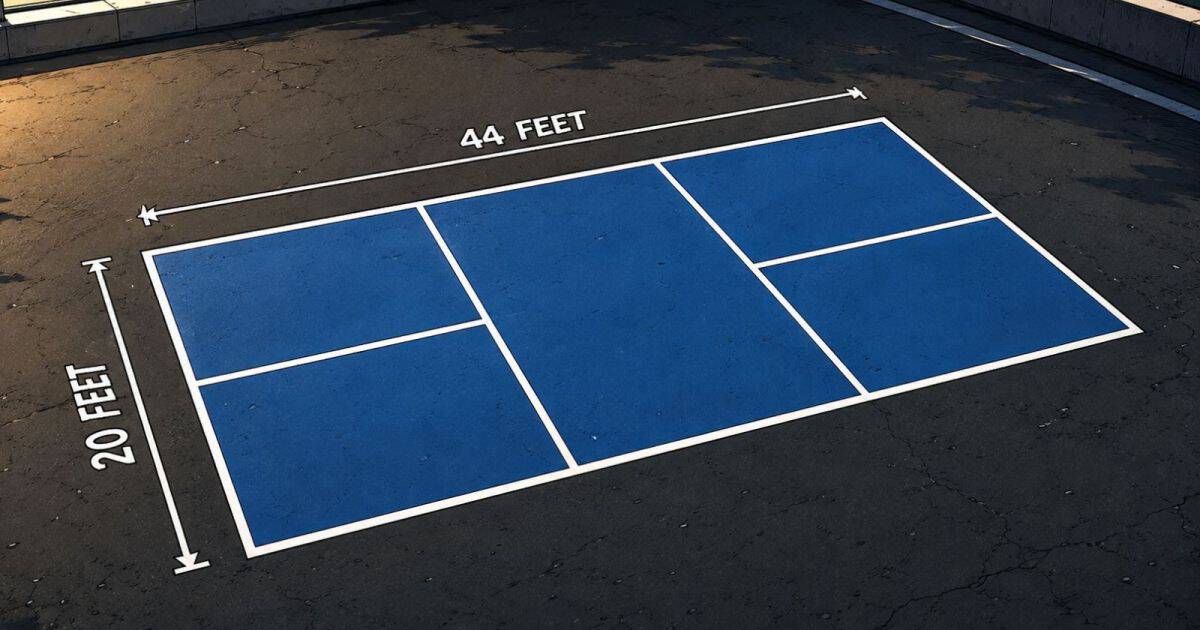
Quick Answer: USA Pickleball’s preferred footprint for a new court is 34 by 64 feet, adding a 7 foot buffer beside each sideline and a 10 foot buffer behind each baseline to the 20 by 44 foot playing surface. The 30 by 60 foot minimum still works for casual play. The lined court itself stays 20 by 44 feet either way.
The playing area is the lined rectangle where the game happens. The footprint is that rectangle plus the space you actually run into behind and beside it. Two different numbers, and only one of them is negotiable.
What Are the Actual Dimensions?
Under the 2026 USA Pickleball rulebook, the playing surface is 20 feet wide by 44 feet long for both singles and doubles, per Rule 3.A.1. That lined rectangle never changes size between the two formats.
The kitchen, officially the non-volley zone, extends 7 feet back from the net on each side of the court under the rulebook’s Rule 3.A.4.c.
The rulebook lists two total footprints for the space around those lines, in Rule 3.A.3. The minimum recommended footprint is 30 by 60 feet, built from a 5 foot buffer on each side of the court (5 + 20 + 5 = 30) and an 8 foot buffer behind each baseline (8 + 44 + 8 = 60). The preferred footprint for new construction is 34 by 64 feet, built from a 7 foot buffer on each side (7 + 20 + 7 = 34) and a 10 foot buffer behind each baseline (10 + 44 + 10 = 64).
Here is the full picture in one place:
- Playing area: 20 by 44 feet, identical for singles and doubles.
- Kitchen: 7 feet from the net on each side, under Rule 3.A.4.c.
- Minimum footprint: 30 by 60 feet, using 5 foot sidelines and 8 foot backcourts.
- Preferred footprint: 34 by 64 feet, using 7 foot sidelines and 10 foot backcourts.
USA Pickleball’s own construction guidance repeats the same split: a 34 by 64 foot total size is preferred, and 30 by 60 feet is the minimum recommended size. The two numbers exist because a lot of courts were originally built on converted tennis courts, and 30 by 60 feet was the tighter fit those conversions allowed.
How Much Space for a Pickleball Court Do You Really Need Around the Lines?
Ten feet behind each baseline is the preferred distance under the USA Pickleball rulebook (Rule 3.A.3), and it works as a practical floor for adult play. Below that, a returner backing up on a deep serve meets the fence instead of finishing the swing.
On the sides, 7 feet is the current preferred distance under the rulebook, while 5 feet matches the older 30 by 60 minimum footprint. Pickleball involves far less side to side movement than tennis, so sidelines are the first place to trim if space runs short.
Picture a backyard court with only 6 feet behind the baseline. Every deep serve turns into a choice: reach for the ball or protect a shoulder from the fence. That changes how the game plays, not just how it feels.
Can You Fit a Court in a Standard Backyard?
Often, yes. A 34 by 64 foot footprint covers 2,176 square feet (34 times 64), which fits on typical suburban lots once setbacks are subtracted. Shape is usually the tighter constraint, not raw area, since 64 feet in one direction is a long run for most yards.
Before measuring anything, check three things: property setback requirements, any HOA restrictions, and where utility lines run. The guide to pickleball court permits covers what usually gets flagged, and the guide to HOA rules for backyard courts covers the rest.
USA Pickleball’s construction guidance also recommends orienting outdoor courts north to south, so players are not looking straight into the sun during morning or late afternoon play. The guide to what direction a pickleball court should face covers that reasoning in more depth.
If the footprint does not fit, the honest options are a smaller practice area for dinking and serving, a driveway setup, or joining a club. Squeezing a 44 foot court into a yard with no runoff space turns practice time into an injury risk.
How Much Space for Two Courts Side by Side?
No governing body publishes an official footprint for two courts built side by side. The USA Pickleball rulebook and USA Pickleball’s construction guidance both cover only the single court measurements above, the 30 by 60 minimum and the 34 by 64 preferred footprint.
One practical approach lets two adjacent courts share a single runoff strip between them instead of stacking two full outer buffers back to back. As an example, keep each court’s outer 7 foot sideline buffer and make the shared middle strip 10 feet wide: 7 + 20 + 10 + 20 + 7 equals 64 feet across, on the same 64 foot length as a single preferred court. That is an illustration to plan from, not a published standard, so confirm any real layout with a builder or engineer before pouring anything.
Ten feet between the two playing areas is comfortable under a plan like that. Eight feet is tight but workable. Below that, balls from one court start interrupting play on the other. The guide to how many pickleball courts fit on a tennis court walks through that math for a shared, fixed footprint.
Frequently Asked Questions
Is a pickleball court the same size for singles and doubles?
Yes. Under the USA Pickleball rulebook, Rule 3.A.1 sets one size for both singles and doubles: 20 by 44 feet. Nothing changes between the two formats, which is one reason the sport is quick to set up.
Why do some sources list 30 by 60 and others list 34 by 64?
Both numbers are real. The USA Pickleball rulebook lists 30 by 60 feet as the minimum footprint and 34 by 64 feet as the preferred footprint for new construction, under Rule 3.A.3. The two figures answer different questions: how small a court can be, and how much space it should have.
What is the minimum ceiling height for indoor pickleball?
No pickleball governing body publishes a ceiling height requirement. Facility design guidance from RunSwift puts the minimum around 18 feet for casual play, with 20 to 26 feet preferred for competitive or league play. Lobs are a real part of the game, and a low ceiling changes strategy. The guide to indoor pickleball court cost covers what the extra height adds to a build.
Can a court be smaller than 30 by 60?
Builders can fit the 20 by 44 playing area into less space, but play quality drops and injury risk rises without a real buffer around the lines. Below 30 by 60, consider a half court for drills instead of a compressed full court.
How much space is needed between a court and a fence?
The fence sits at the edge of the total footprint. Under the USA Pickleball rulebook’s preferred footprint, that puts the fence 7 feet from each sideline and 10 feet behind each baseline. The guide to pickleball court fence height covers the rest of that decision.
Does the court surface need to be perfectly flat?
No. A perfectly flat outdoor court lets water pool, and standing water damages the surface over time. USA Pickleball’s construction guidance points builders to slope and drainage specifications in its Construction and Maintenance Manual rather than publishing a single grade figure in the rulebook itself.
How much does the extra space from 30 by 60 to 34 by 64 cost to build?
Going from a 30 by 60 minimum footprint to a 34 by 64 preferred footprint adds 376 square feet (2,176 minus 1,800), about 21 percent more surface. At $11 to $28 per square foot installed, as of September 2026, that runoff space adds roughly $4,100 to $10,500 to a build, based on HomeGuide’s cost data. HomeGuide puts the national average total cost for a court at $34,000, so that upgrade is a small share of the total project.
Is room needed for a bench or seating?
Not inside the footprint. Put seating outside the runoff area entirely, never within the 34 by 64 foot preferred space. Anything a player can collide with belongs beyond the fence line.
Measuring a yard this weekend? Taking a tape measure to a few public courts nearby first is a useful sanity check before committing to a layout, and the Pickler Junction directory lists local court builders who can confirm setback and drainage requirements before anyone pours concrete.
Written by the Pickler Junction Team.