How to Maintain a Pickleball Court
Quick Answer: Pickleball court maintenance means clearing debris weekly, cleaning the surface about once a month, filling cracks before they spread, and resurfacing every four to eight years. According to SportMaster, an acrylic sport surfacing manufacturer, high pressure and deicing chemicals both damage the coating. A standard recoat runs $1,500 to $3,500, according to HomeGuide, as of September 2026.
Routine maintenance is what keeps a court playable for years instead of months. Water causes most of the damage on this list, so nearly every task below either clears water off the surface or keeps it from working underneath it.
What Should You Do Weekly?
Clear the surface. Leaves, pine needles, and dirt trap moisture against the coating and feed algae growth, and an algae film on an acrylic surface gets slick fast.
A backpack blower clears a court in a few minutes, and a push broom does almost as well. Either beats leaving debris to sit until the weekend.
Check the net while you are out there. Sagging tape, a loose center strap, and rusted post hardware are cheap to fix now and more annoying to fix later. The guide to correct net height covers what to measure.
How Often Should You Wash the Surface?
According to SportMaster, courts need a general cleaning about once a month, more often where trees or shade keep the surface damp. That is more frequent than most owners assume, and it is also cheap: a rinse and a sweep, not a full scrub.
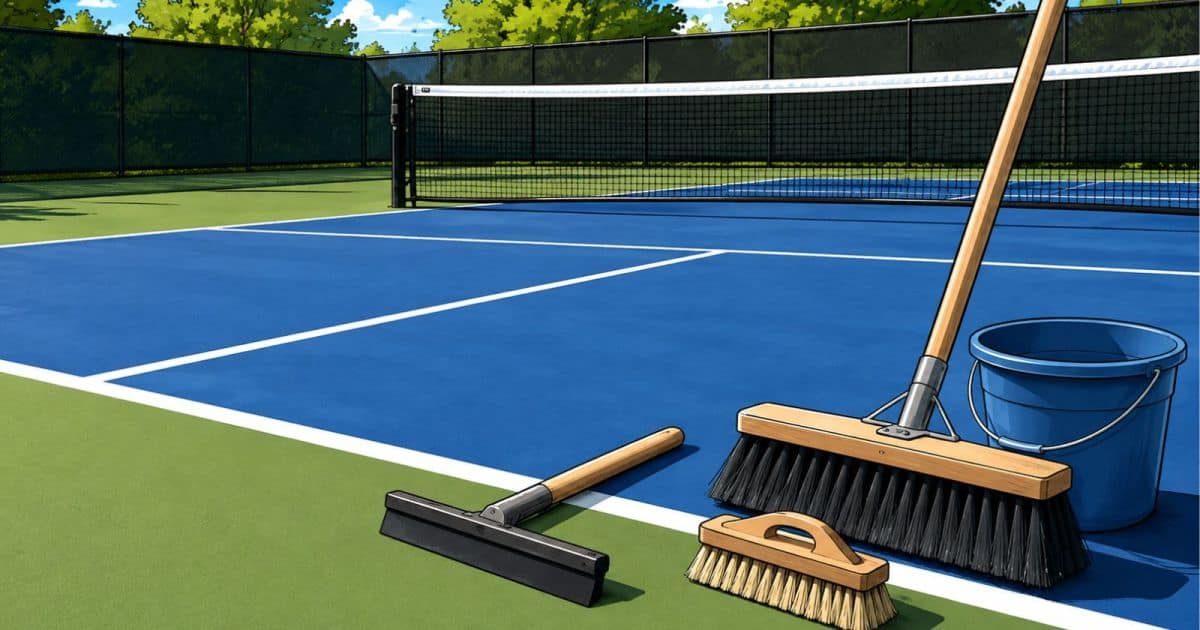
For a deeper wash, use a mild detergent with a soft bristle brush, or a pressure washer used carefully. SportMaster’s maintenance guidance warns against holding the wand too close to the surface or running excess pressure, since that can strip the sand texture out of the acrylic coating and leave it slick. Tennis Pursuits recommends keeping pressure in the 1,500 to 2,000 psi range for court surfaces and holding the wand well back, though pressure washer specs vary enough that a written product label is worth checking too.
For algae or mildew, SportMaster’s guidance calls for two parts household bleach to one part water on affected spots, or a stronger mix of water, trisodium phosphate, and bleach for heavier buildup. Rinse thoroughly afterward, and never let cleaning solution dry on the coating.
When Do Cracks Become a Real Problem?
A hairline crack is the cheapest version of the problem it will ever be. Water gets into it, then freezes or softens the base underneath, and the crack widens and branches from there.
SportMaster’s acrylic crack repair products are built for cracks running from about 1/8 inch up to a full inch wide, which is a useful rough marker for when a crack has moved from something to watch to something to fill.
If one side of a crack sits higher than the other, that signals a base problem, not just a surface problem. Patching the top will not fix settling underneath, and the court needs a contractor to look at the base itself.
Use an acrylic crack filler made for sport surfaces rather than a general driveway or asphalt product. Sport-surface fillers, like the ones SportMaster sells, are formulated to cure hard and accept a color coat over the top, which is not what driveway sealant is built for.
How Often Does a Court Need Resurfacing?
Most outdoor pickleball courts need resurfacing every four to eight years, according to court resurfacing company Pickletile, with heavy daily use and harsh freeze-thaw climates shortening that window.
Signs it is time: the color looks chalky or faded, the texture feels smooth instead of gritty underfoot, painted lines have faded or bled, or puddles sit on the surface after rain, per Pickletile.
A standard recoat, meaning a clean, patch work, two to three acrylic coats, and new lines, runs $1,500 to $3,500, according to HomeGuide. Jobs that need significant crack repair or partial base work cost more; Pickletile puts base-repair jobs in the $12,000 to $25,000 range. For how that compares with building new, see the true cost to build a pickleball court in 2026.
Tile courts skip this step entirely. Individual tiles get swapped out instead of a full recoat, which is one advantage covered in the look at whether DIY court kits are worth it.
What Ruins a Court Fastest?
Standing water does the most damage, by a wide margin. If puddles sit for more than an hour after rain, the slope is off, and every other fix on this page is temporary until that gets corrected. The guide to court slope and drainage covers the fix.
After drainage, the next fastest way to wreck a court is tree roots pushing up from below, a sprinkler head misting the surface every morning, parking a vehicle on it, or dragging metal furniture across the coating.
Fading, chalky color also points to sun exposure and age catching up with the coating. If a resurfacing is coming up anyway, see what colors a pickleball court can be before picking a new coat.
Frequently Asked Questions
Can you pressure wash a pickleball court?
Yes, if done carefully. Tennis Pursuits recommends keeping pressure around 1,500 to 2,000 psi, using a wide fan tip, and holding the wand at least twelve inches off the surface. Too much pressure strips the sand texture out of the acrylic coating and leaves the court slick.
How much does it cost to resurface a pickleball court?
A standard recoat runs about $1,500 to $3,500, according to HomeGuide. Add significant crack repair or base work, and the price can climb into the $12,000 to $25,000 range, per Pickletile. Get a written scope, since the word resurfacing can describe very different amounts of work.
How do you get rid of algae on a court?
Scrub the area with two parts household bleach to one part water, or a stronger mix of water, trisodium phosphate, and bleach for heavier buildup, then rinse well, according to SportMaster’s maintenance guidance. Trimming back overhanging branches to cut shade and moisture does more for the long run than any cleaner.
What is the best crack filler for a pickleball court?
An acrylic crack filler built for sport surfaces, not a driveway or asphalt sealant. SportMaster’s sport-surface products cover cracks from about 1/8 inch to a full inch wide, cure hard, and accept a color coat over the top, which general driveway sealant is not built for.
Do you need to reline a court after resurfacing?
Yes. A new color coat covers the old lines completely, so lines go on as the last step of the job. It is also a good moment to reconsider the layout if the space doubles for another sport.
How do you maintain a court in winter?
Keep it clear of snow and leaves, and skip ice melt chemicals and metal shovels. SportMaster’s maintenance guidance specifically advises against snow or ice melt chemicals and hard or sharp tools, since both damage the coating. A plastic shovel or a broom is the safer choice.
How much should you budget annually?
Spread a $1,500 to $3,500 recoat, per HomeGuide, over a four to eight year resurfacing cycle, per Pickletile, and add routine cleaning supplies, and the yearly average lands somewhere between roughly $300 and $900 for a single court. Skipping that yearly upkeep tends to just move the cost to the resurfacing bill, and moves it sooner.
How long does a well-maintained court last?
Base lifespan depends on the material underneath. Sport court builder GMB says asphalt bases often need full replacement by around 15 years, while post-tensioned concrete bases can run 25 to 30 years or more with the same care. Good drainage is what gets a base to the top of its range. The acrylic surface coating is the part that wears out faster and gets recoated every four to eight years regardless of what is underneath it.
Ready to find a contractor for crack repair or a full resurfacing job? Pickler Junction’s pickleball court construction and infrastructure directory lists builders and suppliers by region, and a season spent comparing a four year old surface to a twelve year old one makes the difference obvious underfoot.
Written by the Pickler Junction Team.