Pickleball Court Lighting: The Complete Guide for Night Play
Quick Answer: Good pickleball court lighting means LED fixtures sized to the illumination levels USA Pickleball and the American Sports Builders Association publish: 30 foot-candles for recreational play, 50 for club play, and 75 for tournament play. Poles typically run 20 feet tall outdoors, mounted on the sides of the court so light crosses the play area and glare stays low.
Lighting turns a court into an all-evening amenity. Dark spots, glare, and annoyed neighbors can undo that fast. Here is what to plan before you buy a single fixture.
How much light does a pickleball court need?
The answer depends on how the court gets used. USA Pickleball, working with the American Sports Builders Association, sets illumination targets in its 2023 Construction and Maintenance Manual, and the official lighting partner LSI Sports Lighting publishes the same three categories in its pickleball lighting specification sheet.
The brightness targets:
- Recreational play (Category III): 30 foot-candles average.
- Club and competitive play (Category II): 50 foot-candles average.
- Tournament and professional play (Category I): 75 foot-candles average.
Brightness alone does not make a court playable. Even coverage matters just as much, since a bright center with dark corners still hides the ball at the edges. Ask any lighting designer for a photometric layout before you commit to fixture count or spacing, so you can see projected coverage across the full court, not just an average number.
How should the lights be set up?
LED fixtures on side-mounted poles are the current standard. USA Pickleball notes that LED lighting runs for more than 100,000 hours before it needs replacing, while older HID lamps last around 12,000 hours and need three to twelve minutes to warm up to full brightness. That difference alone is why almost every new install goes LED.
The setup essentials:
- Fixtures: LED, weather-resistant, built for outdoor sports use. LSI Sports Lighting’s outdoor pickleball fixtures carry an IP66 rating for dust and moisture, a rated LED life above 100,000 hours, and a five-year limited warranty.
- Pole height: Poles for a typical backyard or park court run about 20 feet, according to cost and installation data from HomeGuide. USA Pickleball’s own lighting partners cover a wider range: LSI Sports Lighting builds fixtures for poles from 10 to 39 feet for placement close to the court, while Musco Lighting, USA Pickleball’s other named partner, designs for outdoor installations with poles set back from the court at heights above 40 feet.
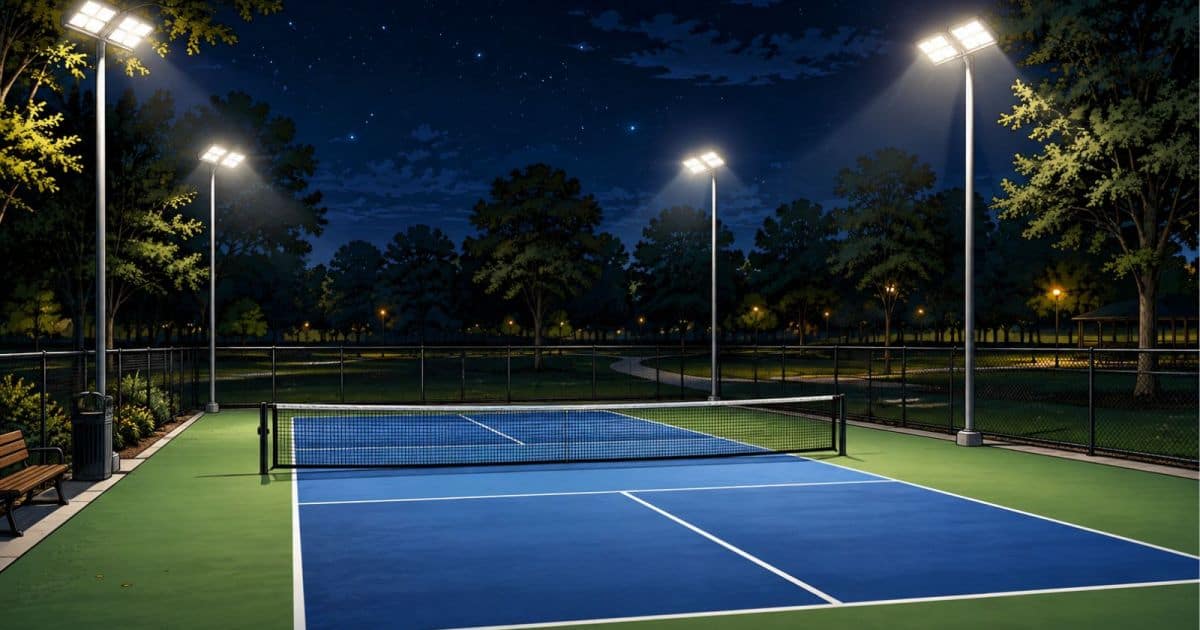
- Pole placement: USA Pickleball recommends poles centered on, or just outside, the court fence, with a minimum of 5 feet of clearance from the sideline. Placing poles on the sides, rather than behind the baseline, keeps light crossing the play area instead of shining into players’ eyes.
- Number of poles: A single court commonly uses 2 to 4 poles, each carrying multiple fixtures, based on HomeGuide’s cost breakdown.
- Color options: Manufacturers such as LSI Sports Lighting offer multiple color temperature choices per fixture line. Ask your installer to match the color temperature to your local lighting ordinance and to the look of any neighboring courts.
A photometric plan, which models light levels and spill before anything goes in the ground, catches problems while they are still cheap to fix.
What else should you plan for?
Lighting a court well is about more than brightness. A few practical factors protect both your investment and your relationship with neighbors.
Plan for these:
- Glare control, through fixture optics, shielding, and pole placement rather than raw pole height alone.
- Light trespass at the property line. DarkSky Society’s exterior lighting guidelines recommend spill at a residential property line stay at or below 0.05 foot-candles, and at or below 0.1 foot-candles next to business property, for context, full moonlight measures about 0.01 foot-candles. Local zoning can set a different limit, so check your municipal code before finalizing a design.
- Weather resistance. Look for an IP rating built for outdoor exposure, the kind LSI Sports Lighting publishes for its outdoor pickleball fixtures.
- Local ordinances and HOA rules, which may cap pole height or require a photometric study before permitting. See the guide on HOA rules for backyard pickleball courts before you design around an assumed height limit.
- Controls and warranty. Musco Lighting advertises up to 25 years of warranty support on its sports lighting systems, plus a remote scheduling system that turns courts on and off from a phone or computer. Compare warranty terms across manufacturers before you buy.
- Cost. As of September 2026, HomeGuide places typical lighting installation for a home pickleball court at $5,000 to $10,000, for a setup of 2 to 4 poles around 20 feet tall with several LED fixtures on each pole. Commercial and multi-court installs run higher once photometric design and taller poles enter the budget.
For the indoor-versus-outdoor tradeoffs, see the comparison of indoor and outdoor pickleball court lighting. If you are still deciding whether to build a dedicated court or convert an existing one, the guide to playing pickleball on a tennis court covers what changes about layout and lighting placement. A court construction contractor or lighting specialist can turn any of this into a site-specific photometric plan.
Frequently asked questions
How many foot-candles does a pickleball court need? USA Pickleball and the American Sports Builders Association set 30 foot-candles average for recreational play, 50 for club and competitive play, and 75 for tournament or professional play, per the specification categories published by official lighting partner LSI Sports Lighting.
How high should pickleball court light poles be? Typical backyard and park installs use poles around 20 feet, according to HomeGuide’s cost data. USA Pickleball’s lighting partners build for a wider range, LSI Sports Lighting for poles from 10 to 39 feet placed near the court, and Musco Lighting for taller poles, above 40 feet, set back from the court. Local ordinances may cap the height allowed on your property.
What kind of lights are best for pickleball courts? LED fixtures are the standard. USA Pickleball notes LED lighting runs over 100,000 hours before replacement, against roughly 12,000 hours for older HID lamps, which also need several minutes to warm up.
Where should the light poles go? USA Pickleball recommends poles centered on or just outside the court fence, at least 5 feet from the sideline. Side placement keeps light crossing the court instead of shining into players’ eyes the way baseline-mounted lights can.
How do you avoid annoying neighbors with court lights? Control glare with proper fixture optics and shielding, and check local zoning before you install. DarkSky Society’s guidelines recommend keeping spill at a residential property line at or below 0.05 foot-candles, though your city’s actual ordinance may set a different number.
Why is a photometric plan important? It models light levels and spill before installation, so a contractor can catch dark spots, glare, or light trespass on paper instead of finding them after the poles are set in concrete.
How much does pickleball court lighting cost? HomeGuide estimates $5,000 to $10,000 installed for a typical home court with 2 to 4 poles around 20 feet tall. Commercial installs with a full photometric design and taller poles cost more.
Who makes pickleball court lighting? USA Pickleball names two official lighting partners, LSI Sports Lighting for lower pole heights placed near the court, and Musco Lighting for taller outdoor poles set back from play. Both publish fixture specifications and warranty terms directly.
Great night lighting comes down to the right foot-candle target, even coverage, and a plan for glare and spill before installation. Browse pickleball court builders and lighting specialists in the Pickler Junction directory to get a photometric plan for your site.
Written by the Pickler Junction Team.