Pickleball Shot Selection Explained
Quick Answer: Shot selection in pickleball comes down to two inputs: how high you contact the ball, and where your opponents are standing. High contact with opponents not yet set means attack with a drive. Low contact with opponents set at the kitchen line means play soft with a drop, dink, or reset. Everything else refines that base decision.
Shot selection is what separates players who own good strokes from players who win points. The good news is that the decision rule is simpler than the number of available shots suggests.
What are the two inputs?
Contact height first, opponent position second.
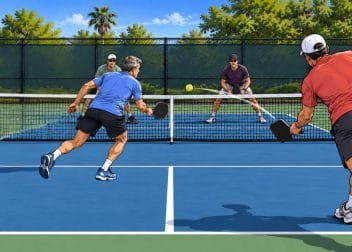
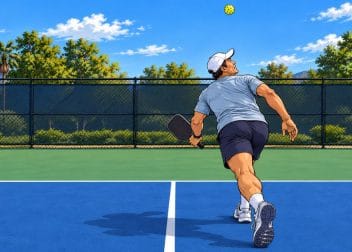
Contact height tells you whether you can hit down at the ball. A ball you meet above net height can be driven or put away, because your paddle can travel downward through it and the ball stays low on the other side. A ball you meet below net height cannot: hitting it hard forces you to lift, and a lifted ball at pace is an easy putaway for anyone standing at the net.
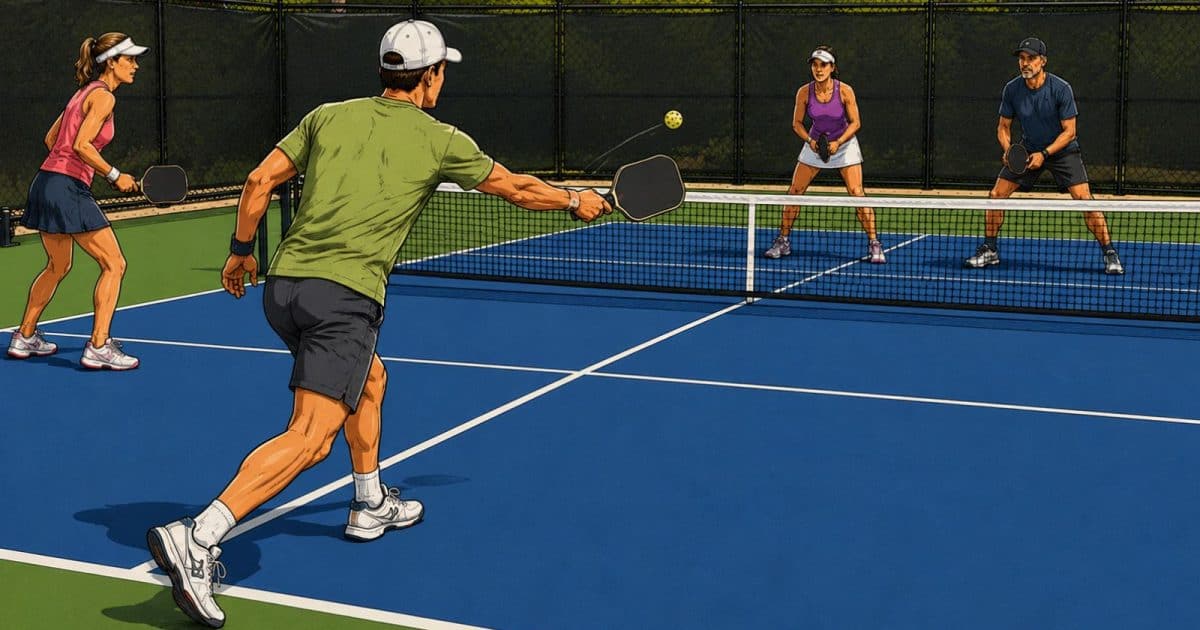
Opponent position tells you what an attack is worth. Two opponents already set at the kitchen line will block a hard, low ball right back down at your feet, so attacking into them hands over the advantage. Opponents still moving forward toward the kitchen line have less time to react and worse balance, so the same shot pays off.
Combine the two and a simple grid appears. High contact plus opponents not yet set is the clearest case for an attack. Low contact plus opponents set at the kitchen line is the clearest case for a soft shot. The cases in between, high contact against set opponents, or low contact against opponents still moving, are where your judgment does the work.
Which shot fits which situation?
Five shots cover most of recreational and club play, and each one has a narrow job.
- The drive. High contact, opponents not yet set. Hit hard, low, and flat, with topspin, aimed at feet or hips. Covered in the guide to the drive in pickleball.
- The drop. Low contact from deep in the court, opponents already at the net. Soft and arcing into the kitchen so you can advance behind it. Covered in the guide to the third shot drop.
- The dink. Both teams parked at the kitchen line. Soft, short, and kept below net height at the opponent’s contact point.
- The reset. Under pressure in the transition zone. Absorb the incoming pace and drop the ball short, buying you time to move forward. Covered in the guide to the reset in pickleball.
- The lob. Opponents crowding the net, ideally hit toward their backhand side. High risk, and best used sparingly.
Choosing between the drive and the drop is the call players get wrong most often on the third shot, and the third shot drive versus third shot drop guide breaks that specific decision down further.
Notice how little this list depends on skill level. The same five shots apply at every level of play. What changes as you improve is how reliably you can execute the one the situation actually calls for.
What are the common selection errors?
Three errors account for most avoidable point losses.
Driving low balls. The instinct to swing hard when a point feels like it is slipping away is strong, and it produces lifted drives that get put away at the net. The fix here is entirely a decision, not a technique change.
Dropping when the ball could be attacked. This is the mirror error. Players who have learned patience sometimes over-apply it and pass on genuinely attackable balls, which lets opponents reset and start the point over. A ball met above net height against opponents who are not yet set is meant to be hit, not dropped.
Lobbing as an escape. A lob hit on purpose against opponents crowding the net is effective. A lob hit because a player has run out of other ideas tends to float short, get smashed, and hand the point straight back. Many players reach for the lob under pressure instead of choosing it deliberately, and that habit costs points over a match.
Underlying all three errors is deciding after the ball arrives instead of before. Choosing the shot while the ball is still traveling, based on where contact will happen and where the opponents actually are, is most of what improving shot selection means in practice.
Does shot selection change with level?
The rules of the decision do not change. The margins around it do.
At lower levels, opponents miss more often, so aggressive selection gets punished less. A drive that would be blocked cleanly by a stronger player wins the point outright against a less experienced opponent. That pattern is real, and it explains why some beginners win matches by hitting hard. It also explains why that same approach stops working right around the level most players are trying to reach.
At higher levels, both teams reach the kitchen line and stay there, so the soft game decides most points and attackable balls become rarer and shorter lived. Selection gets stricter as you improve, not more creative.
The practical takeaway is worth stating plainly: learning to pass on a marginal attack costs a few points in the short term, and it is what makes reaching the next level possible. Players who never make that trade tend to stall at the same level for a long time, and closing that gap is a decision, not a skill you are missing.
FAQ
What is shot selection in pickleball? Choosing the right shot for the situation instead of the shot that feels satisfying to hit. Two inputs decide most of it: contact height and where the opponents are standing.
When should a player drive instead of drop? Drive when contact happens at or above net height and the opponents are not yet set at the kitchen line. Drop when contact is low or the opponents are already there.
Why do drives keep getting blocked back? Usually because they are hit from below net height, or aimed into opponents already established at the kitchen line. Both situations give the block an easy downward angle.
When is a lob a good idea? When opponents are crowding the net, ideally toward their backhand side, and the hitter has enough control to place it deep. Used as an escape from a losing rally, it is one of the more punished shots in recreational play.
What is a common selection mistake? Driving a ball contacted below net height. That shot requires lifting the ball, and a lifted ball at pace is an easy putaway for opponents standing at the net.
Does shot selection matter more than technique? At recreational levels, often yes. Many points are lost by choosing the wrong shot rather than by executing the right shot poorly.
How can a player improve shot selection? By deciding while the ball is still traveling, based on expected contact height and opponent position, instead of reacting once the ball has already arrived.
Should beginners bother learning this early? Yes, earlier than most do. The habits formed while a shot that only works because opponents are missing is still winning points are the same habits that later have to be unlearned.
Working the decision under match pressure is easier with a second set of eyes on it, and the pickleball coaches directory is a place to find one who drills shot selection directly.
Written by the Pickler Junction Team.