Are DIY Pickleball Court Kits Worth It?
Quick Answer: A DIY pickleball court kit is worth it only if a sound, level slab already exists, since surfacing alone costs $0.50 to $17 per square foot. Skip it if the slab is missing, because a full contractor build from bare ground runs $20,000 to $50,000, while other kit-related costs range from about $200 to $50,000 depending on scope.
A pickleball court kit bundles a surface, a net, and lines so you can install them over ground that is already flat and hard. Participation grew from 4.2 million players in 2020 to 24.3 million in 2025, according to the Sports & Fitness Industry Association, and many new players want a court closer to home than the nearest park. Nothing in a kit touches what sits underneath it, which is where the real cost question starts.
What Do You Actually Get in a Court Kit?
Court kits vary by manufacturer, but most include some combination of the same parts:
- Interlocking tiles or an acrylic coating, the playing surface
- A regulation net, portable or set into sleeves
- Line tape or paint, laid to the court boundaries
- Sometimes fencing or containment netting, usually an add-on
Under Section 3 of the 2026 USA Pickleball rulebook, a net measures 36 inches high at the sideline posts and 34 inches at the center, worth checking before buying a bargain net. VersaCourt sells a locking tile system in light blue, green, and red, though it quotes pricing per project rather than a published per-square-foot rate. Sport Court works the same way, connecting buyers with a local CourtBuilder instead of listing prices online. What colors a pickleball court can be covers the options and what they mean for visibility and heat.
Never in the box: the slab, the drainage, the excavation, or the permit. That is why a kit’s price tag looks so much smaller than a full build.
What Does a Kit Cost Compared to a Contractor?
Real per-square-foot figures, based on cost data compiled by HomeGuide as of September 2026:
- Interlocking rubber or polypropylene tiles: $4 to $17. On a 30 by 60 foot court, 1,800 square feet, that works out to $7,200 to $30,600.
- Standard acrylic hard court, fully installed: $0.50 to $1.00, or $900 to $1,800 for the same area. This figure is for an installed system, not materials alone.
- Cushioned acrylic system, fully installed: $2 to $4, or $3,600 to $7,200. Cushioned and standard acrylic are alternatives to each other, so do not add them together.
- Full contractor build from bare ground: $11 to $28 all in, which is why a complete court averages $34,000 nationally and typically runs $20,000 to $50,000, according to HomeGuide.
The gap between surfacing and building is not markup. A concrete pad alone costs $9,000 to $18,000, HomeGuide reports, and asphalt runs $5 to $12 or more per square foot, before site preparation adds another $2,000 to $10,000 or more. A regulation net alone starts around $200, based on Franklin Sports listings, and other accessories typically run $500 to $2,500. Fencing, if wanted, adds $2,000 to $6,000. If a slab does not already exist, a kit postpones the expensive part rather than avoiding it. The true cost to build a pickleball court walks through the full stack, and the cheapest way to build a pickleball court without cutting corners covers where a budget build can safely save.
When Is DIY the Right Call?
Three situations make a kit worth it. An old sport court or tennis court is already in decent shape. A large, flat driveway or garage slab exists and the owner is willing to give it up to pickleball. Or the goal is a setup that can be taken down and moved later.
The strongest candidate is usually a neglected backyard basketball slab, already poured and sloped for drainage, and often close to the right size once someone measures it. Two people can tile it over a weekend. A worn tennis court is another common starting point, since the slab and drainage are already done. Building a temporary pickleball court on a tennis court covers how lines and a portable net fit onto a surface built for a different sport.
Where DIY is not worth attempting: any slab with cracks wider than a pencil, standing water after rain, or a visible dip. Tiles telegraph everything underneath them, and a bad bounce over a settled joint will show up in every game.
How Hard Is the Install?
Tiles are the easier option. Two people can lay a 30 by 60 foot court in six to ten hours. The pieces snap together, edges get trimmed with a circular saw, and lines are either tiles in a second color or paint over the finished surface.
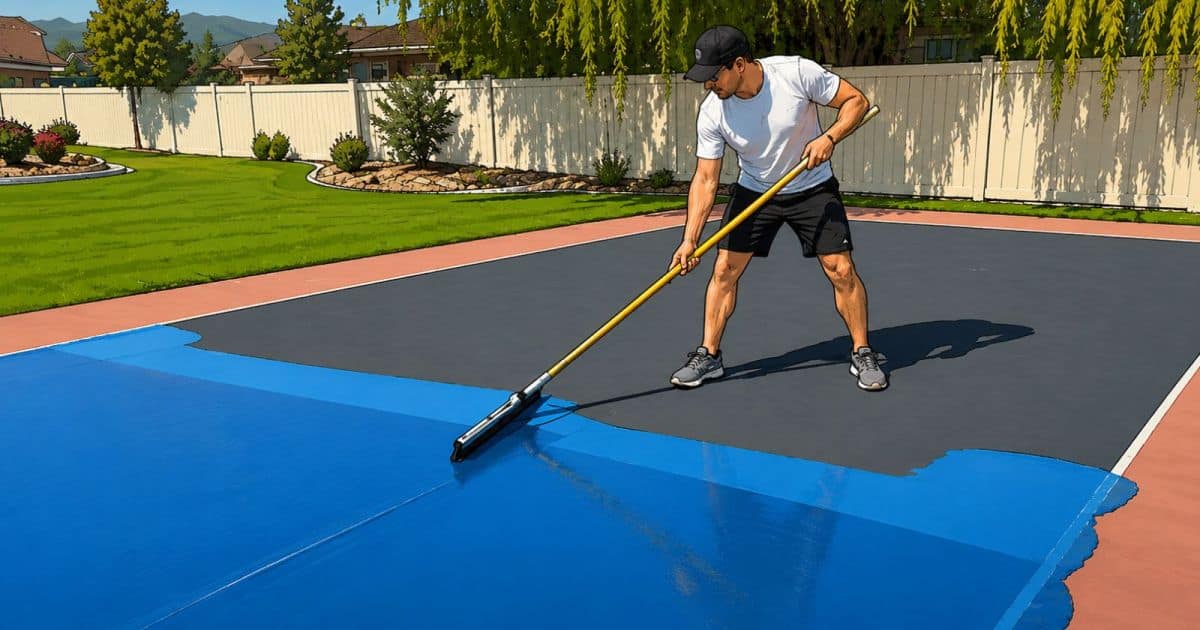
Acrylic coating is harder than it looks. It wants specific temperatures, several thin coats, and a squeegee technique that takes practice. A bad application leaves texture that has to be ground off before a professional can fix it.
Either way, settle the layout before buying anything. How much space a pickleball court needs covers the footprint, including the buffer zone that keeps players from colliding with a fence or wall.
Frequently Asked Questions
How much does a DIY pickleball court kit cost?
Between about $900 and $30,600 over an existing slab, based on HomeGuide’s cost data, depending on whether the surface is coated or tiled. Installed acrylic coating runs $0.50 to $4 per square foot. Interlocking tiles run $4 to $17 per square foot. If a slab still needs to be poured, add $5 to $10 per square foot for concrete, and the project is no longer a simple kit install.
Can pickleball tiles go directly on grass or gravel?
No. Interlocking tiles need a solid, level base to lock together and stay flat. On grass they settle unevenly and pull apart at the seams within weeks. A compacted crushed stone base is the minimum, and concrete performs better.
How long do pickleball court tiles last?
Most manufacturers back their tiles with a multi-year warranty, though terms vary by brand and are worth confirming before purchase. Tiles tend to fade before they fail, and the net and posts usually need replacing first.
Do you need a permit for a DIY pickleball court?
Often, yes, for a new slab, fencing above a certain height, or added lighting. Surfacing an existing slab usually does not trigger a permit review on its own. Do you need a permit for a pickleball court covers what typically sends a project to the local building department.
Are tiles better than a coated concrete surface?
Tiles are gentler on joints, drain faster after rain, and can be pulled up and moved. Coated concrete plays faster, costs less per square foot, and looks closer to a court built for the sport. Tiles tend to suit players managing knee or hip issues.
Can one person install a court kit alone?
Technically, yes. Realistically, it is much harder. Tiles need to be kept square while moving across the court, which is easier with two sets of hands. Working alone often means fighting cumulative drift and trimming a wedge-shaped gap along one edge.
Will a DIY court play like one built by a contractor?
Close, with a caveat. Tile surfaces bounce slightly lower and play a touch slower than acrylic over concrete. Players used to a coated court usually need a short adjustment period, worth knowing if training for tournament play.
Does a home pickleball court add property value?
Sometimes, and often less than an owner expects. A permanent court built to spec can help in markets where the sport already has a following. A tile court over a driveway is generally treated as personal property rather than a permanent improvement, since it can be removed.
Not ready to build yet? Pickleheads, USA Pickleball’s official court finder, lists more than 25,000 places to play nationwide, a low-cost way to see how often a court would actually get used first. When it is time to compare local installers, tile suppliers, and contractors, the Pickleball Court Construction & Infrastructure directory is a place to start.
Written by the Pickler Junction Team.