What Is the Volley Serve in Pickleball?
Quick Answer: The volley serve is pickleball’s traditional serve, hit out of the air rather than off a bounce. Under the 2026 rulebook, Rule 7.C requires an upward paddle arc, contact at or below waist height, and a paddle head that stays below the wrist. It differs from the drop serve, which skips all three requirements.
Every point in pickleball starts with a serve, and for most of the sport’s history there was one legal way to hit it: out of the air, in a single continuous upward swing. That serve now has an official name, the volley serve, because the 2026 rulebook needed a way to separate it from a newer option called the drop serve. A volley in pickleball means striking the ball before it bounces, and the volley serve applies that same idea to the opening shot of a point. This guide covers what Rule 7.C requires, how the release rule in 7.B sets up the swing, and where the full pickleball serving rules draw the line between a legal serve and a fault.
What Are the Three Rules for a Legal Volley Serve?
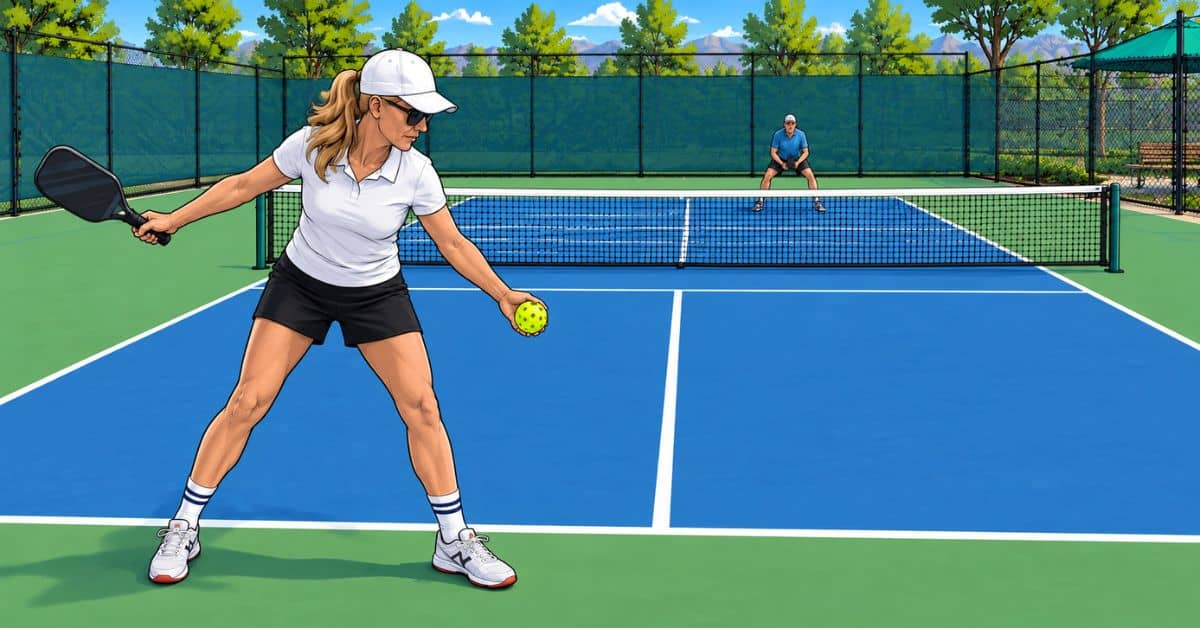
Rule 7.C of the 2026 rulebook lists three conditions that all have to hold at the instant the paddle contacts the ball. First, the paddle has to be moving in a clear upward arc, not a flat or downward swing. Second, the highest point of the paddle head must stay at or below the highest part of the server’s wrist joint at contact, which rules out a paddle face tilted up above the hand. Third, the ball itself must be no higher than the server’s waist at the moment of contact. All three conditions apply to the same swing, so a server who satisfies the arc requirement but contacts the ball above waist height has still committed a fault. The rulebook does not name an underhand motion outright, but the three conditions together leave little room for anything except an underhand or low sidearm swing, which overlaps with the separate question of whether an overhand serve is legal in pickleball; the rulebook answers that with the same three-part test rather than a rule about arm angle.
What Is the Release Rule Before the Volley Serve?
Before the swing even starts, Rule 7.B of the 2026 rulebook controls how the ball leaves the server’s hand. The ball has to be released using only one hand or off the paddle, and the rulebook prohibits adding spin or extra propulsion during that release. Some natural rotation of the ball as it leaves the hand is expected and is not a fault, but a deliberate spin imparted before contact is. This release rule applies specifically to the volley serve, since the drop serve carries its own separate release requirement under Rule 7.D. Getting the release right matters: a server who spins the ball on the drop and then hits a textbook upward arc under 7.C has still committed a fault under 7.B, and referees at sanctioned events are trained to watch the hand separately from the swing.
How Is the Volley Serve Different From the Drop Serve?
The drop serve, covered in Rule 7.D of the 2026 rulebook, removes all three volley serve restrictions at once. A server using the drop serve lets the ball fall to the court and bounce before contact, and none of the arc, paddle head, or waist height conditions from 7.C apply to that swing. The ball can be released from any natural height, bounce anywhere behind the server’s own baseline, and be struck on the way up with a forehand or backhand motion. That flexibility is also why the drop serve gets its own legal test rather than borrowing 7.C, and the guide to whether the drop serve is legal in pickleball breaks down what 7.D actually permits, including that some sanctioned pro events restrict the drop serve even though USA Pickleball allows it under the 2026 rulebook.
What Faults Break a Volley Serve?
Foot placement is checked before the swing begins. Rule 7.A of the 2026 rulebook requires at least one of the server’s feet to stay in contact with the correct serving area, behind the baseline and within the imaginary extensions of the sideline and center line, at the moment the paddle contacts the ball, and neither foot may touch the court itself during the motion. Once the ball is in the air, Rule 7.E lists faults that apply regardless of which serve produced them: landing outside the correct service court, landing in the non-volley zone, striking a permanent object, or hitting the server, the server’s partner, the receiver, or the receiver’s partner before the ball lands. A useful way to sort out an arc problem from a placement problem is the guide to illegal pickleball serves, which separates motion faults under 7.B and 7.C from landing faults under 7.E.
Why Do Most Pros Still Use the Volley Serve?
The drop serve has been a legal option under USA Pickleball rules since 2021, yet most professional players still choose the volley serve when an event’s rules allow either one. Pro player Zane Navratil told The Dink Pickleball that the volley serve keeps the contact point near waist height, while a dropped ball rarely bounces above mid-thigh, so the volley serve gives a server a higher contact point, a harder swing, and a better angle to clear the net. He also said the backspin a drop serve makes possible does little to fool opponents at the pro level, since experienced returners read spin off the swing path rather than the bounce, and that the extra hang time backspin creates raises the odds of missing long or wide. Tour rules add another layer: the PPA tour has restricted the drop serve at points, while the APP tour follows the USA Pickleball rulebook that permits it, so event format can settle the question before personal preference does.
How to Practice the Volley Serve
Because all three volley serve conditions have to line up on a single swing, most coaching drills isolate them one at a time before combining the full motion. A server can start by shadow swinging without a ball to groove the upward arc, checking that the paddle finishes higher than it started and that the paddle head never rises above the wrist. Adding a stationary or gently tossed ball next confirms contact height, since a ball held or dropped at waist level forces the low-to-high swing the rule requires. The guide to improving a pickleball serve works through drills for depth and placement once the legal motion is consistent, and a player still building the basic swing can start with the guide to the pickleball serve for beginners, which covers grip, stance, and toss before adding power. Video from a phone propped at court level, reviewed frame by frame, is often the fastest way to catch a paddle head or waist height fault that is hard to feel in real time.
Frequently Asked Questions
Is the volley serve still legal in 2026? Yes. The volley serve remains a fully legal serve option under the 2026 rulebook, governed by Rule 7.C, alongside the newer drop serve option under Rule 7.D.
Can a volley serve be hit underhand or overhand? The 2026 rulebook does not label the swing by arm angle. It requires an upward arc, a paddle head at or below the wrist, and ball contact at or below the waist, conditions that in practice only an underhand or low sidearm motion can meet.
What happens if the paddle head goes above the wrist on a volley serve? That contact is a fault under Rule 7.C of the 2026 rulebook, since the highest point of the paddle head must stay at or below the highest part of the wrist joint at the moment of contact, regardless of how clean the rest of the swing looks.
Does the ball have to bounce before a volley serve? No. A volley serve is defined by contact made before any bounce, which is what separates it from the drop serve under Rule 7.D of the 2026 rulebook, where the ball must bounce on the court before the paddle strikes it.
Is spin allowed on a volley serve toss? Rule 7.B of the 2026 rulebook allows the natural rotation that happens when a ball leaves the hand, but it prohibits a server from deliberately adding spin during the release, before the paddle ever contacts the ball.
Can a player choose the drop serve instead of the volley serve? In sanctioned play under the 2026 rulebook, a server can generally choose either the volley serve under 7.C or the drop serve under 7.D on any given point, though some tournaments and pro tours set their own restrictions on which serves are allowed.
Does the two-bounce rule apply to the serve itself? The two-bounce rule governs what happens after the serve lands, requiring the receiving team to let the serve bounce and the serving team to let the return bounce before either side can volley. It does not change the contact requirements for the serve itself under the 2026 rulebook.
What other faults can end a serve besides a bad swing? Under Rule 7.E of the 2026 rulebook, a serve faults if it lands outside the correct service court, lands in the non-volley zone, hits a permanent object, or strikes the server, the server’s partner, the receiver, or the receiver’s partner before it lands.
Learning the volley serve is mostly about repetition under a consistent low-to-high swing, and a second set of eyes catches faults that are easy to miss alone. A local instructor can watch contact height and paddle position up close and build a practice plan around whichever fault keeps showing up, and the directory of pickleball coaches lists instructors by city for players who want that kind of feedback on their serve.
Written by the Pickler Junction Team.