Why Hit Down the Middle in Pickleball?
Quick Answer: Hitting down the middle works because it creates hesitation between two opponents, and because the net sits lower at the center of the court than at the sidelines. A middle shot also removes the sharp crosscourt angle a sideline shot opens up. Those three factors make the middle the shot doubles teams should choose more often, at every skill level.
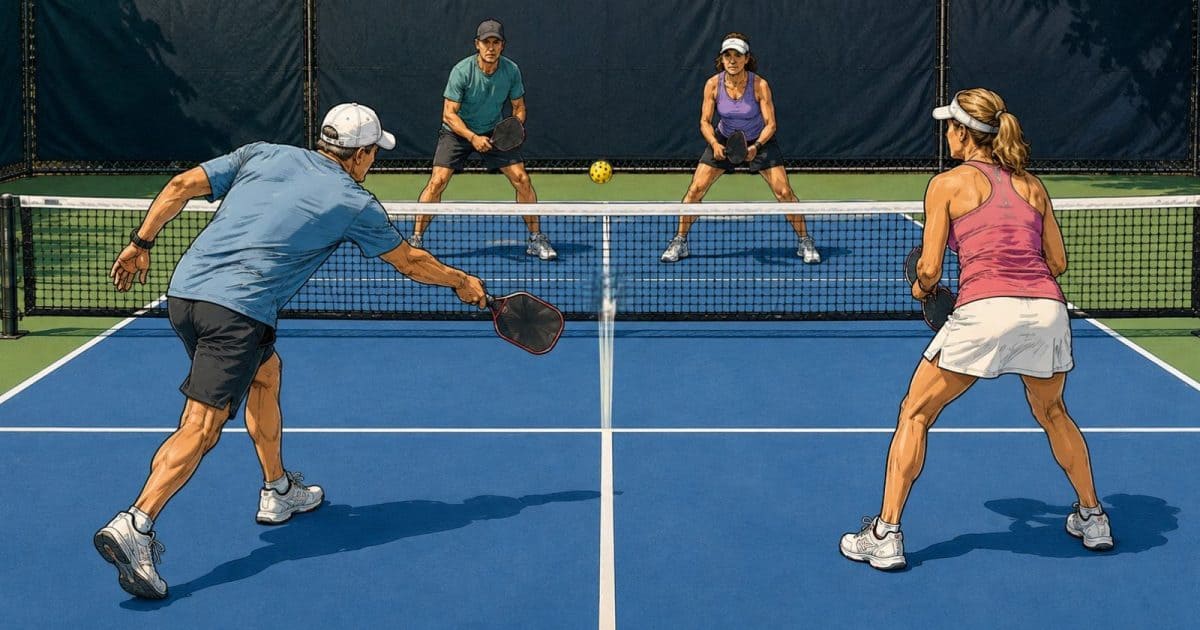
The middle in pickleball doubles is the space between the two opposing players, roughly the center of the court. It is also the target recreational players use the least, even though it carries the largest margin for error of any shot in the game.
Why the middle is so effective
Three reasons, and they build on each other.
Confusion. Two players, one ball, and a half second to decide who takes it. Even good partnerships hesitate. Hesitation produces late contact, and late contact produces a weak return.
The net is lower there. Under the 2026 USA Pickleball rulebook, the net must stand 36 inches at the sidelines and 34 inches at the center of the court (Sections 3.B.6 and 3.B.7). That two-inch dip means a ball hit through the middle clears the net with more margin on the same swing.
No angle back. A ball hit to the middle can only be returned into the middle third of the court. A ball hit to a sideline opens a crosscourt angle that can pull a partner out of position.
When to go down the middle
More often than most recreational players do, and especially in these moments.
- On the third shot drop, where the middle gives the most net clearance and the smallest angle back. The guide to how to hit the third shot drop covers the mechanics.
- Against a right-handed and left-handed pairing, where the middle sits between two backhands, or forces a quick decision about which forehand takes it.
- Under pressure, because the middle is the largest target on the court.
- Against a team that just switched or stacked, when both players are least sure who covers what. See pickleball stacking explained.
- On a speed-up, where a ball driven between two players’ bodies is the hardest pace to defend.
The “middle solution” rule
Despite the name, this is not an official rule in the USA Pickleball rulebook. It is a convention many teams agree to before a match: the middle belongs to the forehand.
In a conventional right-handed pairing, that means the player on the left side takes the middle, since a right-hander’s forehand sits in the center of the court. Teams adopt that convention specifically to prevent hesitation between two players.
The exception is a left-right pairing, where both forehands can end up in the middle, or neither can. Those teams need to decide out loud before the first serve. The guide to stacking with a lefty partner covers the positioning in more detail.
Agreeing on the middle before the match starts costs one sentence and prevents one of the most common ways doubles teams give away points.
Defending the middle when you are the one being attacked
Same answer, from the other side of the net.
- Decide before the match, not in the middle of a point.
- Call it early and loudly. “Mine,” said late, is worse than not said at all.
- The forehand takes it, unless the team has agreed otherwise.
- Close the gap physically. Two players hugging their own sidelines leave a gap wide enough to drive a cart through. At the non-volley zone line, partners should stand closer together than feels natural.
The middle at every level
It works at every level, though for different reasons.
At 3.0 and 3.5, it works mostly because of hesitation. Partners have not agreed who takes what, and the ball goes through untouched more often than it should.
At 4.0 and above, that hesitation mostly disappears. The middle still works because of geometry: a lower net, no sharp angle back, and the largest margin for error on the swing. Advanced players and coaches keep choosing the middle even once opponents stop bungling the call, because the geometry advantage never goes away. The guide to pickleball shot selection covers target choice more broadly.
The downside
The middle becomes predictable if it is the only target used. A team that never hits to a sideline lets both opponents lean toward the center, which closes the gap and opens the lines instead.
The middle should be the default shot, not the only shot. Mix in enough shots to the outside that the middle stays open, then attack it when it counts most.
FAQ
Why is the middle the best target in pickleball doubles? It creates hesitation between two players, and under the USA Pickleball rulebook the net sits two inches lower at the center than at the sidelines, so a ball through the middle also cannot be returned at a sharp angle.
Who takes the middle ball in pickleball doubles? By convention, whichever player’s forehand covers the middle, which in a standard right-handed pairing is the player on the left side. This is a team agreement, not a rule in the rulebook, so partners should confirm it before playing.
How much lower is the net at the center of the court? Two inches. Under the rulebook, Sections 3.B.6 and 3.B.7 set the net at 36 inches at the sidelines and 34 inches at the center.
Should a third shot drop go to the middle? In most situations, yes. It gives the most net clearance and leaves the smallest angle for the other team to attack.
Does hitting the middle work against strong players? Yes, though for a different reason than at lower levels. Strong teams rarely hesitate, but the lower net and reduced angle set out in the rulebook still make the middle a high-percentage target.
How do you defend against shots down the middle? Agree in advance who takes it, call it early and loudly, and stand closer to a partner at the non-volley zone line than feels natural.
Is the middle a good place to speed up the ball? Yes. A ball driven at the middle, between two players’ bodies, is one of the harder paces to defend on the return.
Can a team hit down the middle too often? Yes. If a team never goes to a sideline, opponents lean toward the center and the gap closes. Use the outside often enough to keep the middle threat alive.
A doubles team that keeps losing points through the middle usually has a communication problem more than a stroke problem, and it is worth working on with a coach who can watch both partners at once. The Pickler Junction directory lists coaches by city for players who want that kind of session.
Written by the Pickler Junction Team.