Why Does a Pickleball Paddle Lose Its Pop?
Quick Answer: Paddles lose pop when the honeycomb core crushes under repeated impact, or when the face detaches from the core, a defect called delamination. Core crushing is normal wear; delamination is a failure. According to paddle maker Selkirk, competitive players often replace a paddle every three to six months, while recreational players can get a year or more from one.
Losing pop means the paddle no longer returns the same energy to the ball. Shots come off slower and feel muted even though the swing has not changed.
What is physically happening inside the paddle
Two different things can cause it, and they are not the same problem.
Core crushing is the more common cause. Most paddles use a honeycomb core, traditionally built from polypropylene. Each impact compresses the cells slightly, and most spring back. Over thousands of hits, some cells stop recovering, and the core develops flattened areas that no longer bounce back. According to Selkirk, a paddle maker, core crushing can also start as a manufacturing defect, when low-grade foam or an uneven bond is used during the high-heat molding process, rather than developing gradually from play. Selkirk notes that newer foam-filled cores are less prone to this than the traditional polypropylene honeycomb.
Delamination is a different failure: the face separating from the core rather than the core wearing down. It tends to make a paddle louder and hotter before it makes it dead, since the loose face flexes like a trampoline and adds pace the paddle was not built to produce. Thermoformed paddles bond the face and core under heat and pressure in one step, which changes how that bond can fail over time. See what paddle delamination is for the full picture.
It is easy to confuse the two. A paddle that gradually went quiet is worn out. A paddle that suddenly got loud and unpredictable in one spot is failing.
How to tell your paddle has lost its pop
The signs are easier to notice than you might expect, once you know what to check.
- The sound changed. A fresh paddle has a sharp crack. A tired one thuds.
- Dead spots. Balls hit in one area come off noticeably slower than the same ball hit elsewhere.
- You are swinging harder for the same result, especially on serves and drives.
- Drops and dinks feel unpredictable, because a softened area absorbs more pace than the rest of the face.
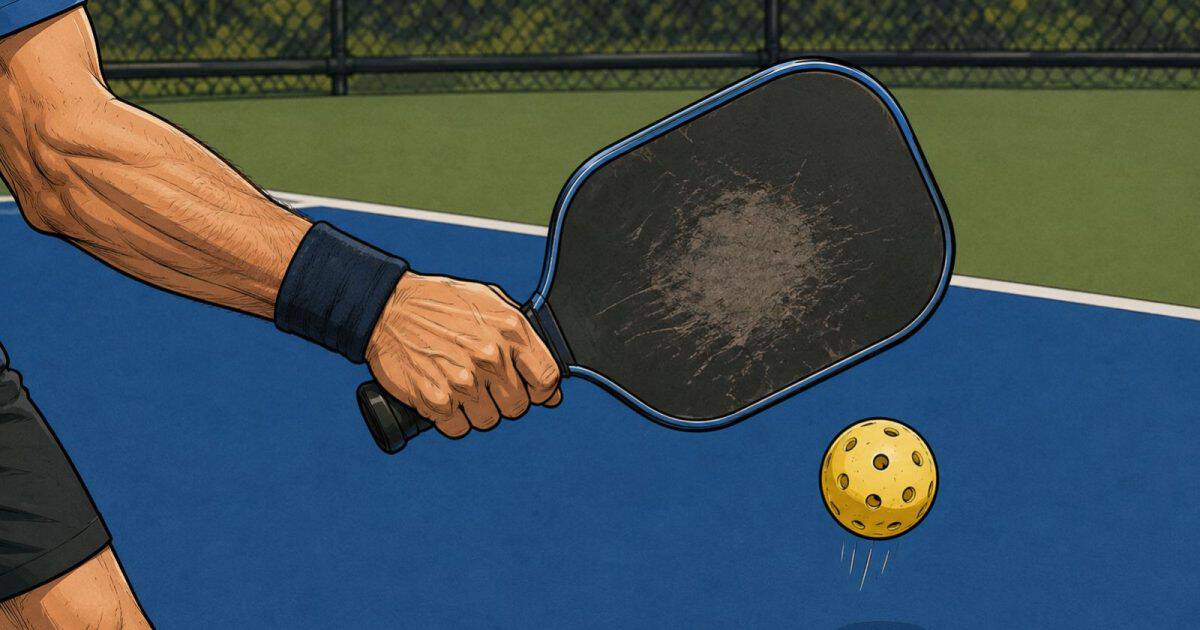
- Visible dents or soft patches show up when you press the face.
A reliable way to compare is to borrow the same paddle model from someone who bought theirs recently and hit ten balls with each. The difference is usually obvious.
How long a paddle lasts
It depends almost entirely on how often you play, and the honest answer is a range rather than a number.
According to Selkirk, competitive players who play often and swing harder tend to replace a paddle every three to six months, while recreational players can use the same paddle for a year or longer with proper care. If you play several times a week, expect to land closer to the shorter end of that range.
Heat, cold, and moisture all speed up core crushing, which is why leaving a paddle in a hot car matters more than it might seem. The guide to storing pickleball paddles covers what actually shortens paddle life.
Whether you can restore a paddle that has lost its pop
No. This is the part that is hard to hear.
A crushed core cannot be uncrushed, and there is no resurfacing or re-tensioning that brings a dead paddle back to life. Warranty coverage will not help either. Pickleball Central’s paddle warranty guide notes that normal wear and tear, including the kind of performance decline that comes from ordinary play, is specifically excluded from most manufacturer warranties.
What actually slows the process down:
- Keep it out of the car. Heat cycling stresses the core and the adhesive holding the face to it.
- Use a cover. Edge and face damage compound over time. See pickleball paddle covers.
- Clean the face gently. Abrasive cleaning wears texture faster than play does.
- Rotate two paddles if you play daily. Two paddles used half as often each will last considerably longer than one paddle used constantly.
- Do not use it as a ball scoop. Dragging the edge across concrete does real damage.
Whether to replace it
If your paddle has dead spots, or you are compensating for it, yes. Playing with a paddle you no longer trust changes your swing in ways that outlast the paddle itself.
If it has simply mellowed slightly and you still like the feel, no. If you value control over raw power, a broken-in paddle can still suit you well, since a slightly softer face is genuinely easier to drop with.
A rattling paddle, or one with a visibly separating face, should come out of rotation regardless. That is delamination, not normal wear, and it plays nothing like what it was built to be.
If you are shopping for a replacement, remember that paddle weight and swing weight both change how a new paddle feels compared to your old one, even at similar stated specs. It is worth understanding how swing weight is measured before you buy, since a paddle that feels heavier is not always the heavier one on a scale.
FAQ
How long does a pickleball paddle last? According to Selkirk, competitive players often replace a paddle every three to six months, while recreational players can get a year or more from the same paddle with proper care.
What does it mean when a paddle loses its pop? The core no longer returns as much energy to the ball, so shots come off slower and sound duller for the same swing.
Is losing pop the same as delamination? No. Losing pop from core crushing is gradual wear that makes a paddle quieter and slower. Delamination is the face separating from the core, and according to Selkirk it tends to make a paddle louder and hotter instead, at least until it fails outright.
Can you fix a paddle that has lost its pop? No. A crushed honeycomb core cannot be restored, and warranty guides treat normal wear as excluded from coverage. Replacement is the realistic option.
Does leaving a paddle in the car ruin it? It speeds up the damage. Repeated heat cycling stresses the core and the adhesive bonding the face to it.
Why does your paddle sound different in one spot? That is usually either a crushed area of the core or the start of delamination. Either way, it is a sign the paddle is near the end of its useful life.
Should you rotate between two paddles? If you play most days, yes. Two paddles each used half as often will together outlast a single paddle used constantly.
Does a paddle with less pop help your control? A slightly broken-in paddle can be easier to drop and dink with. Dead spots are a different problem, and they help nothing.
Shopping for a replacement paddle? Browse the Pickler Junction gear and accessories directory to compare paddle shops near you.
Written by the Pickler Junction Team.