Can You Serve Overhand in Pickleball?
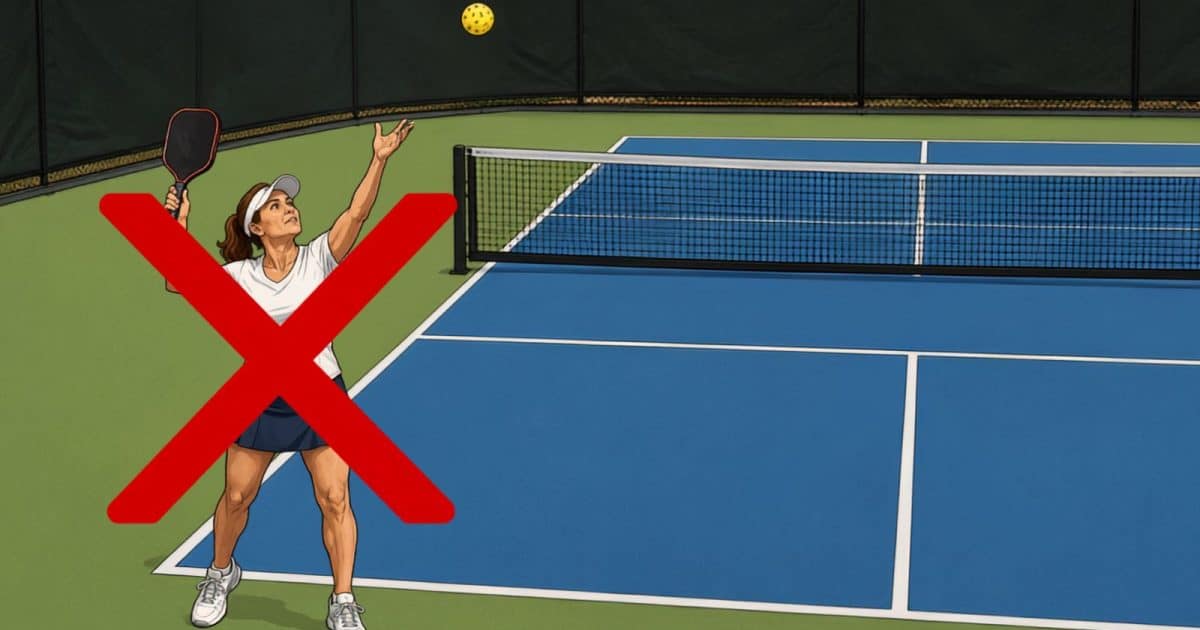
Quick Answer: No. A pickleball serve must be underhand. The paddle has to be moving upward at contact, the ball has to be struck below your waist, and the highest point of the paddle head cannot be above your wrist. An overhand serve is a fault no matter where the ball lands.
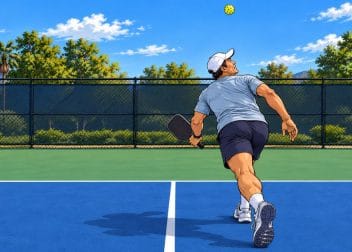
An overhand serve is one struck from above shoulder height with a downward paddle path, the way a tennis serve works, and it is illegal in pickleball under every version of the rulebook.
What the rule requires
Three conditions have to be true at the moment the paddle meets the ball on a volley serve.
- Contact below the waist. The rulebook uses the navel as the reference point.
- Upward paddle motion. The paddle has to be traveling upward through contact.
- Paddle head below the wrist. The highest point of the paddle head cannot be above the highest point of the wrist on your paddle hand.
All three, at once. Fail any one and it is a fault, and there is no second serve to bail you out.
Why the serve is underhand
Because the sport was designed that way from the start, and the design choice has held up.
An overhand serve is the single most dominant shot in tennis. It ends points before rallies begin, and it rewards height and power over everything else. Pickleball’s underhand requirement takes that weapon off the table, which is a large part of why rallies happen at all and why the sport plays across a much wider range of ages and body types.
The service motion is also why the receiving team has a structural advantage. A serve that cannot be hammered means the return can be aggressive, which is why the returning team gets to the kitchen line first.
The drop serve
The drop serve changes the picture, and it is the closest thing to an exception.
On a drop serve you release the ball, let it bounce, and hit it after the bounce. Once it has bounced, the waist-height restriction and the upward-motion requirement no longer apply.
That does not make an overhand serve legal. The ball has to bounce first, and a ball dropped from a normal height will not bounce high enough for anything resembling an overhead. What it does mean is that a drop serve can be struck with a flatter, more natural swing, which is why it is often easier. Our guide to whether the drop serve is legal covers the details.
One more restriction on the drop serve: you must let the ball fall on its own. Throwing or pushing it downward to make it bounce higher is a fault.
Serving overhand by accident
It is a fault, and you lose the serve. In doubles, service passes to your partner or to the other team depending on which server you were.
In casual recreational play, an obviously illegal serve is usually called by the receiving team or self-corrected. In sanctioned tournament play with a referee, the referee makes the call.
The gray area is the serve that looks borderline. A player who habitually contacts the ball right at waist height will get called eventually, and the honest fix is to drop the contact point a few inches rather than argue about where a navel is.
Making sure your serve is legal
- Drop the ball lower. Thigh height gives the paddle room to travel upward.
- Contact out in front, not beside your body, which naturally lowers the contact point.
- Let someone film you. Almost every player who thinks their serve is legal and gets called is surprised by the video.
- Use the drop serve if contact height is a recurring problem. It removes two of the three conditions.
- Do not toss the ball upward on a volley serve. That is the reflex that turns a legal serve into an overhead.
Our guide to the pickleball serve for beginners covers the full motion, and if you want to add rotation once the basics are legal and reliable, how to add spin to your serve explains what the rules do and do not permit.
FAQ
Can you serve overhand in pickleball?
No. The serve must be underhand with the paddle moving upward and contact below the waist. An overhand serve is a fault regardless of whether the ball lands in.
Is a sidearm serve legal in pickleball?
Only if it still meets all three conditions: contact below the waist, upward paddle motion, and the paddle head below the wrist. Most sidearm motions fail the upward-motion test.
How high can you toss the ball on a pickleball serve?
On a volley serve you should not toss it upward at all. Release it and strike it, or use the drop serve. Tossing upward is what produces illegal contact height.
Does the drop serve let you hit overhand?
No. The ball has to bounce first, and a naturally dropped ball does not bounce high enough for an overhead. The drop serve removes the height and motion restrictions, not the underhand character of the serve.
Who calls an illegal serve in recreational play?
The receiving team, usually. In refereed tournament play, the referee. In friendly games most players self-correct once it is pointed out.
Why is pickleball’s serve underhand?
To keep the serve from dominating the way it does in tennis. An underhand serve produces rallies rather than aces, which is central to how the sport plays.
Can you jump while serving?
Both feet must be behind the baseline and at least one foot must be in contact with the ground at the moment of contact, so a jump serve is a fault.
Is an overhand serve legal anywhere in pickleball?
No. There is no format or level where an overhand serve is permitted.
If your serve keeps getting called and you cannot see why, a single session with a coach usually settles it faster than a season of guessing. Our directory lists coaches by city.
Written by the Pickler Junction Team.