Pickleball Equipment Names: What Every Piece Is Called
Quick Answer: Core pickleball equipment names are the paddle (face, core, edge guard, handle, throat, butt cap), the ball, the net, and court shoes. Court features have names too: the non-volley zone is the kitchen, the kitchen line marks its edge, and the centerline splits each side into service courts. Learning these terms makes paddle listings and coaching advice easier to follow.
Paddle listings, coaching tips, and rulebook language all assume you already know this vocabulary. This glossary starts with the paddle and works outward to the ball, the court, and the accessories in a typical bag.
The parts of a pickleball paddle
Six terms cover almost every product description you will read.
- Face. The hitting surface, usually carbon fiber, fiberglass, or a composite blend. Texture on the face is what creates spin.
- Core. The material inside, almost always polypropylene honeycomb. Thickness is quoted in millimeters, commonly 13, 14, or 16, though the rulebook sets no thickness limit at all.
- Edge guard. The protective strip around the rim. Some paddles are edgeless, which trades some protection for a slightly larger sweet spot.
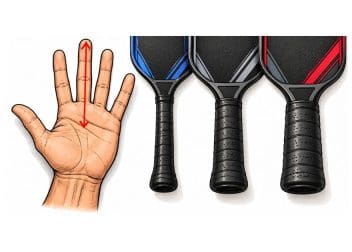
- Handle. Also called the grip. Length matters for two-handed backhands, and circumference is the sizing measurement.
- Butt cap. The flared end of the handle that stops your hand from sliding off during a swing.
- Throat. The narrow section where the handle meets the face.
Two more terms show up constantly in reviews. Swing weight describes how heavy a paddle feels in motion rather than on a scale. Sweet spot describes the area of the face that returns the most consistent response. The guide to choosing a paddle explains how these interact when you compare models.
Size has an actual limit behind it. Under the 2026 USA Pickleball rulebook, Rule 3.D.2 caps a paddle’s combined length and width at 24 inches, with length alone capped at 17 inches. The same section requires a smooth playing surface, so heavy sandpaper-style texturing is not legal for sanctioned play.
What pickleballs are called
Just pickleballs, but real differences separate the two types and the names are worth getting right.
The USA Pickleball Equipment Standards Manual sets one range for every approved ball: 2.87 to 2.97 inches in diameter, a weight between 0.78 and 0.935 ounces (about 22 to 26.5 grams), and 26 to 40 circular holes. The rulebook does not split that range by indoor or outdoor use, but in practice the pattern holds fairly consistently. Outdoor balls tend to sit toward the high end, with more, smaller holes built to survive concrete and wind. Indoor balls tend to sit toward the low end, with fewer, larger holes that grip a paddle face better and play much quieter in a gym.
Balls also have a bounce spec: dropped from 78 inches onto a hard surface, an approved ball bounces 30 to 34 inches high, according to the equipment manual.
You will also hear people describe a ball as cracked or out of round, both of which mean it needs replacing. Outdoor balls tend to crack from impact and pavement. Indoor balls tend to go soft and lose their bounce instead.
What the court features are called
Under the rulebook, the court is a rectangle 20 feet wide and 44 feet long, and every marking on it has a name.
The non-volley zone is the 7-foot area on each side of the net where volleys are not allowed, and everyone calls it the kitchen. The explainer on why it is called the kitchen covers where the term comes from.
The kitchen line marks the back edge of that zone. The centerline runs from the kitchen line to the baseline and splits each side into two service courts. Players often call these the even and odd courts, since the server’s score determines which one is in play. The sidelines and baseline do what their names suggest, bounding the court on the sides and ends.
The net sits at 36 inches at the sidelines and 34 inches at the center, a small dip that lets balls hit near the middle clear more easily. The page on pickleball net height has the full specification.
The accessories with their own names
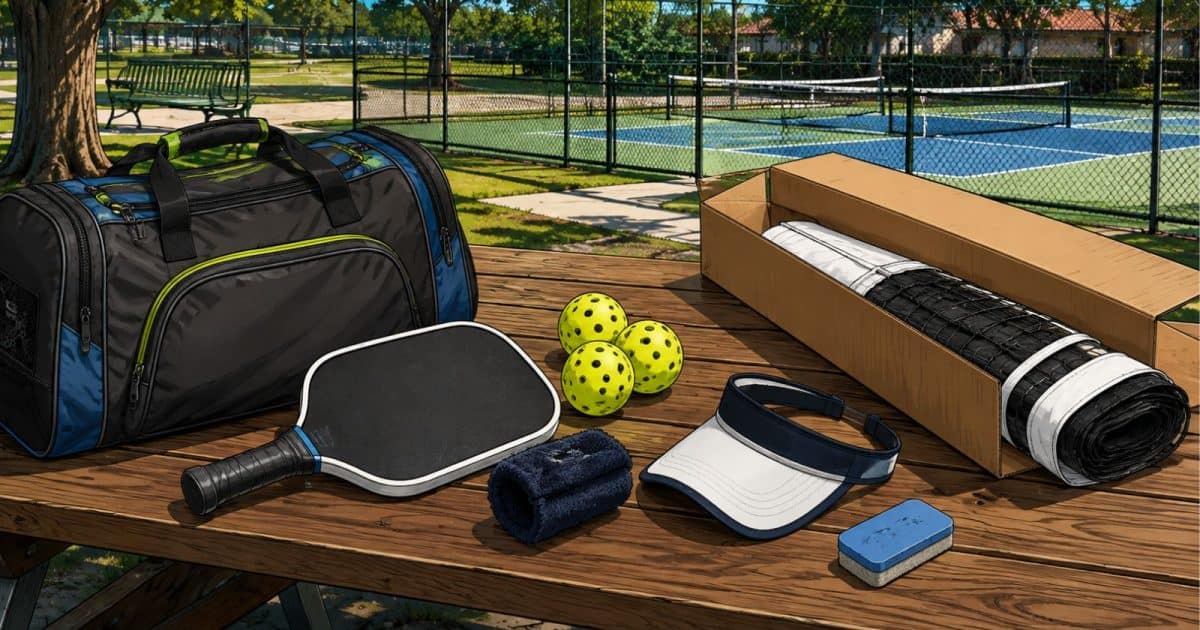
A short list covers what actually shows up in a typical bag.
- Overgrip. A thin wrap applied over the factory grip to change tackiness or thickness.
- Lead tape and tungsten tape. Weighted strips added to a paddle to shift its balance point or add mass.
- Edge tape. Protects the rim and is sometimes used to add a small amount of weight at the same time.
- Court shoes. Built for lateral movement, with different outsole tread and upper support than running shoes.
- Paddle cover. A sleeve that protects the face during transport.
Adaptive gear has its own vocabulary too, since not every player grips a standard handle the same way. The guide to adaptive pickleball equipment covers grip aids, seated-play paddles, and other adjustments.
Learning these terms early makes online shopping much faster. Searching “the bottom bit of the handle” turns up little useful, while searching “butt cap” pulls up the right replacement part in seconds.
The terms that describe how a paddle plays
These show up in nearly every review and confuse newcomers the most.
Thermoformed refers to a manufacturing method that uses heat and pressure to bond the paddle’s layers, which generally produces more power and a stiffer feel than older construction methods. Raw carbon describes an unpainted carbon fiber face that grips the ball for extra spin.
Delamination is a failure mode where the face separates from the core, changing how the paddle plays and making it illegal for sanctioned use. Under the rulebook, Rule 3.D.5 lists holes, cracks, delamination, and indentations as prohibited surface features, alongside rough or sandpaper-like texturing. The equipment standards manual backs that up with a numeric limit on face roughness, so a face that grips the ball well beyond that limit is not tournament legal even before it delaminates.
Static weight is what a scale reads. Balance point describes whether the paddle’s mass sits toward the handle or the head, and most manufacturers list both figures now.
Frequently asked questions
What is the kitchen in pickleball? The non-volley zone, a 7-foot area on each side of the net where volleying is not allowed. Under the rulebook, Rule 3.A.4.c sets this zone at 7 feet from the net on each side, though the name itself is informal rather than official.
What is a paddle face made of? Most commonly carbon fiber, fiberglass, or a composite blend. The material affects both feel and how much spin the face can generate.
How many holes does a pickleball have? Between 26 and 40, according to the USA Pickleball Equipment Standards Manual, which does not officially separate indoor from outdoor balls. In practice, outdoor balls tend to have more, smaller holes and indoor balls tend to have fewer, larger ones.
Is it a racket or a paddle? A paddle. Rackets have strings, while pickleball paddles have a solid, textured face. The rulebook itself refers to the equipment as a paddle throughout.
What is the difference between a grip and an overgrip? The grip is the manufacturer-applied wrap on the handle. An overgrip goes on top of it and gets replaced regularly as it wears out.
What does the throat of a paddle do? It is the structural connection between the handle and the face. Its shape affects stiffness and how much vibration reaches your hand on off-center hits.
What is a hopper? A basket or tube used to hold and collect practice balls during a drilling session.
What equipment does a beginner actually need? A paddle, balls, and court shoes cover the basics. The guide to what beginners need walks through the full starter list.
Knowing this vocabulary makes shopping less confusing and helps coaching advice land the way it is meant to. Ready to see it in person? Browse the Pickler Junction gear and accessories directory to find paddle shops near you that let you demo before you buy.
Written by the Pickler Junction Team.