Why Your Hips Feel Tight After Pickleball
Quick Answer: Hips often feel tight after pickleball because they spent an hour or two holding a ready position, pushing sideways, lunging for wide balls, and stopping, and then spent the rest of the day sitting. For ordinary post-play stiffness, a short walk, gentle movement in several directions, regular mobility work, and enough leg and hip strength usually help more than a hard stretch. Sharp, worsening, or one-sided pain is a different matter and deserves a professional look.
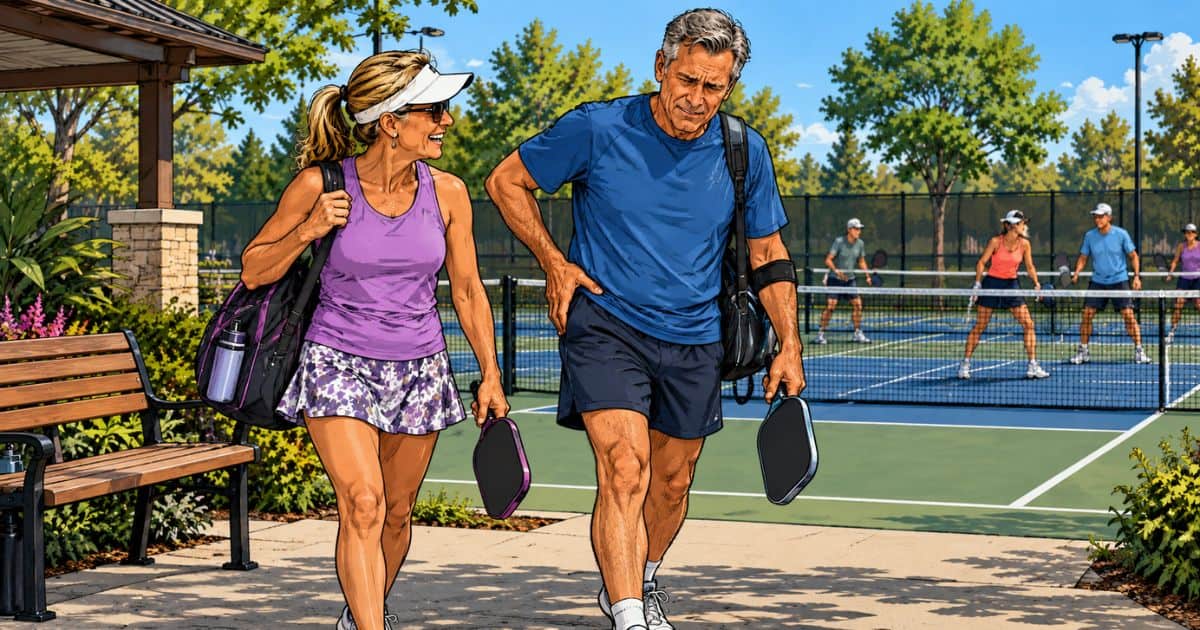
Hip tightness after pickleball can be a little confusing. The hips may have felt perfectly fine during play, only to stiffen up later when getting out of the car, standing after dinner, or taking those first few steps the next morning.
It makes more sense when you consider what the hips have been doing. Pickleball asks players to spend long periods in an athletic ready position, move repeatedly from side to side, reach for wide balls, accelerate forward, stop, and push back toward the middle. Then play ends and many players do exactly the opposite. They sit.
That familiar tight feeling does not necessarily mean the hips suddenly became less flexible. Sometimes they have simply done a lot of work and then spent several hours barely moving at all.
Why Pickleball Can Leave the Hips Feeling Tight
The hips are involved in almost every movement on the court.
A ready position requires some flexion at the hips. Moving laterally asks the muscles around them to help push the body sideways and control it when it arrives. Wide dinks and volleys can require lunging or reaching, while recovering toward the middle asks those same muscles to quickly produce force in the opposite direction.
Even when a player is not moving very far, the muscles around the hips are helping maintain position and keep the body balanced.
That workload accumulates over a session. After an hour or two of repeated starts, stops, reaches, and lateral movements, the muscles may simply feel different than they did before playing.
Fatigue can contribute too. As the legs tire, players may begin taking shorter steps, reaching farther for balls, or relying on one side more than the other. None of those changes has to be dramatic to increase the amount of work being done around the hips. The guide to why your legs feel heavy on day three of pickleball covers how that fatigue builds across a week.
Sitting Can Make the Feeling More Noticeable
The post-pickleball routine can add another piece to the puzzle.
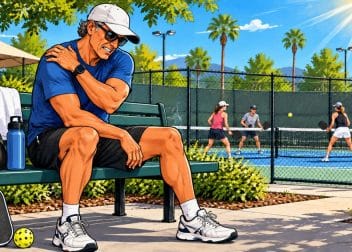
Players finish several games, get into the car, drive home, sit down for a meal, and perhaps spend the evening on the couch. The hips go from several hours of activity to several hours in a relatively fixed position.
That is often when stiffness becomes noticeable.
It can be tempting to assume that sitting has somehow shortened the muscles during the drive home. The explanation does not need to be that dramatic. Bodies often feel stiff after remaining in one position for a while, particularly after those same areas have just handled a substantial amount of activity.
Getting up and moving may make the hips feel noticeably better within a few minutes. That is useful information, even though feeling better after moving is not a diagnosis. It suggests the hips may want movement more than they need an aggressive stretching session.
Start With Movement
When the hips feel stiff after pickleball, gentle movement is a reasonable first step.
Walking is one of the simplest options. A short walk after playing keeps the hips moving without asking them to handle the quick stops and changes of direction they just experienced on court. The Cleveland Clinic gives the same advice for ordinary post-exercise soreness: moving sore muscles can help loosen them up, as long as you do not work them hard.
Later in the day, periodically getting up can help prevent a long stretch of sitting from becoming the entire recovery plan.
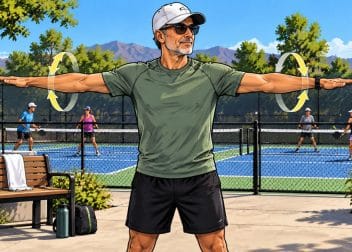
Simple hip movements can also feel good. Slow marching, controlled leg swings, gentle hip circles, or moving in and out of a shallow squat all take the hips through different ranges without forcing them.
The goal is not to see how far the joint can move. It is to restore comfortable movement after a session that required the hips to repeat many of the same positions. The fuller guide to how to recover after pickleball covers the rest of the day.
Work in More Than One Direction
Hip mobility is sometimes treated as though it consists entirely of stretching the front of the hip.
Pickleball requires much more than that.
The hips flex when players get low, extend as they push out of a position, rotate during many strokes, and move side to side during lateral court movement. A useful mobility routine should allow the hips to explore several of those directions.
A controlled lunge can work the hips differently from a squat. Gentle hip rotations introduce another direction. A shallow side lunge begins to resemble the lateral movement used to reach a wide ball.
These movements do not need to become deep stretches. A player who has just spent two hours moving on court does not earn extra recovery points for forcing the hips into the largest range possible.
Comfortable movement is enough.
Strength Matters as Much as Mobility
If the hips regularly feel tired or tight after pickleball, flexibility may not be the only thing worth considering.
The muscles around the hips have to repeatedly move and control the body. Stronger hips and legs may make those demands easier to handle. A 2024 study of 92 recreational pickleball players in the International Journal of Sports Physical Therapy found that players with stronger hip abductors, the muscles on the outside of the hip that drive sideways movement, were faster on a pickleball-specific change-of-direction test, and the authors recommended multi-directional lunging and lower body strength work for players who want to move better and fall less.
Squats, split squats, step-ups, bridges, and controlled lateral movements can all strengthen muscles used during court movement. Side steps with light resistance are another way to work the muscles that help control lateral positioning. The strength training program for pickleball puts those into a two-day plan.
Strength work also gives players more capacity for the later stages of a session. When the legs can continue supporting good movement, there may be less temptation to reach from awkward positions or bend primarily through the back because getting low through the hips and knees has become tiring.
Mobility helps a player reach a position. Strength helps the player control it and get back out.
Look at How You’re Moving on the Court
Repeated hip tightness may also be a reason to pay attention to court movement.
Some players stay in a low crouch much longer than necessary because they have been told to “stay low.” Others take very wide lunging steps for balls they could reach with two smaller steps. Some repeatedly push off the same leg or reach for balls rather than moving the feet into a better position.
None of those habits automatically causes hip problems, but they can increase the amount of work the hips are doing.
The ready position should be athletic without becoming an endurance exercise of its own. Between rallies, players can stand normally and relax. During play, getting the feet closer to the ball can reduce some of the extreme reaching that places greater demands on the hips. The guide to agility training for pickleball works on exactly that footwork.
Sometimes the useful adjustment is not another stretch. It is making movement a little more efficient.
Don’t Try to Stretch Every Tight Feeling Away
Stretching can certainly be part of maintaining comfortable hip mobility. A gentle stretch for the front, back, or side of the hip may feel good after playing.
But tightness is a sensation, not proof that a particular muscle needs to be stretched longer or harder.
If gentle movement makes the hips feel better, there may be no reason to turn the recovery period into an intense flexibility session. Aggressively pushing into uncomfortable positions can be particularly unhelpful when an area is already irritated.
Regular mobility work is generally different from trying to fix everything immediately after a long day of pickleball. A few minutes of comfortable movement performed consistently can be more practical than occasionally forcing a deep stretch because the hips suddenly feel stiff.
When Hip Tightness Deserves More Attention
Ordinary post-activity stiffness should generally improve rather than become progressively worse.
Pain that is sharp, persistent, or worsening is different from the familiar feeling of being stiff after playing. A loss of motion that does not ease within a few days, pain that interferes with walking or sleeping, symptoms following a fall, or recurring pain in the hip or groin should not simply be stretched repeatedly.
A few signs need urgent care rather than a mobility routine. The NHS lists severe hip pain after a fall or injury, being unable to walk or put weight on the leg, and any tingling or loss of feeling in the hip or leg after an injury as reasons to get emergency help. It lists severe hip pain that started suddenly without an injury, a hip that is swollen and feels hot, skin around the hip that has changed color, and hip pain along with a high temperature and feeling generally unwell as reasons to see a doctor urgently. None of those is a tight hip after pickleball, and none of them should be managed with stretching.
A healthcare professional can help determine whether the problem is actually related to mobility or whether something else is contributing. The guide to when to see a doctor for a pickleball injury covers the timing.
The same applies when one hip consistently behaves very differently from the other. Bodies are not perfectly symmetrical, but a substantial or increasing change is worth paying attention to.
Final Thoughts
The hips do a tremendous amount of work during pickleball, even when players are not thinking about them. They help maintain the ready position, move the body laterally, reach wide balls, stop, rotate, and recover for the next shot.
Then they often spend the rest of the day sitting.
When the result is ordinary post-play tightness, the answer does not have to be a harder stretch. Walking, gentle movement in several directions, regular mobility work, and enough strength to handle the demands of the game may all help the hips feel and move better.
The goal is not exceptionally flexible hips. It is having enough comfortable, controlled movement for everything the next game is going to ask them to do. If a hip keeps hurting no matter how carefully it is treated, a physical therapist or sports medicine physician who works with court sports can find out why, and the physicians and therapists directory is a good place to find one. This article is general information, not medical advice.
Written by the Pickler Junction Team.