What Muscles Does Pickleball Work?
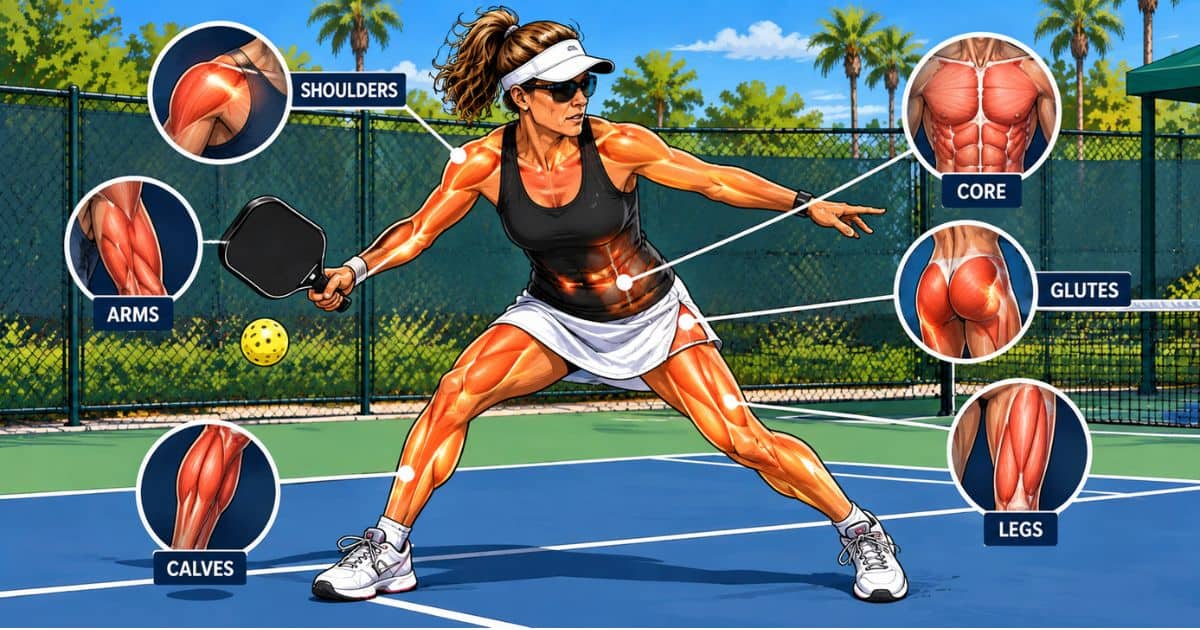
Quick Answer: Pickleball works muscles in short bursts tied to specific movements. Quadriceps, glutes and calves handle the split step and the lunge, hip abductors control lateral pushes, the obliques manage rotation, forearm flexors and extensors fire at ball contact, and the shoulder rotators work mainly on overheads, since the underhand serve keeps the cuff out of extreme positions.
Pickleball loads different tissue at different moments, and the moment matters more than the running total. The separate answer on whether pickleball builds muscle covers the gym comparison, since the pattern sits closer to endurance work than to loaded strength training.
Why does the shot matter more than the sport?
A pickleball point is a sequence of short efforts. Lozano and colleagues, analyzing seven professional men’s singles matches for the International Journal of Sports Science and Coaching in 2025, found 77.4 percent of rallies lasted 3 to 9 seconds, with a work-to-rest ratio near 1:3.8 and effective playing time at 20.5 percent. Demand arrives in packets. A quadriceps that never exceeds a moderate load across an hour still hits a hard eccentric spike in the half second a player brakes for a drop.
Direct electromyography on pickleball is scarce, so most of what follows comes from tennis and throwing research, and each finding below names its sport.
Which muscles does the serve work?
The pickleball serve is underhand and low-velocity next to a tennis serve, but the sequencing is the same: legs and trunk first, arm last. Physiopedia’s summary of throwing biomechanics puts roughly 50 percent of ball velocity down to the step and body rotation. Contact below the waist keeps the rotator cuff out of the extreme positions a tennis serve reaches, so the deltoid, pectoralis major and wrist flexors do the visible work.
Chow, Park and Tillman, measuring lower trunk muscles during tennis serves for BMC Sports Science, Medicine and Rehabilitation in 2009, recorded both rectus abdominis muscles above 40 percent of maximum voluntary contraction during windup and acceleration, and concluded that large lumbar spinal loads are expected in that phase. That is one reason lower back strain during pickleball shows up on serves and overheads rather than dinks, and much of why core strength matters for pickleball players.
What works during the return and the split step?
The split step is a hop and landing timed to the opponent’s contact, a stretch-shortening action. The landing loads the calf and quadriceps eccentrically, then releases that energy into the first step. Physiopedia describes the gastrocnemius and soleus as the main ankle plantarflexors and a significant source of propulsive force in walking, running and jumping. The return adds hip and trunk rotation on top. Because a split step repeats on nearly every shot and each landing is absorbed rather than driven, the calves take a high count of eccentric loads across a session.
Which muscles power the third shot drop and the transition zone reset?
The two-bounce rule under the 2026 rulebook forces the serving team to let the return bounce, so the third shot is played from deep and has to be softened rather than hit. A drop is a decelerating swing: the shoulder and forearm brake as much as they move, and the legs supply a slow upward push.
The reset from the transition zone is the same problem while moving forward: stopping, sinking and absorbing a fast ball at once. Higbie and colleagues, reviewing deceleration in athletes generally for the International Journal of Sports Physical Therapy in 2025, cited quadriceps activation exceeding 161 percent of maximum voluntary isometric contraction during a deceleration task, at knee angular velocities near 493 degrees per second, a laboratory task rather than a measured pickleball reset. That eccentric spike is the mechanism behind front-thigh soreness the next morning, and why knee soreness after pickleball can trace to braking rather than one hard shot.
What does the lateral shuffle and direction change load?
Physiopedia’s hip abductor summary credits the group with roughly 70 percent of pelvic control in single-leg stance, and names gluteus medius as the muscle that stops the opposite side of the pelvis dropping in single-leg weight bearing. Myers and Hanks, in the International Journal of Sports Physical Therapy in 2024, tested 92 recreational pickleball players and found hip abduction strength correlated with faster times on a pickleball T-test of forward running, lateral shuffle and backpedal, at r values of -0.41 to -0.48. Of that group, 42 percent reported falling, and fallers were slower on the test. Hip abduction strength alone did not predict fall history.
Below the hip, the adductors and quadriceps decelerate the plant leg and the knee absorbs what they do not, which sits behind whether pickleball is hard on the knees.
Which muscles work during the dink at the kitchen?
Dinking looks like the least muscular part of the game, and the demand it makes is postural rather than explosive. That demand is isometric: a partial squat held over minutes, with the quadriceps and glutes holding a knee and hip angle instead of moving through one, the ankle dorsiflexors keeping the shins forward, and the trunk braced against rotation. The shoulder stabilizers hold the paddle in a narrow window while the forearm makes small constant corrections. Sustained low-level activation burns without loading any muscle heavily.
What does the overhead demand?
The overhead puts the shoulder through a throwing-like arc. Owens, Khaiyat and Coyles, recording 14 muscles in overhead throwing athletes for the International Journal of Sports Physical Therapy in 2024, tracked seven of the fourteen, the external obliques and gluteus maximus alongside the deltoids, latissimus dorsi, serratus anterior, infraspinatus and supraspinatus, a fair map of an overhead. Their injured group showed shifted activation timing and lower upper trapezius activity, so scapular muscles matter too. Physiopedia’s throwing summary notes that the posterior cuff, teres minor and infraspinatus, contracts eccentrically during deceleration to control the arm after release. That braking role is the usual explanation for rotator cuff and shoulder pain in pickleball players.
Why do the forearm and grip work harder than expected?
Grip demand is easy to underestimate. Rigozzi, Vio and Poronnik, using a wearable grip and EMG device on tennis forehands for Sensors in 2023, recorded experienced players peaking near 96.6 percent of maximum voluntary contraction in grip force at impact, and recreational players showing significantly higher wrist extensor activity through most of the follow-through. If pickleball grip behaves anything like that tennis pattern, near-maximal grip hundreds of times is a real load even though nothing in the swing looks heavy.
Mis-hits raise that cost. Ikenaga and colleagues, reporting in 2020 on impact location in tennis forehands, found off-center impacts toward the upper racquet face produced significantly greater extensor carpi radialis activity than centered impacts. The American Academy of Orthopaedic Surgeons identifies the extensor carpi radialis brevis tendon as the one usually involved in tennis elbow, and that muscle stabilizes the wrist when the elbow is straight. That chain is the story behind pickleball elbow and much wrist pain in pickleball players. Kim and colleagues, surveying 232 recreational players for Frontiers in Public Health in 2025, found 44.8 percent of reported injuries in the upper extremity.
Frequently asked questions about muscles used in pickleball
What muscles does pickleball work the most? The quadriceps, glutes, calves and hip abductors, since every split step, lunge and direction change routes through them. Rigozzi and colleagues measured tennis grip force peaking near 96.6 percent of maximum voluntary contraction at impact, and pickleball has no equivalent published measurement, so the forearm flexors and extensors plausibly work harder than their size suggests.
Does pickleball work your core? Yes, mostly isometrically. Chow, Park and Tillman recorded rectus abdominis activity above 40 percent of maximum voluntary contraction during tennis serve phases, and the trunk resists rotation on dinks and resets.
Which pickleball muscle groups get sore first for a new player? Calves and quadriceps, because the split step and transition zone braking are eccentric actions, and eccentric loading produces more delayed soreness.
Does pickleball work the upper body? Partly. Shoulder, forearm and grip work on every shot, and the chest and lats contribute on serves and overheads, but the paddle is light, so none of them meet the resistance a gym lift supplies.
What muscles does the dink use? The quadriceps and glutes holding a partial squat, the ankle dorsiflexors keeping the shins forward, the trunk bracing against rotation, and the forearm and shoulder stabilizers steering the paddle.
Why do the calves get sore from pickleball? The gastrocnemius and soleus are the main ankle plantarflexors and absorb each split step landing before pushing off again. Those cycles add up faster than they feel.
Do singles and doubles work different muscles? The groups are the same. Singles asks more per point through longer sprints, while doubles concentrates demand at the kitchen, where the squat hold and grip dominate.
Which muscles should a player strengthen off court? Hip abductors, eccentric quadriceps strength, calves, grip and forearm. A plan for off-court workouts for pickleball players targets those directly, which court time does not.
Mapping muscles to movements helps up to the point where a player has to change how they move. A coach watching a split step or a grip in person can see what an article cannot, and a physical therapist is the right stop when a muscle keeps flaring up. Instructors are listed in the Pickler Junction directory of pickleball coaches. This article is general information, not medical advice.
Written by the Pickler Junction Team.