Is Pickleball Addictive? Why Players Cannot Stop
Quick Answer: Not in the clinical sense. Pickleball is built on features that create real pull: rallies that end fast, a skill floor low enough to play on day one, and rotation formats that pair you with different partners each session. Clark and Zack, writing in Addictive Behaviors in 2023, tie reward variability plus high event frequency to behavioral addiction potential.
One session in spring, and by summer the paddle lives in the trunk. Plenty of the sport’s collected quotes and locker room one-liners run on that premise. The pull traces to scoring, skill curves, and who you stand next to.
Is pickleball addictive, or is that just how the sport gets talked about?
“Addictive” here is the everyday word, the one people use about a television series, and no clinical diagnosis sits behind it.
Luke Clark and Martin Zack, in Addictive Behaviors in 2023, argue that two properties matter together: reward variability and event frequency. Variable schedules, they write, “ensure the ongoing elicitation of reward prediction errors,” and frequency compounds that, since more trials in a given time make a cue better at biasing pursuit. They add the limit that matters here: natural activities usually do not deliver rewards often enough to reach that territory. By that standard pickleball is a natural activity rather than an engineered one, which is the reason to describe its pull rather than diagnose it.
Why does pickleball produce so many win-or-lose moments per hour?
Pickleball rallies are short, and every one has a winner and a loser. Prieto-Lage and colleagues, in a 2024 notational analysis in Applied Sciences, coded 1,145 points across 15 men’s singles matches from five PPA Tour tournaments. Of those rallies, 43 percent lasted 1 to 4 shots and 44 percent 5 to 8, so 87 percent ended within 8 shots.
The Apple Heart and Movement Study found pickleball workouts averaged 90 minutes with a standard deviation of 47, against 81 minutes for tennis. Ninety minutes where most exchanges resolve inside eight shots is a dense stream of small, uncertain outcomes, and games to 11, win by 2, with side-out scoring stack up many rallies.
The load stays moderate. The same study recorded average peak heart rates of 143 bpm for pickleball against 152 for tennis, and the breakdown of what pickleball does to heart rate across a session explains why 90 minutes feels sustainable.
Why can a complete beginner get real rallies on day one?
Tennis and squash generally take weeks of practice before a beginner sustains a rally. Pickleball does not. USA Pickleball states that “within minutes or a single short session, beginners often grasp enough to play and have fun.” Serves are underhand and diagonal, and the 20 by 44 foot court is small enough that coverage is not a fitness test. Under the 2026 rulebook the two-bounce rule requires a bounce on each side before anyone volleys, which USA Pickleball says “reduces the advantage of powerful serves and encourages longer, more exciting rallies for players of all levels.” A 7-foot non-volley zone prevents camping at the net. Take away the overhead serve and force two bounces, and that single short session is enough for a real exchange, so the reward arrives before the frustration does.
How much of the pull is social rather than athletic?
A large share. Selkirk’s guide to open play etiquette describes the paddle rack: paddles queue in arrival order, and when a game ends the next four rotate on. Winners do not stay, and signing up for open play means “rotating in with whoever is next, regardless of familiarity or playing style,” so a two-hour session cycles through several games with a rolling cast.
Kurth and colleagues surveyed 825 US adults aged 50 and older, average age 61, in the Journal of Primary Care and Community Health in 2025. Respondents who currently played averaged 6.7 social connections through physical activity, against 3.8 for never-players. Never-players had 1.5 times higher odds of loneliness than current players, and 65 percent of respondents who had tried the sport were still playing, though a cross-sectional design cannot establish cause. The research on pickleball, isolation, and who shows up alone rests on that same survey, where former players carried nearly 2 times higher odds of loneliness than current players, an association that is the measured reason a regular pickleball community around a court does so much retention work.
Why does improvement feel fast at first and then stall?
Early progress here is unusually legible, and then it flattens. Pickleheads notes that the majority of rated players cluster between 3.0 and 4.0 on the DUPR scale and that 3.5 is where players start separating from the pack. The cluster Pickleheads describes is itself the sign that 3.0 to 3.5 is a slower stretch than nothing to 3.0.
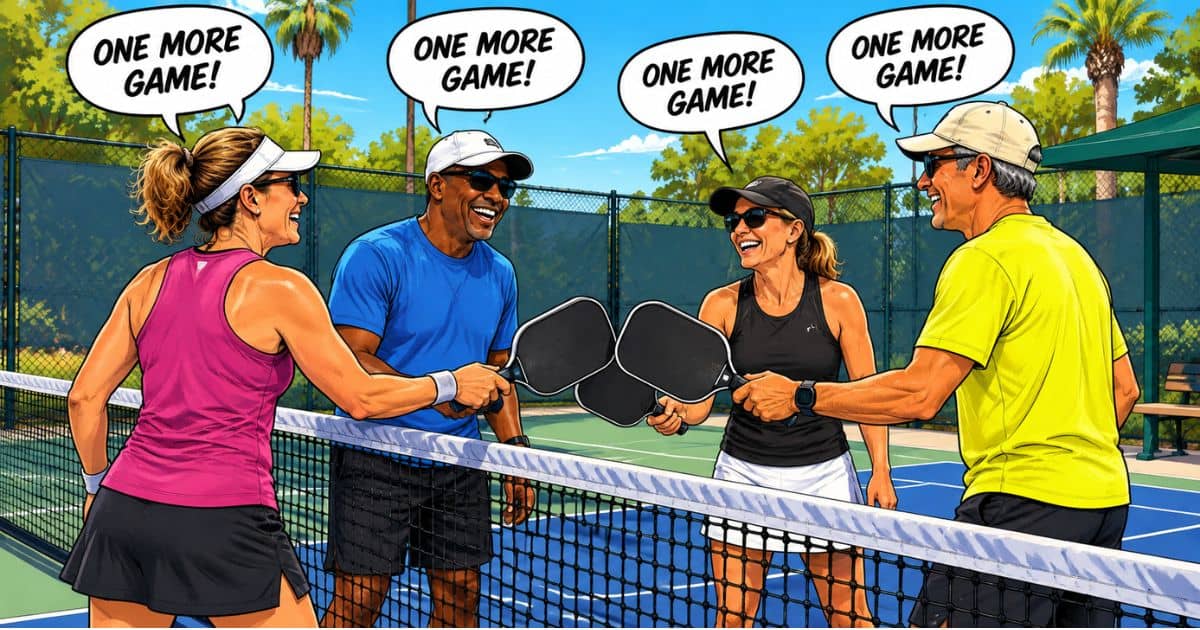
That shape generates the one-more-game pattern: more reps produced more skill while progress was obvious, and the instinct persists after progress stalls. The available response is to play more or to practice differently, and only the second addresses a plateau. Knowing which muscles the sport actually loads is worth more then than another rotation.
What does the research on exercise and mood actually show?
Enough to be interesting, not enough for grand claims. The Apple Heart and Movement Study found participants logging 10 or more pickleball workouts a year had 60.1 percent lower odds of a screening result associated with depressed mood, an association in observational data. The available dopamine evidence is not even human: Bastioli and colleagues, in the Journal of Neuroscience in 2022, gave mice wheel access for 30 days and measured roughly 30 to 40 percent higher evoked dopamine release across striatal regions.
The 2023 systematic review by Cerezuela, Lirola and Cangas in Frontiers in Psychology pooled 13 studies covering 5,405 participants and found pickleball participation predicted subjective well-being and quality of life, while calling for longitudinal work before anyone claims cause. That is the honest reason pickleball tends to put people in a better mood.
When does playing every day start to cost you?
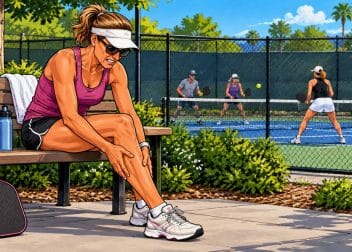
Hanks and Myers surveyed 253 recreational players for a 2025 Journal of Functional Morphology and Kinesiology paper. Forty-one percent, 104 of 253, reported at least one upper extremity injury. Of the same 253, 95 players, 37.5 percent, reported a chronic upper extremity injury and 27 players, 10.7 percent, an acute one, counts that overlap because a player could report both. Acute injury risk was 4.97 times higher with consecutive-day play and 2.38 times higher for sessions over two hours, and chronic injury was more common above six hours a week.
Spacing and volume both show up in that data. Consecutive days carried the largest acute association at 4.97 times, while long sessions and weeks above six hours carried their own, in survey data that cannot establish cause. Telling normal post-session soreness from something worth attention matters, lateral movement loads the hips hard enough that hip pain after playing has its own troubleshooting, and a schedule should start from how many weekly sessions the injury data supports.
Frequently asked questions
Is pickleball addiction a real medical condition? No, there is no recognized clinical diagnosis for it. Behavioral addiction as Clark and Zack define it involves harm and loss of control, which a busy playing schedule by itself does not describe. Anyone whose playing is causing harm they cannot stop should raise it with a clinician.
Why is pickleball so addictive compared with tennis? The skill floor is lower, since USA Pickleball says beginners often grasp enough to play within minutes, and outcomes arrive faster: the 2024 Applied Sciences analysis found 87 percent of pro rallies ended within 8 shots.
How fast do people get hooked? The 2025 Journal of Primary Care and Community Health survey of 825 US adults aged 50 and older found that 65 percent of those who had ever tried pickleball were still playing, though the survey did not measure how quickly that happened.
Is being addicted to pickleball bad for you? The measured downside in the research is injury risk. The 2025 injury study tied consecutive-day play to 4.97 times the acute injury risk, an association that points toward spacing sessions rather than playing less overall.
How many days a week is too many? That data points at consecutive days as the largest acute risk factor, with chronic injury also more common above six hours a week. Four sessions across seven days carries a different risk profile than four in four straight days.
Does pickleball really release dopamine? Exercise raised striatal dopamine release in mice by roughly 30 to 40 percent in the 2022 Journal of Neuroscience study. Human measurement during pickleball has not been published, so any session figure is extrapolation.
Why do beginners improve fast and then stop improving? Pickleheads notes that rated players cluster between 3.0 and 4.0, the band where strategy and shot control are still being built. Early gains come from basic mechanics, which respond fast.
Can playing every day cause tennis elbow? Epicondylalgia was the most common overuse complaint in the 2023 International Journal of Racket Sports Science survey of 128 players, 28 percent of whom reported an overuse injury.
The pull is no mystery: short rallies, fast outcomes, a low floor, and a format that hands you new partners. What deserves protecting is the part that keeps someone playing at 70, which means rest days and a group with enough court time. The pickleball clubs directory lists clubs and open play programs by ZIP code. This article is general information, not medical advice.
Written by the Pickler Junction Team.